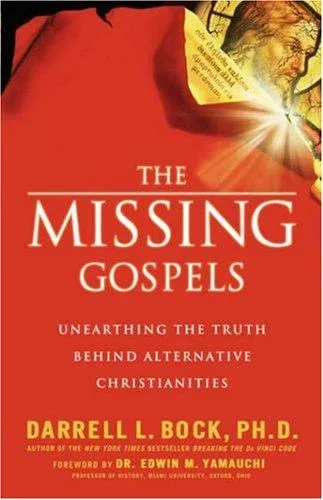
The Missing Gospels
 78
78

The Missing Gospels
Darrell L. Bock’s The Missing Gospels approaches the contentious topic of excluded Christian texts with a commendable academic rigor. Rather than sensationalizing the "lost" scriptures, Bock situates them within the complex process of canon formation. His strength lies in meticulously detailing the historical and theological arguments employed by early Church leaders to differentiate canonical from non-canonical writings. The work explores how figures like Irenaeus, in the late 2nd century, were already establishing boundaries, often against what they perceived as Gnostic deviations. A limitation, however, is the book’s dense academic prose, which may prove challenging for readers without a specialized background in patristics or New Testament textual criticism. The section detailing the criteria for canonicity, particularly regarding apostolic succession and doctrinal coherence, is particularly illuminating. While it navigates the scholarly terrain effectively, its accessibility for a broader audience interested in esoteric Christian traditions is somewhat constrained by its scholarly focus. Bock’s examination offers a sober, evidence-based counterpoint to more speculative theories about suppressed gospels.
📝 Description
78
Darrell L. Bock's 2006 book examines early Christian texts excluded from the New Testament canon.
This 2006 book investigates early Christian writings that did not become part of the New Testament. Darrell L. Bock analyzes why these texts were excluded, the standards used for inclusion, and the theological and political factors influencing early Christian groups. The work addresses scholars, theologians, and students of biblical history who already understand the New Testament's background and development.
Bock's research occurs within the context of late 20th and early 21st century scholarly discussions about the variety of early Christian thought and how the canon was formed. This period saw renewed attention to Gnostic and apocryphal writings, partly due to discoveries like the Nag Hammadi library in 1945. The book interacts with a long history of biblical scholarship that has studied these "lost" texts.
The book engages with the study of early Christian literature that falls outside the officially recognized canon. This includes texts often associated with Gnostic traditions or other heterodox movements that competed for influence in the early centuries CE. Bock scrutinizes the historical and theological reasons these writings were marginalized or suppressed, contrasting them with those that gained acceptance. The work considers the historical processes and debates that led to the formation of what became orthodox Christian scripture.
💡 Why Read This Book?
• Gain a critical understanding of the criteria used to establish the New Testament canon, moving beyond popular myths about "suppressed" texts based on historical theological debates as early as the 2nd century. • Explore the historical and theological landscape of early Christianity, examining the diverse currents of thought that vied for influence before the canon solidified around AD 367. • Understand the specific nature of "missing" gospels, differentiating between those considered heretical by early authorities and those simply outside the mainstream of emerging orthodoxy.
⭐ Reader Reviews
Honest opinions from readers who have explored this book.
❓ Frequently Asked Questions
What is the primary focus of Darrell L. Bock's "The Missing Gospels"?
The book's primary focus is the historical and theological process by which certain early Christian writings were excluded from the final New Testament canon, examining the criteria and debates involved.
When was "The Missing Gospels" first published?
Darrell L. Bock's "The Missing Gospels" was first published in 2006.
Does the book discuss Gnostic texts specifically?
Yes, the work explores the nature of Gnostic texts and their role in the discussions and decisions surrounding canon formation in early Christianity.
Who would benefit most from reading this book?
Scholars of early Christianity, theologians, and students of biblical history seeking a detailed, academic examination of the New Testament canon’s formation will find it most beneficial.
What does the book say about the reasons for exclusion?
It details reasons such as theological divergence from emerging orthodox viewpoints, lack of apostolic authority, and limited circulation among early Christian communities.
Does Bock present alternative historical theories about the canon?
Bock presents a historically grounded analysis, focusing on the scholarly consensus regarding canonization rather than speculative theories about deliberately suppressed texts.
🔮 Key Themes & Symbolism
Canon Formation Debates
The work scrutinizes the complex, often contentious, process by which early Christian communities determined which texts would form the authoritative New Testament canon. Bock details the theological and practical considerations that led to the inclusion of some writings while excluding others, tracing the arguments of early Church Fathers who established boundaries for orthodoxy. This exploration highlights the fluidity and eventual stabilization of the canon, moving beyond simplistic narratives of deliberate suppression to reveal a nuanced historical development.
Gnostic and Apocryphal Texts
A significant portion of the book addresses the nature and theological content of texts often labeled "apocryphal" or "Gnostic." Bock analyzes their origins, teachings, and how their divergence from developing orthodox doctrines influenced their reception. The work clarifies that "missing" does not always equate to "hidden" or "suppressed," but often indicates texts that simply did not gain widespread acceptance or were deemed heretical by influential figures within the early Church.
Criteria for Authority
Bock meticulously outlines the criteria early Christian leaders employed to authenticate scriptures. These often included apostolic origin (authorship by or connection to an apostle), consistency with established doctrine (orthodoxy), and widespread usage within churches. The book demonstrates how these standards, applied over centuries, served to shape the boundaries of what would become the universally recognized New Testament.
Historical Context of Early Christianity
The book provides a scholarly lens through which to view the diverse intellectual and religious field of the 1st to 4th centuries CE. It situates the canonization process within the broader context of competing philosophical ideas, various Jewish sects, and the evolving identity of Christianity itself, offering a grounded understanding of the forces shaping early Christian literature and belief.
💬 Memorable Quotes
Direct passages from the work, attributed to the author.
“The canon was not a list of books that was decided upon overnight.”
— This statement underscores the gradual and contested nature of the New Testament's formation. It implies that the acceptance of specific texts as authoritative unfolded over an extended period, involving ongoing theological discussion and communal consensus-building.
“Criteria such as apostolicity and orthodoxy were key in the selection process.”
— This highlights the foundational principles used by early Church leaders to evaluate potential scriptures. 'Apostolicity' refers to a text's connection to the apostles, while 'orthodoxy' concerns its alignment with established Christian teachings, both serving as gatekeepers for canonical inclusion.
“Many texts were never intended for wide circulation.”
— This observation suggests that the exclusion of certain early Christian writings wasn't always due to active suppression, but sometimes because their authorship, purpose, or intended audience limited their reach and eventual acceptance into a universal canon.
“The debate over what constituted genuine Christian teaching was vigorous.”
— This points to the intellectual and theological dynamism of the early Church. It acknowledges that various interpretations and teachings competed for dominance, making the process of defining authoritative scripture a complex and often contentious undertaking.
“The Nag Hammadi library provides a window into alternative Christian expressions.”
— This refers to the significance of the 1945 discovery of Gnostic texts. It implies that these writings, though largely excluded from the canon, offer valuable insights into the diversity of early Christian thought and practice that existed alongside the traditions that eventually prevailed.
🌙 Esoteric Significance
Tradition
While not strictly an esoteric text itself, Bock's work engages with the historical roots of traditions that later informed esoteric Christian movements, particularly Gnosticism. It examines the textual and theological boundaries established by early Church authorities that effectively marginalized alternative spiritual interpretations of Christ's teachings. The book provides a scholarly grounding for understanding the historical context from which many later esoteric doctrines either emerged or were deliberately positioned in opposition to established Christian dogma.
Symbolism
The "missing Gospels" themselves often contained symbolic narratives and allegorical interpretations of Christ's life and teachings, which appealed to later esoteric traditions seeking deeper, hidden meanings. Concepts like the "Sophia" figure in Gnostic texts, or the emphasis on secret knowledge (gnosis), represent symbolic departures from literal interpretations, pointing towards inner spiritual realities that became central to many esoteric schools.
Modern Relevance
Contemporary scholars and practitioners interested in Gnosticism, alternative spiritualities, and the historical Jesus often consult works like Bock's to understand the historical framework surrounding these "lost" texts. It provides a crucial counterpoint to more speculative or romanticized views of suppressed Christian knowledge, offering a scholarly assessment of why certain texts were excluded and what that exclusion signifies for the development of Christian thought, influencing discussions in comparative religion and historical theology.
👥 Who Should Read This Book
• Students of early Christianity and New Testament textual criticism seeking a rigorous academic analysis of canon formation. • Theologians and biblical scholars interested in understanding the historical debates that shaped orthodox doctrine and scripture. • Readers curious about the historical context of "lost" Gospels and Gnostic texts, who desire a scholarly perspective rather than speculative theories.
📜 Historical Context
Darrell L. Bock's The Missing Gospels emerged in an era, the late 20th and early 21st centuries, characterized by intense scholarly engagement with the diversity of early Christianity. This period saw significant interest in Gnostic and other non-canonical texts, partly fueled by archaeological finds such as the Nag Hammadi library discovered in 1945. The work situates itself within a long tradition of biblical scholarship grappling with the formation of the canon. Bock engages with the legacy of Church Fathers like Irenaeus, whose writings in the late 2nd century already sought to define orthodox boundaries against what he perceived as Gnostic deviations. While Bock's work itself is not a primary historical document, it analyzes a period where competing schools of thought, particularly Gnosticism versus emerging proto-Orthodoxy, were vying for theological supremacy, a debate critically shaped by figures like Marcion in the mid-2nd century.
📔 Journal Prompts
The criteria for canonicity: apostolicity and orthodoxy.
The historical role of Church Fathers in defining scripture.
The theological divergence of Gnostic texts.
Early Christian debates on genuine teaching.
The impact of textual discoveries on biblical scholarship.
🗂️ Glossary
Canon
The collection of books accepted as genuine and authoritative scripture by a religious community. In Christianity, the New Testament canon refers to the specific set of texts recognized as divinely inspired.
Apocrypha
Texts, often religious in nature, that are not part of the accepted canon of scripture. The term can refer to Old Testament pseudepigrapha or New Testament apocrypha.
Gnosticism
A complex set of religious ideas and systems, prevalent in the early Christian era, characterized by a belief in a transcendent God and the existence of a secret knowledge (gnosis) that leads to salvation.
Orthodoxy
In early Christianity, the body of beliefs and doctrines that were widely accepted and considered correct by the majority of influential Church leaders and communities.
Apostolicity
A criterion used in canon formation, referring to whether a text was believed to have been written by an apostle of Jesus or someone closely associated with them.
Church Fathers
Influential early Christian theologians and writers whose teachings played a significant role in shaping Christian doctrine and the New Testament canon, active from roughly the 1st to the 8th century.
Nag Hammadi Library
A collection of Gnostic and other early Christian texts discovered in Egypt in 1945, providing invaluable primary source material for understanding diverse early Christian movements.
🔮 Readers Also Liked
Browse all →








More by Darrell L. Bock
All books →
More Free Sacred Texts & Gnosticism Books
View all →