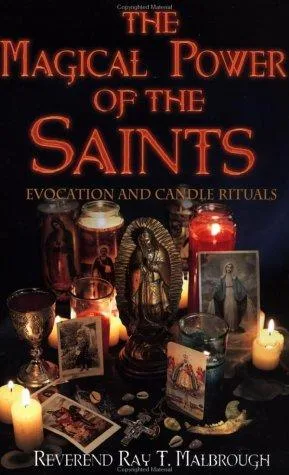
The Magical Power of the Saints
 84
84

The Magical Power of the Saints
Ray T. Malbrough’s "The Magical Power of the Saints" presents a refreshingly direct guide to a less-explored facet of Christian esotericism. Unlike purely academic or devotional texts, Malbrough offers a functional toolkit for interacting with the saints as active agents in magical workings. The strength lies in its systematic approach, providing clear instructions for utilizing saint candles, psalms, and herbal baths for seventy-four different figures. A notable passage details the specific correspondences for Saint Benedict (white candle, associated day), illustrating the book's practical nature. However, the work occasionally feels repetitive in its structure, presenting each saint in a similar, formulaic manner. While the intent is clarity, this can sometimes dilute the distinct spiritual essence of each saint. Still, for practitioners seeking a tangible method to engage with saintly intercession, Malbrough provides a grounded and actionable resource.
📝 Description
84
Ray T. Malbrough's 2014 book details using Christian saints as allies in magical practice.
Published in 2014, "The Magical Power of the Saints" by Ray T. Malbrough presents a practical system for petitionary magic. It moves beyond simple hagiography to describe how to work with Christian saints as spiritual partners. The book emphasizes the use of "saint candles," specifically seven-day vigil candles with saint images, as central elements in ritual. Malbrough offers guidance for engaging with numerous saints, outlining their associated colors, specific days, and suitable prayers or psalms for invocation.
This work is suited for those interested in devotional magic and folk Catholicism. It appeals to practitioners who favor concrete ritualistic methods over abstract concepts, providing a structured approach to asking saints for help with life's challenges. The book's systematic presentation also holds interest for readers studying comparative religion or the history of magical traditions.
Malbrough's work draws on a long history of folk magic and saint veneration found in various cultures, particularly within Christian communities. While formal religious doctrine often focuses on prayer and intercession, folk traditions frequently incorporate direct ritualistic actions. This book sits within contemporary esoteric Christianity, which reinterprets traditional religious figures and practices through a magical lens, differing from purely academic or theological examinations.
💡 Why Read This Book?
• You will learn a practical, candle-based system for invoking specific saints, detailed by Malbrough, which offers a tangible method for petitionary magic beyond simple prayer. • You will gain insight into the correspondences for 74 saints, including their specific candle colors and associated Psalms, allowing for a more focused and personalized devotional practice as outlined by Ray T. Malbrough. • You will discover how to integrate traditional elements like herbal baths with saintly invocations, providing a multi-sensory approach to spiritual work that is directly instructed in the book.
⭐ Reader Reviews
Honest opinions from readers who have explored this book.
❓ Frequently Asked Questions
What is the primary focus of "The Magical Power of the Saints"?
The book focuses on practical, ritualistic magic using Christian saints as spiritual allies. It teaches how to petition saints through "saint candles," prayers, psalms, and herbal baths for specific needs.
How many saints are covered in Ray T. Malbrough's book?
Ray T. Malbrough's work covers seventy-four different saints, providing specific instructions for working with each one.
What are "saint candles" as described in the book?
Saint candles are seven-day vigil candles imprinted with the imagery of specific saints. They serve as focal points for prayer and ritual in the magical practices described by Malbrough.
Does the book require prior knowledge of magic?
While some familiarity with prayer or devotional practices is helpful, the book is designed to be a practical guide, making it accessible to beginners interested in this specific form of saintly magic.
What kind of outcomes can one expect from these practices?
The book suggests that these practices can help petition saints for assistance in various life matters, acting as a bridge for divine intervention through focused intent and ritual.
When was "The Magical Power of the Saints" first published?
The book was first published on January 8, 2014, making it a relatively contemporary guide to these esoteric practices.
🔮 Key Themes & Symbolism
Saintly Intercession Rituals
This theme centers on the active invocation of Christian saints as powerful intermediaries for magical work. Malbrough outlines specific protocols for petitioning these figures, moving beyond simple prayer to structured ritual. The book details the use of seven-day vigil candles, each associated with a particular saint's imagery and color, serving as a potent focal point for focused intent and desire. This approach emphasizes the saints not as distant historical figures but as accessible spiritual allies capable of influencing worldly affairs through devotional practice and symbolic action.
Correspondences and Symbolism
A core element is the mapping of specific correspondences to each saint, enabling more effective magical operations. This includes the color of their designated "saint candle," the appropriate day of the week for petitioning them, and relevant Psalms or prayers to recite. For example, Saint Benedict is associated with white candles. Understanding these symbolic links is crucial for aligning one's magical work with the perceived energies and domains of influence of each saint, creating a resonant connection for petition.
Folk Catholicism and Practical Magic
The book taps into the rich tradition of folk Catholicism, where religious figures and practices are often integrated into everyday life and magical workings. It presents a systematized approach to these devotional practices, making them accessible to a modern audience. The emphasis is on practical application – how to perform these rituals effectively to achieve desired outcomes, blending spiritual devotion with tangible magical techniques rooted in historical custom.
Seven-Day Vigil Candles
These specialized candles are central to Malbrough's system. Each seven-day vigil candle is designed to burn continuously for a week, providing an extended period for the practitioner's intentions to manifest. The book instructs readers on how to select, dress, and consecrate these candles, often imprinted with the image of the saint being invoked. Their prolonged burning time is seen as amplifying the power of the petition and maintaining a constant energetic link to the saint.
💬 Memorable Quotes
Direct passages from the work, attributed to the author.
“Learn how to do powerful, practical magic when you use candles and call on the saints.”
— This foundational statement highlights the book's core purpose: to bridge devotional practice with tangible magical results, specifically through the use of saint candles as a primary tool.
“This book can be your personal guide to help you call on the saints as your spiritual allies.”
— This emphasizes the accessible and supportive nature of the text, positioning it as a direct manual for practitioners seeking to establish a working relationship with saintly figures.
“You will learn how to work with seventy-four different saints through the use of 'seven-day vigil candles' (saint candles), prayers, psalms, herbal baths, and more.”
— This outlines the comprehensive scope of the book, detailing the specific methods and the wide array of saints covered, promising a thorough introduction to this particular magical system.
“For example, you would call on Saint Benedict (whose candle color is white and day of the w”
— This snippet illustrates the book's practical, correspondence-based approach, showing how specific details like candle color are linked to individual saints for ritualistic efficacy.
“The Magical Power of the Saints is a guide to petitionary magic.”
— This succinct interpretation clarifies the book's functional intent, framing the entire work as a manual for making specific requests and seeking aid through spiritual intercession.
🌙 Esoteric Significance
Tradition
This work sits within the broad stream of Western Esotericism, specifically engaging with esoteric Christianity and folk magic traditions. It draws upon centuries of saint veneration but operationalizes it within a magical framework, similar to how other esoteric traditions might utilize angelic or elemental correspondences. It departs from purely theological approaches by emphasizing the saints' active role in manifesting tangible results through ritual, aligning with a magical worldview that sees the divine accessible through specific, performative acts.
Symbolism
The primary symbols are the "saint candles" themselves, representing the saint's presence and power, often distinguished by color (e.g., white for Saint Benedict). Psalms function as potent symbolic language, acting as sacred utterances believed to carry specific spiritual frequencies or intentions. Herbal baths further incorporate natural symbolism, connecting the practitioner to the earth's energies as part of the ritualistic process aimed at purification and spiritual enhancement.
Modern Relevance
Contemporary practitioners of folk magic, devotional witchcraft, and certain branches of esoteric Christianity find value in Malbrough's systematic approach. Thinkers and groups exploring the intersection of popular religion and magical practice, or those seeking accessible, deity-focused magical systems outside of more complex ceremonial traditions, often reference or utilize the methods presented in this book.
👥 Who Should Read This Book
['• Practitioners of folk Catholicism or devotional magic seeking to deepen their connection with saints through structured ritual.', '• Individuals interested in comparative religion and the historical development of magical practices within Christian contexts.', '• Beginners in esoteric studies who prefer concrete, step-by-step guides for spiritual and magical work.']
📜 Historical Context
Published in 2014, Ray T. Malbrough's "The Magical Power of the Saints" emerged in an era where interest in folk magic, devotional practices, and personalized spirituality within established religious frameworks was growing. It engages with a long-standing tradition of saint veneration present in Catholicism and Orthodoxy, but reframes it through the lens of practical, petitionary magic. This contrasts with the more austere theological interpretations that emphasize prayer solely as supplication rather than as a component of ritual efficacy. While not directly engaging with contemporaries in the same niche, Malbrough’s work appeals to the broader resurgence of interest in practical occultism and esoteric Christianity seen in the late 20th and early 21st centuries, exemplified by authors exploring similar themes of divine contact and ritual power. The book's reception within academic circles has been limited, but it serves a dedicated community interested in applying traditional beliefs to contemporary magical practice.
📔 Journal Prompts
The efficacy of Saint Benedict's white candle and associated prayers.
Personal experiences with petitionary magic using saintly figures.
How the use of Psalms can amplify intent in devotional rituals.
Integrating herbal baths into a saint invocation practice.
Developing a personal working relationship with a chosen saint.
🗂️ Glossary
Saint Candle
A seven-day vigil candle imprinted with the image of a specific Christian saint, used as a focal point in magical petitionary work.
Petitionary Magic
A form of magic focused on making specific requests or appeals to spiritual entities, in this case, Christian saints, for assistance.
Seven-Day Vigil Candle
A type of candle designed to burn continuously for approximately seven days, often used in devotional and magical practices for sustained focus.
Correspondences
The symbolic associations (e.g., colors, days, herbs, prayers) linked to specific saints or spiritual entities, believed to enhance magical efficacy when utilized correctly.
Psalms
Sacred songs, prayers, and poems from the Book of Psalms in the Hebrew Bible, often incorporated into Christian devotional and magical practices for their spiritual power.
Hagiography
The writing of the lives of saints, typically focusing on their spiritual achievements and miracles, which serves as a basis for understanding their traditional roles.
Spiritual Allies
Entities or beings (in this context, saints) invoked and worked with as supportive partners in spiritual or magical endeavors.