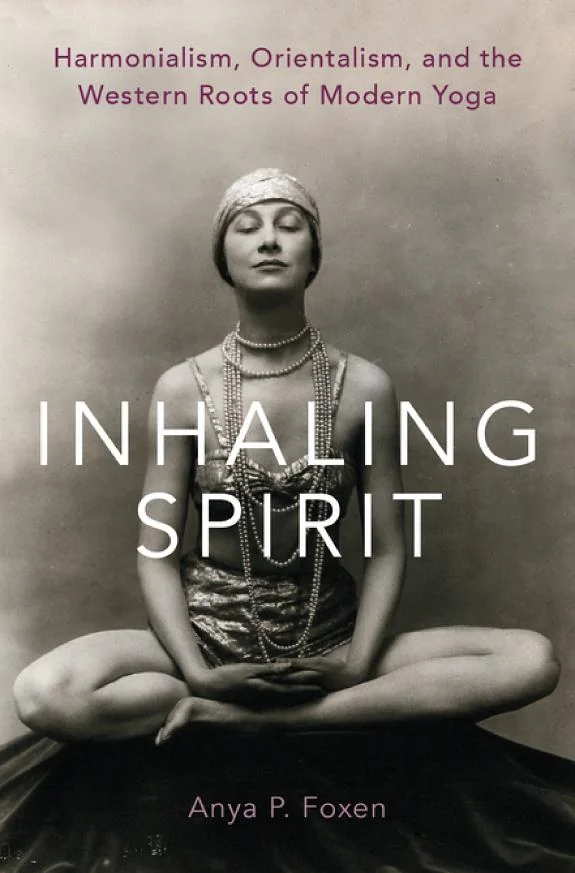
Inhaling Spirit
 77
77

Inhaling Spirit
Anya P. Foxen’s "Inhaling Spirit" makes a bold assertion, suggesting that much of what passes for modern yoga in the West owes as much, if not more, to Hellenistic philosophy as it does to pre-modern Indian traditions. This is a provocative thesis, delivered with scholarly rigor. Foxen’s meticulous examination of the historical evidence, particularly her focus on the syncretic nature of early 20th-century yoga development, is compelling. She navigates complex textual and philosophical landscapes to demonstrate how concepts and practices from Stoicism, Neoplatonism, and other Hellenistic schools were integrated into nascent yoga forms. While the book is exceptionally well-researched, its dense academic style might present a barrier for readers unfamiliar with classical philosophy or comparative religious studies. However, for those willing to engage, the revelation that certain modern postural yoga elements are genealogically closer to ancient Greek thought than to traditional Indian ones is a significant, albeit challenging, insight. "Inhaling Spirit" offers a necessary re-framing of yoga's origins.
📝 Description
77
Anya P. Foxen's "Inhaling Spirit" argues modern yoga stems from Hellenistic philosophies, not just ancient Indian lineages.
Published in 2023, Anya P. Foxen's "Inhaling Spirit" challenges common assumptions about yoga's origins. The book proposes that many contemporary yoga practices, particularly those popular in the West, are not solely derived from ancient Indian traditions. Instead, Foxen details a significant syncretism where Hellenistic philosophies and Western esoteric currents played a crucial role in their formation. This perspective moves away from viewing yoga as a singular, unbroken lineage, highlighting a more complex history shaped by global cultural exchange.
The work analyzes the transcultural processes that led to the yoga we recognize today. It shows how intellectual and spiritual ideas from diverse sources merged, especially during periods of cultural contact. Foxen asserts that Hellenistic thought, including specific philosophical concepts and aesthetic principles from Greek antiquity, was a foundational element in developing early modern yoga. This dual ancestry complicates the traditional narrative of yoga's history and its modern presentation.
This book engages with traditions often categorized as Western esotericism. It examines how philosophical ideas, particularly those from Hellenistic Greece, were reinterpreted and integrated into spiritual practices that later became codified as yoga. Foxen's work situates these developments within a history of occultism and alternative spiritual movements that often sought to synthesize diverse ancient wisdom traditions. The analysis connects these currents to the formation of modern Western spiritual identities and practices.
💡 Why Read This Book?
• Understand the significant, often overlooked, Hellenistic philosophical influences on modern postural yoga, moving beyond a purely Indian origin narrative as discussed in relation to the early 20th century. • Gain a nuanced perspective on transcultural exchange and syncretism by examining how disparate traditions, like those from ancient Greece and India, merged to create new spiritual practices. • Re-evaluate your own yoga practice by considering its dual ancestry, potentially uncovering deeper connections to Western esoteric thought as explored in Foxen's analysis of specific philosophical concepts.
⭐ Reader Reviews
Honest opinions from readers who have explored this book.
❓ Frequently Asked Questions
What specific Hellenistic philosophical schools influenced modern yoga according to Anya P. Foxen?
Anya P. Foxen's "Inhaling Spirit" highlights the influence of Stoicism and Neoplatonism, among other Hellenistic philosophies, on the development of modern yoga practices. The work suggests these schools contributed distinct concepts and ethical frameworks that were integrated into early 20th-century yoga.
How does "Inhaling Spirit" challenge traditional views on yoga origins?
The book challenges the notion of a direct, unbroken lineage from ancient Indian yoga to modern Western practice. It argues for a significant syncretic process where Hellenistic thought played an equally, if not more, foundational role for some contemporary forms.
When was "Inhaling Spirit" first published?
Anya P. Foxen's "Inhaling Spirit" was first published on March 2, 2020. This allows it to engage with recent scholarship and present contemporary analysis of yoga's historical development.
Who is Anya P. Foxen, and what is her background?
Anya P. Foxen is an author whose work "Inhaling Spirit" is situated within Esoteric studies. While her specific academic background isn't detailed here, her book engages with complex scholarship on yoga, philosophy, and transcultural exchange.
What is meant by 'syncretism' in the context of "Inhaling Spirit"?
Syncretism, as explored in the book, refers to the merging and blending of different religious, philosophical, or cultural beliefs and practices. Foxen uses it to describe how elements from Indian yoga and Hellenistic traditions combined to form new expressions of yoga.
Is "Inhaling Spirit" a practical guide to yoga?
No, "Inhaling Spirit" is primarily an academic and critical work exploring the historical and philosophical roots of modern yoga. It is not a how-to guide for practitioners but rather a scholarly examination of its origins.
🔮 Key Themes & Symbolism
Hellenistic Philosophical Entanglement
This theme centers on Anya P. Foxen's core argument: the profound, yet often unacknowledged, influence of Hellenistic philosophies, such as Stoicism and Neoplatonism, on the formation of modern postural yoga. The work scrutinizes how concepts related to ethics, self-discipline, and cosmological views from ancient Greece were absorbed and integrated into the evolving practices of yoga, particularly in the early 20th century. It moves beyond simple diffusion to examine a complex syncretism, suggesting these Western philosophical currents are genealogically significant, sometimes even more so than pre-modern Indian yogic traditions for certain contemporary expressions.
Transcultural Syncretism in Practice
Foxen details the dynamic process of transcultural exchange and syncretism that birthed contemporary yoga. This theme examines how spiritual and philosophical ideas, originating from geographically and culturally distinct traditions like ancient India and the Hellenistic world, were not merely juxtaposed but actively merged. The book explores the specific mechanisms and historical junctures where this fusion occurred, leading to the creation of novel practices and belief systems. It highlights that what is often perceived as a singular, ancient lineage is, in fact, a composite born from cross-cultural dialogue and adaptation.
Re-evaluating Yoga Lineage
A central aim of "Inhaling Spirit" is to prompt a critical re-evaluation of yoga's historical lineage. The book challenges the monolithic narrative of yoga originating solely from ancient Indian yogic traditions. By presenting evidence for substantial Hellenistic contributions, Foxen encourages readers, scholars, and practitioners to consider a more complex, multi-rooted ancestry for modern yoga. This theme calls for a nuanced understanding that acknowledges the entangled origins and the ongoing evolution of spiritual practices through global interaction and intellectual synthesis.
Esoteric Dimensions of Yoga's Genesis
While grounded in scholarly research, "Inhaling Spirit" also touches upon the esoteric dimensions inherent in the cross-pollination of philosophical and spiritual traditions. It explores how the synthesis of Indian yogic techniques with Hellenistic contemplative practices created new avenues for inner exploration. This theme considers the esoteric undercurrents that may have driven the adoption and adaptation of these diverse elements, suggesting that the pursuit of spiritual transformation played a key role in the syncretic fusion of these ancient wisdom streams.
💬 Memorable Quotes
Direct passages from the work, attributed to the author.
“Modern postural yoga is the outcome of a complex process of transcultural exchange and syncretism.”
— This statement captures the book's foundational argument, challenging the simple narrative of yoga's origins and emphasizing its hybrid nature, shaped by interactions between diverse cultural and philosophical systems.
“Some of what we call yoga... is genealogically only slightly related to pre-modern Indian yoga traditions.”
— This highlights the book's provocative thesis that certain contemporary yoga practices may have stronger links to non-Indian traditions, particularly Hellenistic philosophies, than to their purported ancient Indian roots.
“It is equally, if not more so, grounded in Hellenistic...”
— This phrase directly points to the significant, and perhaps primary, influence of Hellenistic thought on specific modern yoga forms, suggesting a dual or even dominant Western philosophical ancestry.
“This book doubles down on those claims and digs even deeper, looking to uncover the disparate but entangled roots of modern yoga practice.”
— This indicates the author's intent to build upon existing scholarship regarding yoga's complex origins, promising a more thorough and intricate exploration of its many-sided historical development.
“Recent scholarship has shown that modern postural yoga is the outcome of a complex process of transcultural exchange...”
— This sets the stage by referencing contemporary academic consensus, positioning the book as an extension and deepening of existing scholarly work on yoga's historical development and cross-cultural influences.
🌙 Esoteric Significance
Tradition
While not explicitly aligning with a single esoteric lineage, "Inhaling Spirit" engages with the broader Hermetic and Neoplatonic currents that have historically informed Western esotericism. The book's focus on the integration of Hellenistic philosophical and contemplative practices into yoga appeals to the syncretic tendencies common in Western esoteric traditions, which often draw from diverse sources like Hermeticism, Kabbalah, and Gnosticism. Foxen’s work contributes by revealing how these Western esoteric-adjacent philosophies directly shaped a practice now often viewed solely through an Eastern lens, thus broadening the understanding of esoteric influences on global spiritual movements.
Symbolism
The work implicitly engages with symbols of integration and synthesis. The very act of combining Indian yogic techniques with Hellenistic philosophical frameworks can be seen as a symbolic representation of the Hermetic principle 'As Above, So Below,' where macrocosmic philosophical truths are mirrored in microcosmic practices. Concepts such as the Stoic emphasis on virtue and reason, and Neoplatonic ideas of emanation and the ascent of the soul, become symbolic touchstones. These philosophical ideals, when blended with yogic postures and breathwork, symbolize a holistic approach to spiritual development, aiming for integration of mind, body, and spirit through diverse conceptual lenses.
Modern Relevance
Contemporary thinkers and schools exploring comparative spirituality and the history of Western esotericism find "Inhaling Spirit" highly relevant. Scholars examining the globalization of spiritual practices and the evolution of mind-body disciplines often cite Foxen's work for its nuanced perspective on yoga's origins. Furthermore, practitioners and theorists within Western esoteric traditions who are interested in the historical cross-pollination of ideas will find its analysis of Hellenistic influence particularly valuable for understanding the layered development of contemplative practices in the modern era.
👥 Who Should Read This Book
• Students of comparative religion and philosophy: Those interested in how distinct intellectual traditions, like Indian yoga and Hellenistic thought, merge and evolve will find this book's analysis of syncretism invaluable. • Critical yoga practitioners: Individuals seeking a deeper, more historically informed understanding of modern yoga's roots beyond traditional narratives will benefit from the book's scholarly deconstruction of yoga's origins. • Scholars of Western Esotericism: Researchers interested in the historical interplay between Eastern and Western spiritual philosophies will appreciate the detailed examination of Hellenistic influences on early 20th-century yoga.
📜 Historical Context
Published in 2020, Anya P. Foxen's "Inhaling Spirit" emerged at a time when scholarship on yoga was increasingly deconstructing its traditional narratives. The preceding decades had seen a growing academic consensus, as noted by Foxen, that modern postural yoga was not a direct, unbroken transmission from ancient India but rather a product of complex transcultural exchange and syncretism. This period saw scholars like Mark Singleton challenging the myth of yoga's ancient origins in works such as "Yoga Body: The Origins of Modern Posture Practice" (2010). Foxen's work builds upon this foundation, specifically focusing on the often-understated role of Hellenistic philosophies. While competing schools of thought often presented yoga as purely an Indian spiritual export, Foxen's analysis introduces a significant counter-narrative, emphasizing its entanglement with Western philosophical traditions. The book's contribution lies in its detailed exploration of how Greek antiquity, particularly Stoicism and Neoplatonism, directly informed early 20th-century yoga formulations.
📔 Journal Prompts
The entanglement of Hellenistic philosophy and modern yoga.
Analyze the concept of syncretism as applied to yoga's historical development.
Reflect on the dual ancestry of modern yoga practices.
Consider the implications of yoga's origins for contemporary practitioners.
Examine how transcultural exchange shapes spiritual disciplines.
🗂️ Glossary
Transcultural Exchange
The process by which ideas, beliefs, practices, and artifacts move between different cultures, leading to mutual influence and transformation. It's a key concept in understanding how yoga evolved beyond its Indian origins.
Syncretism
The merging or blending of different, often seemingly contradictory, beliefs, practices, or philosophies into a new, unified whole. In "Inhaling Spirit," it refers to the combination of Indian yogic traditions with Hellenistic thought.
Hellenistic Philosophy
Philosophical traditions that flourished in the Greek world from the 4th century BCE to the Roman Empire, including Stoicism, Neoplatonism, and Epicureanism. These schools explored ethics, logic, physics, and metaphysics.
Genealogically Related
Pertaining to the historical lineage or origin of something. Foxen uses this to discuss how closely certain modern yoga practices are historically connected to pre-modern Indian yoga versus Hellenistic traditions.
Pre-modern Indian Yoga
Refers to yoga traditions and texts originating in India prior to the significant Western engagement and adaptation that began in the late 19th and early 20th centuries, such as the Yoga Sutras of Patanjali.
Postural Yoga
Yoga primarily focused on physical postures (asanas). This term is often used to distinguish modern, often Western-influenced, yoga from older, more meditative or philosophical forms.
Esoteric
Intended for or likely to be understood by only a small number of people with a specialized knowledge or interest. In this context, it relates to mystical or hidden spiritual teachings.
This book appears in 1 collection
🔮 Readers Also Liked
Browse all →







From the “Western Esotericism” Collection
View all →








More Free Sacred Texts & Gnosticism Books
View all →