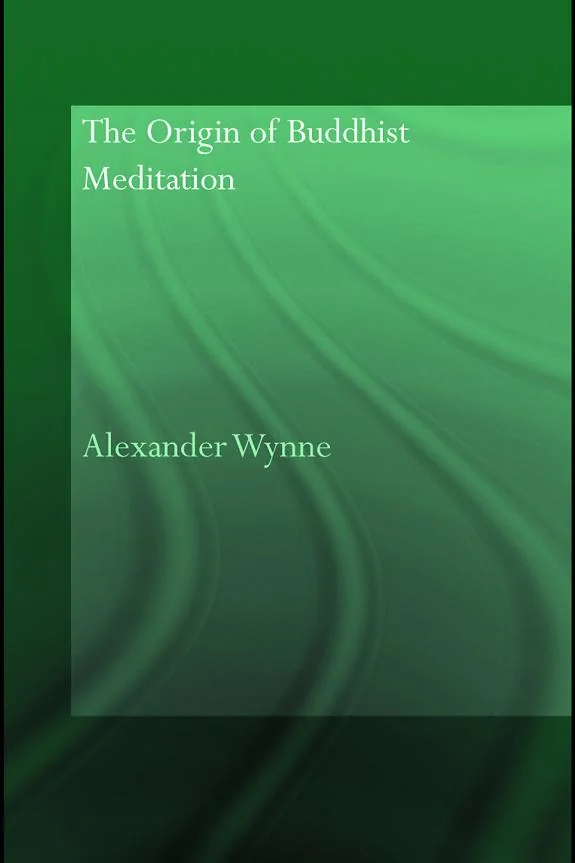
The Origin of Buddhist Meditation
 80
80

The Origin of Buddhist Meditation
Alexander Wynne's "The Origin of Buddhist Meditation" offers a compelling, albeit dense, re-evaluation of the foundational practices of Buddhism. By anchoring his arguments in early Brahminic literature like the Upanishads, Wynne makes a strong case for the historical reality of the Buddha's teachers and the specific yogic systems they taught. This approach provides a refreshing counterpoint to purely philosophical or later doctrinal interpretations of Buddhist meditation. A notable strength is the detailed textual analysis that underpins his claims. However, the work's academic rigor, while admirable, may present a barrier for readers unfamiliar with Sanskrit or specialized Buddhist terminology, occasionally obscuring the practical implications of his findings for modern practitioners. The exploration of the Moksadharma as a source for understanding the Buddha's meditative lineage is particularly insightful, highlighting the interconnectedness of ancient Indian spiritual traditions. Ultimately, "The Origin of Buddhist Meditation" is an indispensable resource for scholars seeking to understand the historical genesis of Buddhist contemplative techniques.
📝 Description
80
Alexander Wynne's 2007 book traces Buddhist meditation to its earliest traceable elements.
Published in 2007, Alexander Wynne's scholarly work meticulously examines the origins of Buddhist meditation. It moves beyond established narratives to trace the practice back to its earliest traceable elements, suggesting connections to the Buddha himself. Wynne's research focuses on identifying foundational texts and concepts that predate or directly influenced the Buddha's teachings.
This book is intended for serious students and scholars of Buddhist studies, comparative religion, and the history of contemplative practices. It appeals to those who seek a rigorous, evidence-based exploration of meditation's roots, particularly individuals interested in the historical development of spiritual disciplines and the influence of Brahmanic traditions on early Buddhism.
Wynne's analysis situates the Buddha's meditative techniques within the intellectual milieu of ancient India. The book engages with early Brahminic literature, specifically the Upanishads and Moksadharma, to reconstruct the likely methods the Buddha encountered. This approach challenges conventional understandings by positing historical teachers and specific meditative systems that informed the Buddha's own path to enlightenment.
This study engages with the historical roots of meditative practices that became central to Buddhist traditions. By examining pre-Buddhist Brahmanic literature like the Upanishads and Moksadharma, Wynne situates the Buddha's innovations within a broader Indian yogic and ascetic milieu. The work seeks to clarify the specific lineages of instruction and practice that informed the earliest Buddhist contemplative disciplines, moving beyond generalized notions of spiritual awakening to pinpoint historical influences.
💡 Why Read This Book?
• Gain insight into the historical teachers who influenced the Buddha, directly challenging common assumptions about the singular origin of his meditative practices, as detailed in the analysis of early Brahminic literature. • Understand the specific yogic methods that likely formed the basis of the Buddha's meditation, moving beyond abstract concepts to concrete historical techniques derived from the Upanishads. • Engage with scholarly debate by exploring Wynne's assertion that the Buddha's meditation originated from distinct teachers, a perspective grounded in textual evidence from the Moksadharma.
⭐ Reader Reviews
Honest opinions from readers who have explored this book.
❓ Frequently Asked Questions
What is Alexander Wynne's primary argument in "The Origin of Buddhist Meditation"?
Wynne argues that the Buddha's meditation techniques originated from historical teachers and specific yogic systems found in early Brahminic literature, such as the Upanishads and Moksadharma, rather than developing in isolation.
Which early Indian texts does Wynne focus on to support his thesis?
Wynne primarily focuses on early Brahminic literature, specifically citing the Upanishads and the Moksadharma, to reconstruct the origins of Buddhist meditation.
When was "The Origin of Buddhist Meditation" first published?
The book "The Origin of Buddhist Meditation" by Alexander Wynne was first published in 2007.
What does Wynne suggest about the Buddha's teachers?
Wynne asserts that the two teachers from whom the Buddha learned meditation were historical figures, and he attempts to identify the specific methods they taught.
Who is the intended audience for this book?
The book is intended for scholars of Buddhist studies, comparative religion, and those interested in the historical development of contemplative practices, requiring a degree of academic engagement.
What does Wynne aim to clarify regarding Buddhist meditation?
Wynne aims to identify authentic teachings of the Buddha on meditation by tracing their origins to specific Brahminic practices and teachers, thereby stimulating scholarly debate.
🔮 Key Themes & Symbolism
Brahminic Meditation Roots
This work posits that the foundations of Buddhist meditation lie not solely within the Buddha's own insights but are deeply intertwined with pre-existing yogic and contemplative systems found in early Brahminic literature. Wynne specifically examines the Upanishads and Moksadharma, suggesting these texts contain the core methods the Buddha learned from his teachers. This perspective challenges a view of Buddhism as entirely sui generis, highlighting its embeddedness within the broader spiritual range of ancient India and offering a more nuanced understanding of its development.
Historical Teachers of the Buddha
A central thesis of Wynne's research is the assertion that the two known teachers of the Buddha, Alara Kalama and Uddaka Ramaputta, were not merely philosophical constructs but historical figures who imparted distinct meditative disciplines. By referencing early Brahminic sources, the book attempts to reconstruct the specific teachings these individuals likely offered, thereby grounding the Buddha's spiritual journey in tangible historical interactions and pedagogical relationships.
Authentic Meditative Teachings
Wynne endeavors to distill the most authentic teachings on meditation attributed to the Buddha by tracing their lineage back to his early teachers and their Brahminic influences. The book uses comparative textual analysis to differentiate between original insights and later elaborations, aiming to provide a clearer picture of the Buddha's direct instructions on contemplative practice. This scholarly pursuit seeks to recover a foundational understanding of meditation stripped of subsequent accretions.
Scholarly Discourse on Meditation
By presenting a rigorous, evidence-based argument for a revised understanding of Buddhist meditation's origins, Wynne actively stimulates debate within the field of Buddhist Studies. The book is designed to challenge established theories and encourage a re-examination of canonical texts and historical narratives. It serves as a catalyst for deeper academic inquiry into the complex intellectual and spiritual currents that shaped early Buddhism and its enduring practices.
💬 Memorable Quotes
Direct passages from the work, attributed to the author.
“Based on the early Brahminic literature, namely the early Upanishads and Moksadharma.”
— This points to the foundational textual evidence Wynne utilizes. He argues that these ancient Indian texts are crucial for understanding the context and origin of the Buddha's meditative path, suggesting a direct lineage of practice.
“The author argues that the two teachers of the Buddha were historical figures.”
— This expresses a core assertion of the book, challenging purely symbolic or legendary interpretations of Alara Kalama and Uddaka Ramaputta by positing their existence as real instructors who imparted specific teachings.
“Attempts to use them to identify some authentic teachings of the Buddha on meditation.”
— This describes the book's objective: to move beyond speculative interpretations and pinpoint the Buddha's genuine instructions on meditation by analyzing the likely content of his teachers' doctrines.
“Stimulating debate within the field of Buddhist Studies.”
— This indicates the book's impact and intended scholarly contribution, positioning it as a work designed to provoke discussion and re-evaluation of established theories regarding Buddhist origins.
💡 Key Ideas
Editorial paraphrase of the work's core concepts — not direct quotes.
The work explores the origin of the method of meditation learned by the Buddha from these teachers.
This paraphrased concept highlights the book's central investigation: reconstructing the specific meditative techniques the Buddha acquired from his known instructors, grounding these practices in historical and textual evidence.
🌙 Esoteric Significance
Tradition
While not strictly adhering to a single Western esoteric lineage like Hermeticism or Kabbalah, Wynne's work touches upon the esoteric underpinnings of contemplative traditions. It aligns with the broader esoteric library's interest in uncovering foundational, often hidden, spiritual knowledge. By seeking the 'authentic teachings' and historical roots, the work echoes an esoteric quest for primordial wisdom, tracing it back to ancient yogic practices that transcend mere religious dogma and point towards direct experiential realization.
Symbolism
The primary 'symbols' explored in this book are not visual but conceptual: the 'teachers' themselves (Alara Kalama, Uddaka Ramaputta) become symbolic archetypes of specific meditative lineages. The 'Upanishads' and 'Moksadharma' function as symbolic repositories of ancient yogic knowledge. The core motif is the transmission of practice, representing the esoteric principle of guru-disciple lineage and the importance of correct transmission for spiritual attainment, moving beyond abstract philosophy to embodied wisdom.
Modern Relevance
Contemporary practitioners and scholars interested in the historical accuracy of meditation techniques, and those seeking to understand the roots of mindfulness beyond secular adaptations, find Wynne's work highly relevant. Thinkers and schools that emphasize the historical continuity of yogic and contemplative practices, or those involved in comparative religion studies seeking to bridge the gap between ancient Indic traditions and modern spiritual exploration, draw upon such meticulous textual analysis.
👥 Who Should Read This Book
• Scholars of Buddhist Studies and Comparative Religion seeking to understand the historical and textual origins of Buddhist meditation, moving beyond devotional narratives to evidence-based analysis. • Advanced practitioners of meditation interested in tracing the lineage of their practice to its earliest identifiable sources in ancient Indian yogic traditions, as presented through early Brahminic literature. • Researchers of ancient Indian philosophy and spiritual history who wish to explore the interconnectedness of Vedic, Upanishadic, and early Buddhist thought, particularly concerning contemplative disciplines.
📜 Historical Context
Published in 2007, Alexander Wynne's "The Origin of Buddhist Meditation" emerged during a period of continued academic interest in the historical Buddha and the early development of Buddhist thought. The work engages directly with the intellectual currents of ancient India, specifically the milieu that produced the Upanishads and the Moksadharma, texts contemporary to or predating early Buddhism. Wynne's approach, which emphasizes identifying historical teachers and specific yogic systems, offers a counterpoint to scholarship focusing solely on philosophical doctrines or later Mahayana developments. His meticulous analysis of Brahminic literature positions his work within a tradition of scholarly inquiry that seeks to understand Buddhism's roots in the broader Vedic and Sramanic movements. While not a direct engagement with a specific contemporary scholar in its blurb, the work implicitly challenges interpretations that may downplay the influence of these early Brahminic traditions on the Buddha's own path, contributing to ongoing scholarly debates about syncretism and originality in early Indian religions.
📔 Journal Prompts
The Moksadharma's role in the Buddha's meditative training.
The historical reality of Alara Kalama and Uddaka Ramaputta.
Early Brahminic literature as a source for authentic Buddhist meditation.
Reconstructing yogic methods from the Upanishads.
The significance of specific yogic practices learned by the Buddha.
🗂️ Glossary
Brahminic Literature
Texts originating from the Brahmanical tradition of ancient India, encompassing philosophical and religious writings that often precede or are contemporary with early Buddhist scriptures, including the Upanishads.
Upanishads
A collection of philosophical texts forming the theoretical basis for Hinduism. They are considered to be the earliest source of most Hindu philosophical concepts and are foundational to the Brahminic tradition.
Moksadharma
A section within the ancient Indian epic Mahabharata, containing philosophical and theological discussions that touch upon concepts of liberation (moksha) and yogic practices, considered relevant by scholars to understanding early meditative traditions.
Yogic Methods
Specific techniques and practices associated with Yoga, aimed at physical, mental, and spiritual discipline. In the context of this book, it refers to the contemplative and meditative practices likely taught by the Buddha's teachers.
Authentic Teachings
Refers to the core, original instructions or doctrines attributed to the Buddha regarding meditation, as distinct from later interpretations or elaborations, sought through historical and textual analysis.
Buddhist Studies
An academic field dedicated to the scholarly study of Buddhism, encompassing its history, philosophy, practices, scriptures, and cultural expressions across various traditions and regions.
Contemplative Practices
A broad category of techniques designed to facilitate emotional or spiritual transformation, promote relaxation, or improve self-awareness. Meditation is a primary example.
This book appears in 1 collection
🔮 Readers Also Liked
Browse all →









From the “Buddhism” Collection
View all →







More Free Sacred Texts & Gnosticism Books
View all →