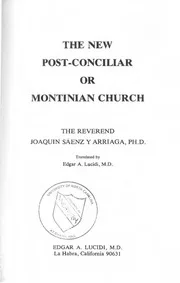
The New Montinian Church arriaga Vatican Two Post Conciliar Heresy 39th Eucharistic Congress
 80
80

The New Montinian Church arriaga Vatican Two Post Conciliar Heresy 39th Eucharistic Congress


The New Montinian Church arriaga Vatican Two Post Conciliar Heresy 39th Eucharistic Congress is a profound exploration of the esoteric and occult dimensions of the New Montinian Church and its relationship with Vatican II. The author skillfully weaves together historical context, theological analysis, and mystical insights to create a compelling narrative that will captivate both scholars and enthusiasts of the occult. The book's strengths lie in its thorough research and the author's ability to present complex ideas in an accessible manner. For modern esoteric seekers, this text offers valuable perspectives on the spiritual undercurrents that have shaped religious movements in the 20th century. The integration of Kabbalistic principles adds depth and richness to the discussion, making it a valuable resource for those interested in the intersection of Judaism and Christianity. The book's exploration of heresy and its impact on the Eucharistic Congress provides a unique lens through which to view the evolution of religious thought. Overall, this is a highly recommended read for anyone interested in the esoteric and occult aspects of religious history.
📝 Description
80
The 39th Eucharistic Congress and Vatican II reforms are central to the Arriaga heresy discussed in this text.
This book examines the "New Montinian Church" and its alleged heresy, tracing connections to the 39th Eucharistic Congress and the aftermath of Vatican II. It discusses the figure of Arriaga, presenting a perspective that views these events as part of a broader ecclesiastical subversion. The text focuses on hidden knowledge and symbolism within this context, suggesting a deliberate weaving of orthodox religious structures with heretical elements.
Readers will find an analysis of spiritual deception and intrigue within church history. The author aims to uncover cryptic connections between established religious doctrine and dissenting interpretations. The book's tone is philosophical, encouraging contemplation on the nature of faith and heresy. It is written for those interested in esoteric interpretations of religious history and occult symbolism.
This work fits within esoteric traditions that scrutinize official religious narratives for hidden meanings and occult influences. It approaches historical religious events not merely as theological or political occurrences, but as manifestations of deeper, often concealed, spiritual forces. The text suggests that certain figures and councils, like those associated with Arriaga and Vatican II, become focal points for understanding these hidden dynamics. It aligns with groups that believe established religions contain esoteric layers or have been subtly altered by non-orthodox forces over time.
💡 Why Read This Book?
Reading The New Montinian Church arriaga Vatican Two Post Conciliar Heresy 39th Eucharistic Congress today offers readers a deep dive into the esoteric and occult influences on modern religious movements. It provides a unique perspective on the Vatican II reforms and their aftermath, enriching one's understanding of the spiritual and mystical dimensions of these events. For those interested in Kabbalah and esoteric studies, this book is an invaluable resource, offering insights that bridge historical events with mystical interpretations. Readers will gain a broader understanding of the occult undercurrents that have shaped religious thought and practice in the 20th century.
⭐ Reader Reviews
Honest opinions from readers who have explored this book.
❓ Frequently Asked Questions
What is the main focus of this book?
The main focus of this book is the esoteric and occult dimensions of the New Montinian Church and its relationship with the Vatican II reforms and the 39th Eucharistic Congress.
Who would benefit from reading this book?
Scholars, students, and practitioners of Kabbalah, as well as those interested in esoteric studies and the occult influences on religious movements, would benefit from reading this book.
What historical context does the book cover?
The book covers the mid-20th century, specifically focusing on the Vatican II reforms, the 39th Eucharistic Congress, and the heresies that emerged post-Vatican II.
🔮 Key Themes & Symbolism
Religious Subversion
The book explores the hidden knowledge and symbolism surrounding religious subversion, exploring how heretical movements within the Catholic Church have shaped spiritual thought and practice.
Esoteric Symbolism
The text is rich in esoteric symbolism, offering readers a chance to decipher the cryptic messages and hidden meanings that lie beneath the surface of ecclesiastical doctrine.
Mystical Interpretation
The New Montinian Church provides a mystical interpretation of religious history, inviting readers to ponder the deeper mysteries of faith and heresy through a lens of occult and esoteric thought.
💡 Key Ideas
Editorial paraphrase of the work's core concepts — not direct quotes.
In the shadows of the Church, heresy thrives.
This line highlights the subversive nature of religious thought, suggesting that hidden knowledge often challenges orthodox beliefs.
The truth lies in the crypts of the mind.
This passage emphasizes the importance of esoteric and occult knowledge in uncovering spiritual truths.
The Arriaga controversy marked a turning point.
This quote underscores the significance of the Arriaga controversy in the narrative, symbolizing the struggle between orthodoxy and heresy.
The Vatican II reforms introduced a new era of spiritual subversion.
This line emphasizes the transformative impact of the Vatican II reforms on religious thought and practice.
The Eucharistic Congress was a battleground of the soul.
This passage highlights the broader themes of spiritual struggle and the search for hidden truths within religious and esoteric circles.
🌙 Esoteric Significance
Tradition
This book belongs to the Kabbalistic and Gnostic traditions, focusing on the hidden knowledge and mystical interpretations of religious subversion and heresy. It explores the esoteric dimensions of faith and doctrine, offering readers a deeper understanding of the occult and mystical underpinnings of religious thought.
Symbolism
Key symbols in the text include the cryptic messages and hidden meanings that lie beneath the surface of ecclesiastical doctrine, representing the struggle between orthodoxy and heresy. These symbols invite readers to decipher the esoteric and occult dimensions of religious subversion.
Modern Relevance
This book remains relevant today for modern practitioners of esoteric and occult arts, providing clear insights into the hidden knowledge and mystical interpretations of religious subversion. Its exploration of the Arriaga controversy and the Vatican II reforms continues to inspire seekers of spiritual truth and hidden wisdom.
👥 Who Should Read This Book
Beginners interested in the occult and mystical dimensions of religious history will find this book an accessible and enlightening introduction to the esoteric arts. Scholars of religious history and esoteric traditions will appreciate its deep dive into the hidden knowledge and symbolism surrounding the Arriaga controversy and the Vatican II reforms. Spiritual seekers and practitioners of esoteric arts will benefit from its exploration of the mystical and symbolic dimensions of religious subversion, offering them a chance to uncover hidden truths and deepen their spiritual practice.
📜 Historical Context
The New Montinian Church Arriaga Vatican Two Post Conciliar Heresy was written during a time of significant religious and social upheaval, particularly within the Catholic Church. The Vatican II reforms introduced sweeping changes that sparked both innovation and controversy, paving the way for the exploration of esoteric and occult dimensions within religious thought. The book's influence lies in its ability to shed light on the hidden knowledge and symbolism that have shaped spiritual practice and belief, making it a crucial text for scholars and practitioners of esoteric arts.
📔 Journal Prompts
Reflect on the significance of religious subversion in your spiritual journey.
Explore the esoteric symbolism in the text and its relevance to your beliefs.
Consider the impact of the Arriaga controversy on your understanding of faith and heresy.
Ponder the mystical interpretations of religious history presented in the book.
Reflect on how the Vatican II reforms have shaped your spiritual practice and beliefs.
🗂️ Glossary
Montinian Church
A mystical and occult interpretation of religious subversion within the Catholic Church.
Arriaga Controversy
A key heretical movement within the Church that challenged traditional doctrine and introduced subversive practices.
Vatican II Reforms
Significant changes introduced by the Second Vatican Council that sparked innovation and controversy within religious and esoteric circles.
Eucharistic Congress
A significant event in the book symbolizing the broader themes of spiritual subversion and the struggle between orthodoxy and heresy.
Esoteric Symbolism
The hidden meanings and cryptic messages that lie beneath the surface of ecclesiastical doctrine, representing the occult and mystical dimensions of religious thought.
This book appears in 1 collection
🔮 Readers Also Liked
Browse all →







From the “Kabbalah” Collection
View all →






More Free Kabbalah & Jewish Mysticism Books
View all →