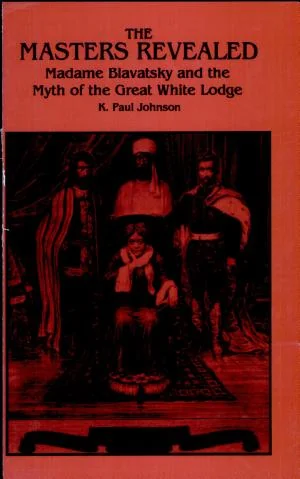
The Masters Revealed
 76
76

The Masters Revealed
K. Paul Johnson's "The Masters Revealed" offers a refreshing, if sometimes dry, demystification of the hidden figures populating esoteric lore. The book's strength lies in its systematic approach, cataloguing individuals like Prince Aleksandr Golitsyn and Abdelkader, and presenting the scant evidence for their supposed spiritual mastery. This critical lens is invaluable for anyone weary of unverified claims. However, the sheer volume of names and brief sketches can make for dense reading; it often feels like an academic index rather than a flowing narrative. The section on Sir Richard Burton, for instance, highlights the author's meticulousness in dissecting historical records versus occult claims. Ultimately, Johnson provides a vital corrective, urging readers to scrutinize the foundations of spiritual authority.
📝 Description
76
K. Paul Johnson's 1994 book scrutinizes figures claimed to be hidden spiritual masters.
This book examines individuals alleged to be hidden spiritual masters, or 'Mahatmas,' within esoteric traditions. It moves past simple praise to investigate historical accounts and claims surrounding figures such as Prince Pavel Dolgorukii, Albert Rawson, and Swami Dayananda Sarasvati. The work acts as a critical catalogue, detailing biographical information and supposed spiritual achievements of these people, many of whom were active around the turn of the 20th century.
"The Masters Revealed" is for serious students of Western esotericism, comparative religion, and occult history. It suits those who question straightforward accounts of spiritual teachers and prefer a more investigative approach. Readers interested in the historical development of movements like Theosophy, or the idea of hidden spiritual hierarchies, will find this book especially useful. It is aimed at both scholars and dedicated practitioners.
Published in 1994, "The Masters Revealed" engages directly with the lore surrounding the Theosophical Society and Helena Blavatsky's concept of the Masters. Johnson's work offers a skeptical examination of the purported identities and roles of these figures within late 19th and early 20th century spiritual movements. It stands as a counterpoint to uncritical acceptance of such esoteric claims, focusing on historical evidence rather than devotional narratives.
💡 Why Read This Book?
• Understand the historical basis for the 'Mahatma' concept by examining specific figures like Swami Dayananda Sarasvati, moving beyond abstract notions of hidden masters. • Develop critical discernment skills for evaluating spiritual claims by analyzing the biographical evidence presented for individuals such as Prince Pavel Dolgorukii. • Gain insight into the intellectual climate of the late 19th century through the exploration of figures like Giuseppe Mazzini and their connections to esoteric movements.
⭐ Reader Reviews
Honest opinions from readers who have explored this book.
❓ Frequently Asked Questions
What is the primary focus of K. Paul Johnson's "The Masters Revealed"?
The book critically investigates the historical identities and alleged spiritual roles of individuals often described as 'Masters' or 'Mahatmas' within esoteric traditions, particularly those prominent in the late 19th and early 20th centuries.
When was "The Masters Revealed" first published?
The original publication date for "The Masters Revealed" by K. Paul Johnson was July 22, 1994.
Which esoteric movements does this book engage with?
It primarily engages with the lore surrounding Theosophy and the concept of a 'Great White Brotherhood,' examining figures linked to these movements.
Does the book present the 'Masters' as real entities?
No, the book takes a critical and investigative stance, aiming to explore the historical evidence for these figures rather than presenting them as definitively real or unreal.
Who are some of the individuals discussed in "The Masters Revealed"?
The book discusses a wide array of individuals, including Prince Pavel Dolgorukii, Albert Rawson, Jamal ad-Din 'al-Afghani', Sir Richard Burton, Swami Dayananda Sarasvati, and many others.
What is the author's approach to the subject matter?
K. Paul Johnson employs a scholarly, evidence-based approach, contrasting claims found in esoteric literature with available historical and biographical records.
🔮 Key Themes & Symbolism
Deconstructing the Mahatma Myth
This work systematically dissects the popular notion of hidden spiritual adepts, often termed 'Mahatmas,' which gained prominence in the late 19th century. Johnson scrutinizes the biographical data of figures like Prince Pavel Dolgorukii and Albert Rawson, comparing esoteric claims with historical records. The aim is to ascertain the tangible reality behind the spiritual archetypes, questioning the origins and nature of the Great White Brotherhood as presented in movements like Theosophy. It encourages a critical perspective on spiritual hierarchies.
Historical Figures in Esoteric Circles
Johnson presents profiles of numerous individuals who were either claimed to be Masters or were significant figures within esoteric movements. From Prince Aleksandr Golitsyn and Giuseppe Mazzini to Swami Dayananda Sarasvati and Sir Richard Burton, the book examines their documented lives and their alleged connections to hidden spiritual traditions. This catalogue serves as a reference for understanding the human element behind complex spiritual narratives and the individuals who shaped them.
The Search for Spiritual Authority
The book implicitly explores the human need for spiritual guidance and the construction of authority within religious and esoteric systems. By examining figures like Jamal ad-Din 'al-Afghani' and Raphael Borg, Johnson probes how individuals gain or are ascribed spiritual status. It questions the validity of claims based on lineage, hidden knowledge, or purported spiritual attainment, encouraging readers to look for verifiable evidence and understand the psychological and social factors involved in belief.
Theosophy and its Precursors
A significant portion of the book implicitly or explicitly engages with the legacy of Helena Blavatsky and the Theosophical Society. Johnson investigates figures who were either contemporaries, influences, or purported members within the esoteric circles that Theosophy drew upon. By analyzing individuals like Lydia Pashkov and James Peebles, the work provides context for the development of Theosophical doctrines and the broader spiritual landscape from which they emerged.
💬 Memorable Quotes
Direct passages from the work, attributed to the author.
“Prince Pavel Dolgorukii was a figure claimed to be a Master.”
— This statement highlights the book's method: identifying individuals named in esoteric literature and presenting them as subjects for historical investigation, rather than accepting their claimed status without question.
“Albert Rawson's connection to esoteric teachings is examined.”
— This points to the book's focus on biographical details and alleged spiritual affiliations, seeking to ground abstract spiritual concepts in the lives of specific, albeit often obscure, historical persons.
“Swami Dayananda Sarasvati is listed among the potential Masters.”
— This indicates the broad scope of Johnson's inquiry, extending beyond Western esoteric traditions to include figures from Indian spiritual movements who were also considered significant by figures like Blavatsky.
“The book catalogues figures like Giuseppe Mazzini.”
— This emphasizes the encyclopedic nature of the work, presenting a structured list of individuals whose lives intersected with esoteric ideas and movements, facilitating comparative study.
“Sir Richard Burton's alleged esoteric involvement is scrutinized.”
— This suggests the book applies a critical lens to well-known historical figures who also had documented or rumored connections to occult and mystical traditions, separating fact from speculation.
🌙 Esoteric Significance
Tradition
The work primarily engages with the Theosophical tradition and its offshoots, particularly the concept of the Great White Brotherhood and its constituent Masters. Johnson critically examines how this lineage, popularized by Helena Blavatsky, constructed its pantheon of hidden spiritual guides. While not adhering to Theosophy, the book serves as an essential critical companion to its study, analyzing the historical and biographical underpinnings of its core tenets.
Symbolism
The book's focus is less on overt symbolism and more on the 'symbolic' nature of the Masters themselves as archetypes of hidden wisdom and spiritual authority. Figures like Prince Pavel Dolgorukii or Swami Dayananda Sarasvati, when presented as 'Masters,' function as potent symbols of spiritual attainment and hidden knowledge within the esoteric narrative. Their alleged existence represents the idea of a guiding hierarchy overseeing humanity's evolution.
Modern Relevance
Contemporary scholars of Western Esotericism and researchers into alternative spiritualities frequently cite "The Masters Revealed." Its methodical debunking of unsubstantiated claims makes it a vital resource for anyone studying the history of Theosophy, spiritualism, or the broader occult revival of the 19th and 20th centuries. Thinkers interested in the sociology of belief and the construction of spiritual authority continue to draw upon Johnson's critical framework.
👥 Who Should Read This Book
• Students of Theosophy and Helena Blavatsky: Gain a critical perspective on the historical individuals claimed as Masters, moving beyond devotional accounts. • Researchers in Comparative Esotericism: Access a catalogued examination of figures linked to various occult and spiritual movements of the 19th and 20th centuries. • Skeptical Inquirers into Spiritual Movements: Develop tools for evaluating claims of hidden knowledge and spiritual authority by analyzing biographical evidence.
📜 Historical Context
Published in 1994, K. Paul Johnson's "The Masters Revealed" arrived at a time when academic interest in Western Esotericism was solidifying, partly as a reaction against earlier, more uncritical studies. The book directly addresses the phenomenon of the 'Mahatmas' central to Helena Blavatsky's Theosophy, which had captivated spiritual seekers since the late 19th century. Johnson's work stands in contrast to the devotional literature surrounding figures like Blavatsky and Annie Besant, offering a skeptical, evidence-based examination. He engages with the historical context of figures like Giuseppe Mazzini, placing them within the political and spiritual currents of their time. The book's reception has been noted for its contribution to a more critical historiography of esoteric movements, challenging foundational myths within Theosophy and related traditions.
📔 Journal Prompts
The historical evidence for Prince Aleksandr Golitsyn's supposed role.
Analysis of the concept of 'Mahatma' as applied to figures like Swami Dayananda Sarasvati.
Comparing the documented life of Sir Richard Burton with esoteric claims.
The function of 'hidden Masters' in spiritual movements like Theosophy.
Investigating the sources cited for the spiritual authority of individuals like Giuseppe Mazzini.
🗂️ Glossary
Mahatma
A Sanskrit term meaning 'great soul.' In esoteric contexts, particularly Theosophy, it refers to highly evolved spiritual beings who guide humanity from behind the scenes.
Great White Brotherhood
A concept in Theosophy and related esoteric traditions referring to a hidden hierarchy of spiritual masters who are believed to guide the spiritual evolution of humanity.
Adepts
Individuals who have achieved a high level of spiritual attainment and possess advanced knowledge or powers, often seen as intermediaries between humanity and higher spiritual forces.
Theosophy
A spiritual movement founded in the late 19th century by Helena Blavatsky, seeking to understand the underlying principles of all religions and to promote universal brotherhood.
Esotericism
Teachings or practices that are concerned with the true spiritual nature of things, accessible only to a select few who are initiated or possess specialized knowledge.
Hagiography
The writing of the lives of saints or revered figures, often characterized by an uncritical or idealized portrayal of the subject.
Spiritualism
A belief system centered on the idea that the spirits of the dead can communicate with the living, often through mediums, popular in the 19th and early 20th centuries.
This book appears in 1 collection
🔮 Readers Also Liked
Browse all →





From the “Theosophy” Collection
View all →






More Free Sacred Texts & Gnosticism Books
View all →