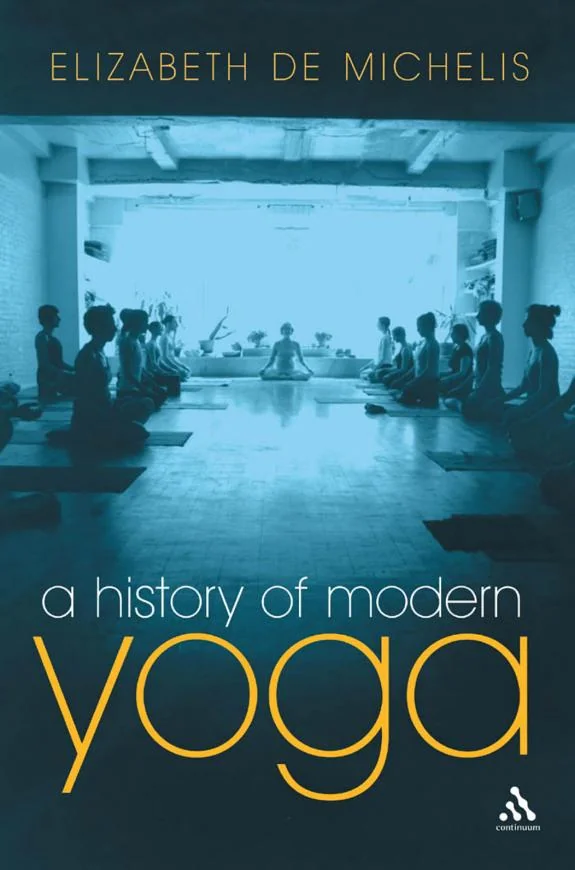
A History of Modern Yoga
 74
74

A History of Modern Yoga
Elizabeth De Michelis's A History of Modern Yoga is a meticulously researched account that cuts through much of the romanticized mythology surrounding the practice's Western arrival. De Michelis excels at demonstrating how yoga, far from being a static import, was actively reshaped by diverse hands – from Theosophists like Helena Blavatsky to early 20th-century Indian nationalists and eventually, Western fitness entrepreneurs. One particularly illuminating section details the early 20th-century efforts to codify and standardize yogic postures, a process driven by both Indian reformers seeking to legitimize yoga and Westerners aiming to make it palatable and accessible. While the book's academic rigor is its greatest strength, its density might prove challenging for readers seeking a purely devotional or anecdotal exploration of yoga. The sheer volume of historical detail, while invaluable for scholars, can occasionally obscure the emotional or experiential dimensions that many modern practitioners associate with yoga. Nevertheless, for anyone wishing to understand the complex lineage of contemporary yoga, De Michelis provides an essential, if demanding, foundation.
📝 Description
74
Elizabeth De Michelis's 2005 book traces yoga's Western evolution from the late 19th century onward.
A History of Modern Yoga examines the complex socio-historical forces that shaped yoga in the West between the late 1800s and the early 2000s. Moving past simple narratives of ancient origins, Elizabeth De Michelis scrutinizes the diverse influences, including Theosophy, Indian nationalism, Western fitness trends, and New Age philosophies, that contributed to yoga's contemporary forms. The book is a valuable resource for students of yoga, religious studies scholars, and historians interested in the material and intellectual history of global spiritual movements. It challenges readers to view yoga not as a static tradition but as a dynamic, contested practice, highlighting the detailed analysis of primary sources and engagement with academic discussions about yoga's Westernization.
Published in 2005, De Michelis's work emerged as academic interest in the global spread of spiritual practices grew. It directly confronts Orientalist critiques and nationalist viewpoints common in earlier discussions of yoga, contrasting with essentialist histories like that of Mircea Eliade. De Michelis underscores the active roles played by both Western practitioners and Indian reformers in adapting and spreading yoga. The book introduces key concepts such as the "Internationalisation of Yoga," the "rediscovery" of yoga's physical dimensions, and the emergence of "neo-orthodoxy" in its Western reception.
This book situates the development of modern yoga within broader trends of esoteric thought and practice that flourished in the late 19th and early 20th centuries. It acknowledges the role of movements like Theosophy in translating and reinterpreting Indian spiritual traditions for Western audiences. By tracing yoga's adaptation and integration into Western physical culture and New Age philosophies, De Michelis highlights how esoteric currents engaged with and transformed established religious forms, creating new spiritual expressions for a modern era.
💡 Why Read This Book?
• Understand the specific historical processes, such as the "Internationalisation of Yoga" starting in the late 19th century, that led to yoga's widespread adoption in the West, moving beyond simplistic origin stories. • Gain insight into how figures like Theosophists and early 20th-century Indian nationalists actively participated in shaping yoga's reception and practice outside of India. • Learn about the crucial distinction between classical yoga traditions and the modern postural focus, including the "rediscovery" of asana as a key component for Western audiences.
⭐ Reader Reviews
Honest opinions from readers who have explored this book.
❓ Frequently Asked Questions
When was A History of Modern Yoga first published and by whom?
A History of Modern Yoga by Elizabeth De Michelis was first published on December 8, 2005, by Continuum Books.
What academic disciplines does this book draw upon?
The book draws heavily on religious studies, history, sociology, and cultural studies to analyze yoga's development.
Does the book discuss the influence of Theosophy on yoga in the West?
Yes, De Michelis extensively details the significant role Theosophical societies and figures played in introducing and popularizing yoga in the late 19th and early 20th centuries.
What is the "Internationalisation of Yoga" according to De Michelis?
The 'Internationalisation of Yoga' refers to the complex process by which yoga moved from India to the West, involving adaptation, interpretation, and dissemination by both Indian reformers and Western practitioners from the late 1800s onwards.
Is this book suitable for casual yoga practitioners?
While comprehensive, the book's academic tone and detailed historical analysis are best suited for serious students, scholars, or practitioners interested in the scholarly history of yoga rather than introductory or purely spiritual guides.
What does De Michelis say about yoga's physical postures in the modern era?
De Michelis highlights the 'rediscovery' and emphasis on asana (postures) in modern yoga, noting how this aspect was often downplayed in earlier, more contemplative interpretations and became central to its Western appeal.
🔮 Key Themes & Symbolism
Western Adaptation of Yoga
De Michelis meticulously chronicles how yoga, upon arriving in the West from the late 19th century, underwent significant transformations. It wasn't merely transplanted but actively adapted by diverse groups, including Theosophists and early proponents of physical culture. This theme emphasizes that modern yoga is a product of cross-cultural negotiation and often reflects Western intellectual and social currents as much as its Indian origins. The book challenges notions of an unbroken, pure lineage, showing instead a dynamic process of reinterpretation and reinvention.
The Role of Indian Reformers
A crucial aspect of De Michelis's argument is the agency of Indian reformers in presenting yoga to the West. Figures like Swami Vivekananda and later, influential gurus, strategically framed yoga to suit Western audiences and address Orientalist perceptions. This involved emphasizing its philosophical and ethical dimensions, sometimes downplaying its more esoteric or ritualistic elements. The work examines how these reformers sought to establish yoga as a legitimate spiritual and intellectual discipline, contributing to its internationalization.
Yoga and Physical Culture
The book sheds light on the often-overlooked connection between yoga and Western physical culture movements emerging in the late 19th and early 20th centuries. De Michelis details how the emphasis on physical postures (asana) became increasingly prominent, partly due to Western interests in health, fitness, and bodily discipline. This development is presented not as a deviation from yoga's essence, but as a significant factor in its popularization and its integration into modern lifestyles, distinguishing it from earlier, more contemplative practices.
Theosophical and Esoteric Influences
De Michelis dedicates significant attention to the foundational role of Theosophy and other esoteric movements in introducing yoga concepts to the West. The Theosophical Society, founded in 1875, provided an intellectual framework and a receptive audience for Indian spiritual ideas, including early forms of yoga. This section explores how these esoteric circles interpreted and disseminated yogic philosophy and practices, often blending them with Western occult traditions, thereby shaping the initial reception of yoga in Europe and America.
💬 Memorable Quotes
Direct passages from the work, attributed to the author.
“Yoga's Western history is a story of complex interactions and adaptations, not simple transmission.”
— This interpretation highlights De Michelis's central thesis: that modern yoga in the West is a co-created phenomenon, shaped by both Indian senders and Western receivers, leading to diverse and often unexpected forms.
“The early 20th century saw a deliberate effort to 'rediscover' and codify yogic postures for a Western audience.”
— This points to the active process of selection and organization that occurred as yoga moved West, where physical postures became a primary accessible entry point, differing from older contemplative traditions.
“Indian reformers strategically presented yoga as a philosophical and ethical system to counter Orientalist views.”
— This illustrates the conscious efforts by Indian figures to legitimize yoga in the West by emphasizing its intellectual and moral aspects, appealing to Western rationalism and spiritual seeking.
“Theosophy acted as a crucial conduit for early yogic ideas into Western esoteric circles.”
— This emphasizes the specific historical pathway through which yoga concepts first entered mainstream Western consciousness, often through the lens of Theosophical interpretations and syncretic beliefs.
“Modern yoga's emphasis on asana distinguishes it significantly from its classical predecessors.”
— This interpretation underscores the divergence between ancient yogic traditions, often focused on meditation and asceticism, and the highly physicalized practice common in contemporary Western yoga.
🌙 Esoteric Significance
Tradition
This work fits within the academic study of Western Esotericism, specifically examining how Eastern traditions were adopted and transformed within this milieu. While not an esoteric text itself, it analyzes the historical engagement of esoteric societies, particularly Theosophy, with yogic philosophy and practices. De Michelis maps the transmission and adaptation of these ideas, demonstrating how they were integrated into evolving Western spiritual landscapes, often blending with Hermetic, Gnostic, and occultist frameworks prevalent in the late 19th and early 20th centuries.
Symbolism
The book implicitly discusses symbols through the concepts it explores. For instance, the "rediscovery" of asana signifies a shift from internal, meditative symbolism (like chakras or kundalini, often discussed abstractly) to the external, physical symbolism of the body as a site of discipline and spiritual practice. The very act of "Internationalisation" can be seen as a symbol of global interconnectedness and the syncretic potential of spiritual ideas, where the symbol of yoga itself becomes a vehicle for diverse meanings across cultures.
Modern Relevance
De Michelis's work remains highly relevant for contemporary thinkers and practitioners interested in the historical roots of modern yoga. It informs discussions within Western Esotericism by illustrating the historical interplay between Eastern philosophies and Western occult traditions. Modern yoga studios, teachers, and scholars draw upon its insights to understand the lineages and the often-complex, sometimes commercialized, evolution of the practice. It provides a critical lens for examining how yoga continues to be interpreted and applied in fields ranging from wellness and mindfulness to therapy and academic research.
👥 Who Should Read This Book
• Academic researchers in religious studies, history, and cultural studies seeking a scholarly analysis of yoga's global diffusion and transformation. • Yoga practitioners interested in understanding the historical and social forces that shaped contemporary yoga practices beyond idealized narratives. • Students of Western Esotericism looking to understand the historical transmission and adaptation of Eastern spiritual concepts within Western esoteric movements like Theosophy.
📜 Historical Context
Published in 2005, Elizabeth De Michelis's A History of Modern Yoga arrived at an important moment for the academic study of yoga. The preceding decades had seen a growing recognition of yoga's global reach, but often through a lens that either orientalized it or presented it as a purely spiritual, ahistorical practice. De Michelis's work directly challenged this by situating yoga's Westernization within concrete socio-historical and intellectual currents. She engaged critically with scholars like Mircea Eliade, whose work had previously emphasized yoga's ancient and esoteric essence. De Michelis's detailed research into figures like Helena Blavatsky and the Theosophical Society, alongside Indian reformers, illuminated the active role of Westerners and Indians in shaping yoga's modern form. The book's meticulous sourcing and analytical depth provided a robust counter-narrative to more simplistic or romanticized accounts, contributing significantly to the scholarly discourse on global spiritual movements.
📔 Journal Prompts
The concept of "Internationalisation of Yoga" and its implications for cultural authenticity.
Early 20th-century Indian reformers' strategies for presenting yoga in the West.
The "rediscovery" of asana and its role in yoga's Western popularity.
Theosophy's role as a conduit for yogic ideas into Western esoteric circles.
Comparing the historical reception of yoga with contemporary global spiritual trends.
🗂️ Glossary
Asana
A physical posture or pose in yoga. While classical yoga texts discuss asana, its prominence and diverse forms in modern Western yoga are a key focus of historical analysis.
Theosophy
A spiritual movement founded in the late 19th century by Helena Blavatsky, which sought to synthesize Eastern and Western mystical traditions, playing a significant role in introducing Indian spiritual concepts, including yoga, to the West.
Internationalisation of Yoga
De Michelis's term for the process by which yoga moved from India to the West, involving adaptation, interpretation, and dissemination by both Indian reformers and Western enthusiasts.
Orientalism
A critical term referring to the way Western cultures perceive and represent Eastern cultures, often in a stereotyped, exoticized, or patronizing manner, which influenced how yoga was initially presented and received.
Neo-orthodoxy
A concept describing attempts to re-establish the authority of classical yogic texts and traditions amidst the widespread diversification and popularization of yoga in modern times.
Physical Culture
A broad term encompassing various movements and practices focused on physical health, exercise, and bodily discipline that were popular in the West during the late 19th and early 20th centuries, influencing yoga's reception.
Swami Vivekananda
A key Indian figure in the late 19th century who played an important role in introducing yoga and Vedanta philosophy to the West, notably at the Parliament of Religions in Chicago in 1893.
This book appears in 1 collection
🔮 Readers Also Liked
Browse all →









From the “Western Esotericism” Collection
View all →









More Free Sacred Texts & Gnosticism Books
View all →