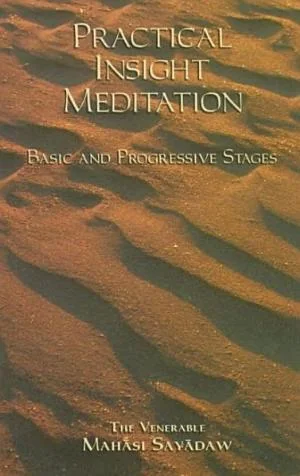
Practical Insight Meditation
 74
74

Practical Insight Meditation
Mahasi Sayadaw's "Practical Insight Meditation" delivers precisely what its title promises: a no-nonsense manual for Vipassanā. The book's strength lies in its directness. Sayadaw, through his translator U Thittila, presents the practice of noting sensations with an almost clinical precision, leaving little room for interpretive meandering. A passage detailing the observation of the abdomen rising and falling, noting 'rising, falling, rising, falling,' exemplifies this straightforwardness. However, for those accustomed to more narrative or psychologically oriented spiritual texts, the relentless focus on moment-to-moment sensation might feel repetitive or even stark. The lack of extensive theoretical exposition, while a virtue for some, could leave others wanting deeper context. It is a guide for doing, not for debating. This is a rigorously practical text for dedicated practitioners.
📝 Description
74
First published in 1991, Mahasi Sayadaw's "Practical Insight Meditation" offers direct instructions for Vipassanā.
This book presents a clear, step-by-step method for cultivating Vipassanā, a core Buddhist insight meditation practice. Mahasi Sayadaw's approach focuses on systematic observation of sensory experience, emphasizing moment-to-moment attention to bodily sensations, feelings, and mental states. The instructions eschew complex philosophical discussion, aiming instead for direct experience of reality's nature. It is suitable for those new to mindfulness meditation as well as experienced practitioners seeking to deepen their understanding and technique. The text appeals to readers who value straightforward guidance grounded in a long monastic lineage, prioritizing practical application over abstract theory.
The 1991 publication arrived as Western interest in Buddhist contemplative practices was growing. Mahasi Sayadaw, a respected Burmese monk, had a significant influence on the global dissemination of intensive meditation retreats. This book became a textual resource for Vipassanā, which was then becoming a focus for both secular and Buddhist mindfulness programs. It offered a contrast to more academic or philosophically oriented Buddhist texts appearing at the time.
Mahasi Sayadaw's teachings stem from the Burmese Theravada tradition, specifically the lineage he developed. This method of Vipassanā emphasizes direct, experiential investigation of phenomena as they arise and pass away. It is a practice aimed at insight into the impermanent, unsatisfactory, and selfless nature of existence, leading to liberation. The book makes these teachings accessible, focusing on the practical application of mindfulness in daily life and formal meditation.
💡 Why Read This Book?
• Gain a direct method for cultivating Vipassanā, as detailed in Mahasi Sayadaw's foundational approach to observing the breath and bodily sensations, which forms the bedrock of his influential meditation technique. • Understand the practice of 'knowing and seeing' (yathābhūtañāṇadassana), a core concept in Buddhist insight, and how observing impermanence through direct experience leads to liberation. • Learn the systematic observation of sensory experience advocated by Mahasi Sayadaw, a method that became widely adopted in Western mindfulness programs following its popularization from the mid-20th century onwards.
⭐ Reader Reviews
Honest opinions from readers who have explored this book.
❓ Frequently Asked Questions
What is the core practice taught in Mahasi Sayadaw's "Practical Insight Meditation"?
The core practice is Vipassanā, or insight meditation, which involves the systematic, moment-to-moment observation of bodily sensations, feelings, and mental phenomena as they arise and pass away, fostering equanimity and understanding of impermanence.
Who was Mahasi Sayadaw and why is his work significant?
Mahasi Sayadaw (1904-1982) was a highly influential Burmese Theravada Buddhist monk who popularized intensive Vipassanā meditation retreats, making the practice accessible to laypeople worldwide and significantly impacting modern mindfulness movements.
When was "Practical Insight Meditation" first published?
The book "Practical Insight Meditation" was first published in 1991, bringing Mahasi Sayadaw's teachings to a broader international audience during a period of growing interest in Buddhist meditation.
Does the book explain the philosophical underpinnings of Vipassanā?
While it touches upon concepts like impermanence and non-self, the book's primary focus is on the practical, experiential aspects of meditation, rather than extensive philosophical discourse.
Is this book suitable for someone completely new to meditation?
Yes, the book is designed for direct instruction and is suitable for beginners seeking a clear, step-by-step guide to establishing a Vipassanā practice, alongside experienced practitioners.
What is the relationship between concentration and insight in this text?
The book presents concentration (samādhi) as a necessary support for developing insight (vipassanā). Stable attention cultivated through practice allows for clearer observation of phenomena.
🔮 Key Themes & Symbolism
Observing Impermanence
The central theme is the direct, experiential realization of anicca (impermanence) through rigorous observation. The text guides the practitioner to witness the constant arising and passing of physical sensations, thoughts, and emotions. By noting these phenomena without judgment, one begins to see their transient nature, undermining clinging and attachment. This is not an intellectual understanding but a felt sense, cultivated through sustained awareness of the body and mind's fluctuating states.
Moment-to-Moment Awareness
The practice hinges on maintaining continuous attention to the present moment. The book emphasizes the importance of noting whatever arises – breath, bodily feelings, sounds, thoughts – as it occurs. This cultivates a state of alert, non-reactive presence. The goal is to train the mind to be aware of the immediate experience, rather than getting lost in past regrets or future anxieties, thereby dissolving habitual patterns of reactivity.
Equanimity in Experience
Cultivating upekkha (equanimity) is crucial. The text instructs practitioners to observe pleasant, unpleasant, and neutral experiences with an even mind. This involves acknowledging sensations or emotions without adding secondary reactions of craving or aversion. By developing this balanced perspective, the meditator learns to respond to life's ups and downs with greater stability and less disturbance, fostering inner peace.
Insight as Liberation
The ultimate aim is liberation (nibbana) through wisdom (paññā). The insight gained from observing impermanence, suffering, and non-self directly dismantles ignorance and the roots of dissatisfaction. The book presents Vipassanā not merely as a relaxation technique but as a profound path to understanding the fundamental nature of existence and freeing oneself from the cycle of suffering.
💬 Memorable Quotes
Direct passages from the work, attributed to the author.
“When the abdomen rises, know that it rises. When it falls, know that it falls.”
— This simple instruction exemplifies the book's directness, urging practitioners to anchor their awareness in the most basic physical sensation of breathing without embellishment or interpretation.
“The practice is to observe the arising and passing of all phenomena.”
— This captures the core of Vipassanā as presented by Sayadaw: a continuous, mindful witnessing of the transient nature of all experiences, both internal and external.
“Concentration is the prerequisite for insight.”
— This highlights the relationship between a stable mind and clear seeing. Developing the ability to focus is essential for the deep observation required to gain true insight into reality.
“See things as they really are.”
— A concise statement of the goal of insight meditation – to perceive reality directly, free from the distortions of personal bias, desire, and aversion.
“Walking meditation involves noting the sensations of lifting, moving, and placing the feet.”
— This illustrates how the principle of noting sensations is applied to different postures and activities, extending mindfulness beyond formal sitting practice.
🌙 Esoteric Significance
Tradition
While rooted in Theravada Buddhism, Mahasi Sayadaw's approach to Vipassanā meditation holds significant esoteric appeal due to its emphasis on direct, unmediated experience of consciousness and reality. Esoteric traditions often seek gnosis – direct knowing – through inner exploration. Sayadaw's method provides a systematic framework for such experiential inquiry, aiming to reveal the fundamental nature of existence beyond conceptual frameworks, aligning with the core esoteric quest for ultimate truth through inner transformation.
Symbolism
The primary 'symbol' is the body itself, observed meticulously. Sensations like the 'rising and falling' of the abdomen are not mere physical events but microcosmic representations of the constant flux of existence (anicca). The process of 'noting' each arising phenomenon can be seen as a form of alchemical 'separation' and 'observation,' breaking down experience into its constituent parts to reveal underlying patterns. The equanimity cultivated acts as a stabilizing 'vessel' for this intense inner work.
Modern Relevance
Mahasi Sayadaw's techniques are foundational to many contemporary mindfulness-based stress reduction (MBSR) programs and secular meditation apps. Thinkers and practitioners like Jack Kornfield and Tara Brach continue to teach and adapt his methods, integrating them into Western psychological and spiritual landscapes. His emphasis on accessible, direct experience continues to resonate with individuals seeking practical tools for mental clarity and emotional regulation in a complex modern world.
👥 Who Should Read This Book
['• Practitioners of Buddhist meditation seeking to deepen their understanding and practice of Vipassanā, particularly those interested in the lineage and methods of Mahasi Sayadaw.', '• Individuals exploring mindfulness techniques for stress reduction and emotional well-being who desire a direct, experiential approach grounded in a traditional path.', '• Students of comparative religion and contemplative studies interested in the practical application of Buddhist meditative disciplines and their historical transmission.']
📜 Historical Context
The 1991 publication of "Practical Insight Meditation" arrived at an important moment for the transmission of Buddhist practices to the West. Mahasi Sayadaw's lineage, established through his influential meditation centers in Burma (now Myanmar), had already begun shaping Western Buddhist thought for decades. His teacher, U Narada, also played a role in disseminating these methods. Sayadaw's approach, characterized by its emphasis on direct, experiential observation of breath and bodily sensations, gained widespread traction, particularly through the work of figures like Joseph Goldstein and Sharon Salzberg, who studied under his guidance. This book offered an authoritative textual resource for the burgeoning Vipassanā movement, which was gaining momentum alongside, and sometimes in dialogue with, secular mindfulness initiatives. It provided a clear counterpoint to more academic Buddhological studies prevalent at the time, focusing instead on the practical application of the Dhamma.
📔 Journal Prompts
The sensation of the abdomen rising and falling: what subtle shifts occur between noting 'rising' and 'falling'?
How does the practice of noting thoughts differ from simply following them?
Reflect on a moment of pleasant sensation and the impulse to prolong it; how does noting alter this reaction?
Consider the concept of 'knowing and seeing' – what challenges arise in applying this to difficult emotions?
The practice of equanimity: how does observing neutral sensations build capacity for difficult ones?
🗂️ Glossary
Vipassanā
Insight meditation; a Buddhist practice focused on developing clear seeing into the nature of reality through mindful observation of phenomena.
Anicca
Impermanence; the Buddhist doctrine that all conditioned phenomena are in a constant state of flux and change.
Samādhi
Concentration; the mental faculty of focused attention, often cultivated as a support for developing wisdom and insight.
Upekkha
Equanimity; a balanced mental state characterized by impartiality and non-reactivity towards pleasant, unpleasant, or neutral experiences.
Yathābhūtañāṇadassana
Knowing and seeing things as they really are; the direct insight into the true nature of reality achieved through meditation.
Dhamma
In Theravada Buddhism, refers to the teachings of the Buddha, the truth, or the phenomena of existence.
Noting
The practice of mentally labeling or acknowledging observed experiences (sensations, thoughts, emotions) as they arise and pass.
This book appears in 1 collection
🔮 Readers Also Liked
Browse all →









From the “Meditation” Collection
View all →







More Free Sacred Texts & Gnosticism Books
View all →