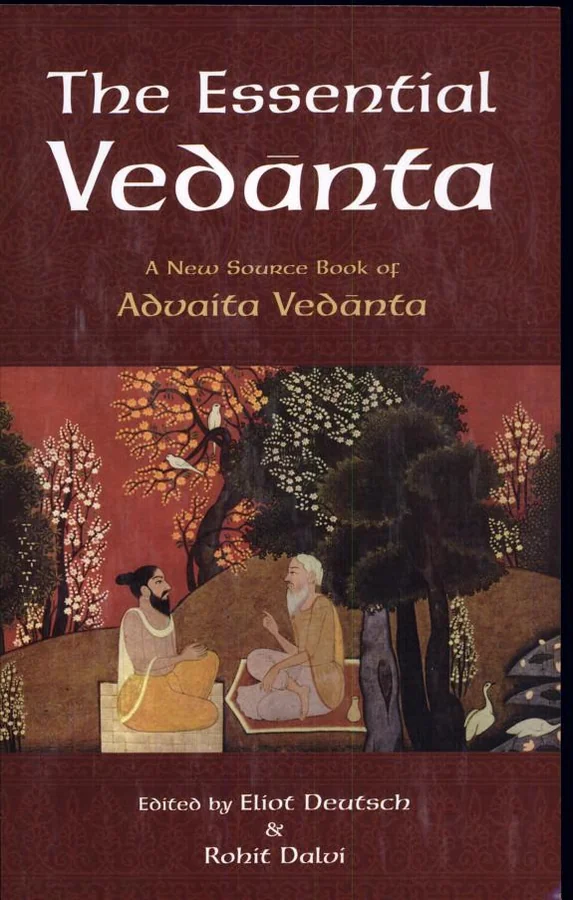
The Essential Vedanta
 72
72

The Essential Vedanta
Deutsch's approach in "The Essential Vedanta" prioritizes clarity, a commendable feat given the subject's inherent profundity. The strength lies in its methodical deconstruction of concepts like Maya, presenting it not as mere deception but as a cosmic principle of concealment and projection. However, the book occasionally feels overly academic, potentially leaving readers unfamiliar with philosophical jargon adrift. The section on the relationship between the empirical self and the Absolute, while informative, could benefit from more illustrative examples beyond abstract reasoning. The work is a solid academic primer, but it lacks the experiential resonance that some readers seek in texts on Indian philosophy. It serves as a reliable map of Advaita Vedanta's conceptual terrain.
📝 Description
72
Eliot Deutsch published 'The Essential Vedanta' in 2004, focusing on Advaita's philosophical core.
Eliot Deutsch's 'The Essential Vedanta' offers a focused introduction to the philosophical underpinnings of Advaita Vedanta, a significant school within Hindu thought. Published initially in 2004, the work distills complex concepts into accessible language. It eschews the devotional aspects often associated with Hinduism to concentrate on the metaphysical framework that posits the fundamental unity of existence. This book is designed for students of Hinduism, scholars of Eastern and Western philosophy, and individuals seeking a clearer comprehension of non-dualist perspectives. It caters to those who want to grasp the core arguments of Vedanta without necessarily engaging in religious practice, appealing to the intellectual seeker. Deutsch's work engages with the long history of Advaita, situating the tradition as a counterpoint to other Hindu philosophical systems and drawing from thinkers like Adi Shankara. The 2004 publication date places it within a period of renewed Western interest in Eastern philosophies.
Emerging within the broad Indian philosophical traditions, Advaita Vedanta has a lineage stretching back over a millennium. This school of thought emphasizes a non-dualistic understanding of reality, asserting the ultimate identity of the individual self (Atman) with the absolute reality (Brahman). It posits that the perceived multiplicity and diversity of the world is an illusion (Maya), and liberation (Moksha) is achieved through the direct realization of this fundamental unity. Deutsch's work engages with this long history and its core assertions.
💡 Why Read This Book?
• Gain a precise understanding of Brahman and Atman as presented in Advaita Vedanta, learning how Deutsch elucidates their identity. • Grasp the concept of Maya, understanding its role not as simple falsehood but as the principle of phenomenal existence, as detailed in the text. • Explore the path to Moksha, identifying the specific philosophical steps Deutsch outlines for liberation from the cycle of rebirth.
⭐ Reader Reviews
Honest opinions from readers who have explored this book.
❓ Frequently Asked Questions
What is Advaita Vedanta and how does Eliot Deutsch explain it?
Advaita Vedanta is a school of Hindu philosophy emphasizing non-duality. Eliot Deutsch explains it as the realization that the individual self (Atman) is identical to the ultimate reality (Brahman), a concept first systematically articulated by Adi Shankara.
When was "The Essential Vedanta" first published?
"The Essential Vedanta" by Eliot Deutsch was first published on August 12, 2004.
What does the term 'Maya' signify in Vedanta, according to this book?
In Vedanta, Maya refers to the cosmic illusion or the principle that conceals the true nature of reality (Brahman) and projects the phenomenal world. Deutsch explores it as the power of manifestation.
Who is Adi Shankara and why is he relevant to Vedanta?
Adi Shankara, a revered philosopher who lived in the 8th century CE, is credited with systematizing and popularizing the Advaita Vedanta school. His commentaries on the Upanishads are foundational to the tradition.
Is this book suitable for complete beginners to Eastern philosophy?
Yes, the book is designed for students of Hinduism and philosophy, aiming to make complex non-dualist thought accessible. It provides a foundational understanding of key Vedantic concepts.
What is the ultimate goal described in Vedanta as presented by Deutsch?
The ultimate goal is Moksha, or liberation. This is achieved through the realization of the non-dual nature of reality, specifically the identity of Atman and Brahman, thereby transcending suffering and the cycle of rebirth.
🔮 Key Themes & Symbolism
The Unity of Brahman and Atman
This theme forms the bedrock of Advaita Vedanta, asserting that the ultimate reality (Brahman) and the individual self (Atman) are not distinct but fundamentally one. Deutsch systematically dismantles the perceived separation, presenting this unity not as a metaphorical connection but as an ontological identity. The work explores how this realization is the key to transcending the illusion of individuality and achieving liberation from the cycle of suffering and rebirth.
The Nature of Maya
Deutsch addresses Maya, often translated as illusion, not as a mere trick of the senses but as the creative power of Brahman that projects the manifold universe we perceive. The book clarifies that Maya is responsible for the appearance of multiplicity and individuality, obscuring the underlying unity of existence. Understanding Maya is crucial for recognizing the phenomenal world as it truly is: a manifestation of the Absolute, not ultimately real in itself.
The Path to Liberation (Moksha)
Central to the book is the exploration of Moksha, the ultimate spiritual goal in Vedanta. Deutsch outlines the philosophical framework that leads to this liberation, emphasizing discriminative knowledge (Viveka) and detachment. The path involves understanding the distinction between the real (Brahman) and the unreal (the phenomenal world and the ego-identity), leading to the direct realization of one's true nature as Atman, which is Brahman.
Advaita's Philosophical Standpoint
The work positions Advaita Vedanta within the broader spectrum of Indian philosophical thought. It highlights Advaita's distinct focus on non-dualism, contrasting it with dualistic schools. Deutsch examines the logical arguments and epistemological foundations supporting the Advaita position, showcasing its rigorous intellectual tradition. The book serves as an introduction to this specific school's metaphysical assertions and its unique approach to understanding existence.
💬 Memorable Quotes
Direct passages from the work, attributed to the author.
“The ultimate truth is that Atman is Brahman.”
— This concise statement expresses the core tenet of Advaita Vedanta. It asserts the identity between the individual soul (Atman) and the absolute, universal consciousness (Brahman), challenging conventional notions of separation.
“Maya veils the true nature of reality.”
— This highlights the concept of Maya as the cosmic principle that conceals the non-dual reality of Brahman, presenting a world of apparent multiplicity and individuality.
“Knowledge of Brahman leads to liberation.”
— This points to the Vedantic emphasis on gnosis as the means to achieve Moksha. The realization of Brahman's true nature is presented as the direct cause of freedom from suffering and rebirth.
“The phenomenal world is not ultimately real.”
— This interpretation of Maya suggests that while the world appears real, its ultimate status is subordinate to the singular reality of Brahman. It encourages a re-evaluation of perceived existence.
“Discrimination between the real and the unreal is key.”
— This refers to Viveka, the intellectual discernment that separates eternal truth (Brahman) from transient phenomena, a critical step in the Vedantic path toward self-realization.
🌙 Esoteric Significance
Tradition
The work engages with the Advaita Vedanta tradition, a school of Hindu philosophy deeply rooted in the Upanishads. While not typically categorized under Western esoteric lineages like Hermeticism or Kabbalah, Advaita's emphasis on direct realization of ultimate reality and its sophisticated metaphysical framework share common ground with esoteric pursuits focused on consciousness and non-duality.
Symbolism
Key symbols explored include 'Brahman,' representing the undifferentiated, absolute reality, often described as Sat-Chit-Ananda (Existence-Consciousness-Bliss). 'Atman' symbolizes the individual self, which Advaita asserts is identical to Brahman. 'Maya' functions symbolically as the veil of illusion that makes the One appear as many, a concept crucial for understanding the perceived world.
Modern Relevance
Contemporary thinkers exploring consciousness studies, non-dual psychology, and comparative mysticism often draw upon Advaita Vedanta. Its principles resonate with modern interpretations of awareness, the nature of self, and the potential for profound shifts in perception, finding echoes in secular mindfulness practices and philosophical explorations of subjective experience.
👥 Who Should Read This Book
• Students of comparative philosophy seeking to understand a foundational non-dualistic system within Hinduism. • Intellectual seekers interested in metaphysical explorations of reality, self, and consciousness, independent of religious dogma. • Scholars of Indian religious traditions looking for a clear, focused exposition of Advaita Vedanta's core tenets.
📜 Historical Context
Eliot Deutsch's "The Essential Vedanta" arrives in 2004, contributing to a long-standing Western engagement with Indian philosophical traditions that gained momentum in the mid-20th century. Advaita Vedanta, with its roots in the Upanishads and systematized by figures like Adi Shankara in the 8th century CE, represents a significant strand of Hindu thought distinct from devotional Bhakti movements or the dualistic philosophies. The book enters a discourse where scholars like Sarvepalli Radhakrishnan had already provided foundational introductions to Indian philosophy for Western audiences decades earlier. Deutsch's work aims for a focused explication of Advaita's non-dual metaphysics, engaging with the intellectual currents that seek to understand Eastern thought through philosophical analysis rather than purely religious or cultural lenses.
📔 Journal Prompts
The concept of Maya and its role in everyday perception.
Atman's identity with Brahman: implications for self-understanding.
The practical application of Viveka in distinguishing the real from the unreal.
The ultimate goal of Moksha as presented in the text.
Brahman as the sole existent reality.
🗂️ Glossary
Advaita Vedanta
A school of Hindu philosophy characterized by its non-dualistic perspective, asserting the oneness of the individual self (Atman) and the ultimate reality (Brahman).
Brahman
The ultimate, unchanging reality or cosmic consciousness that underlies all existence in Hindu philosophy. It is considered infinite, eternal, and formless.
Atman
The individual self or soul. In Advaita Vedanta, Atman is understood to be identical with Brahman.
Maya
A Sanskrit term often translated as illusion, cosmic play, or the power that conceals the true nature of reality (Brahman) and projects the phenomenal world.
Moksha
Liberation or release from the cycle of birth, death, and rebirth (samsara). It is the ultimate spiritual goal in many Indian religions.
Viveka
Discrimination or discernment, particularly the ability to distinguish between the eternal (Atman/Brahman) and the non-eternal (the phenomenal world).
Upanishads
Ancient Sanskrit texts that form the theoretical basis for Hinduism, containing key philosophical concepts like Brahman and Atman.