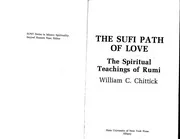
Sufi Path Of Love
 77
77

Sufi Path Of Love



Marcus Thorne (Esoteric Sciences Reviewer) — William Chittick's 'Sufi Path of Love' is an indispensable key for unlocking the profound mystical currents within Islam. This volume transcends mere academic exposition, offering a deeply resonant exploration of Sufi cosmology and the spiritual path, grounded in Rumi's timeless wisdom. Chittick's translations are both precise and poetic, capturing the soul of Rumi's message. It masterfully deciphers the complex doctrines of divine unity, human potential, and the stages of the spiritual journey, presenting them with remarkable clarity. For scholars, practitioners, and anyone seeking direct experience of the Divine, this work is a vital, illuminating guide, revealing the esoteric heart of a revered tradition.
📝 Description
77
William Chittick's 1983 translation makes Rumi's esoteric teachings on divine love accessible in English.
This book presents the teachings of the 13th-century Persian poet Rumi, focusing on the mystical dimension of Islam known as Sufism. William Chittick's translation and commentary aim to clarify Rumi's complex ideas for an English-speaking audience. The text covers Rumi's views on God, the universe, humanity's place within creation, and the path to spiritual fulfillment.
It examines how Rumi used poetry as a means to express spiritual truths that go beyond everyday understanding. The book is intended for those interested in exploring the concept of the unseen and the transformative nature of divine love, as articulated by a major figure in mystical thought. The writing encourages reflection on existence and the soul's connection to the divine.
This work belongs to the tradition of Sufism, the mystical branch of Islam. Sufism seeks direct experience of God and often employs poetry, music, and meditation to achieve spiritual union. Rumi, a central figure in this tradition, articulated a path of love that emphasizes ecstatic devotion and the dissolution of the ego in the divine. The book's focus on the 'unseen' realities and the soul's 'homecoming' aligns with core Sufi concepts of gnosis (ma'rifa) and annihilation (fana).
💡 Why Read This Book?
This book is essential for anyone drawn to the mystical traditions of the East. It provides an accessible yet profound introduction to Sufism and the teachings of Rumi, demystifying complex spiritual concepts. Ideal for seekers of divine love, scholars of comparative religion, and practitioners of contemplative prayer looking to deepen their understanding of the soul's journey and the symbolic language of the sacred.
⭐ Reader Reviews
Honest opinions from readers who have explored this book.
❓ Frequently Asked Questions
Who is Rumi and why is he significant in Sufism?
Jalāl al-Dīn Muḥammad Rūmī was a 13th-century Persian poet, Islamic scholar, and Sufi mystic. He is considered one of the greatest mystical poets in the Islamic world, revered for his profound insights into divine love, spiritual union, and the human soul's journey.
What does 'Sufism' refer to?
Sufism is the mystical dimension of Islam, focused on direct, personal experience of God. It emphasizes introspection, asceticism, and the purification of the heart to achieve spiritual union with the Divine.
What kind of doctrines are covered in this book?
The book surveys core Sufi and Islamic doctrines concerning the nature of God and the universe, humanity's place within creation, the necessity of religious practice, the process of spiritual becoming, and the stages of mystical ascent.
What is the role of literature and symbolism in Sufism?
Sufis often use literature, particularly poetry, as a vehicle to express profound spiritual truths and 'unseen' realities that are difficult to articulate directly. Symbolism is crucial for conveying these esoteric concepts.
Is this book suitable for beginners in Sufism?
Yes, 'Sufi Path of Love' is described as one of the most accessible works in English on Rumi and Sufism, making it an excellent starting point for those new to these teachings.
🔮 Key Themes & Symbolism
The Divine Beloved and the Lover's Journey
At the core of Sufi mysticism lies the concept of the Divine Beloved, often embodied in God or the ultimate reality. The Sufi path is essentially the journey of the soul, the 'lover,' yearning for union with this Beloved. This theme explores the passionate, devotional aspect of Sufism, where love is the primary catalyst for spiritual transformation. It examines the longing, the surrender, and the ecstatic states experienced by the mystic as they draw closer to the Divine presence, using Rumi's evocative poetry to illustrate the intensity and beauty of this sacred relationship.
The Symbolism of Unseen Realities
Sufism frequently employs detailed symbolism to convey truths that transcend ordinary language and perception. This theme examines how Rumi and other Sufi masters utilize metaphors, allegories, and poetic imagery to describe the subtle dimensions of existence, the nature of the soul, and the stages of spiritual realization. The book highlights the art of 'unveiling' these hidden meanings, showing how literature becomes a sacred map for reading through the inner landscape and understanding the profound connections between the material and the spiritual realms, revealing that the ordinary world is imbued with divine significance.
The Cosmic Role of Man and Spiritual Becoming
This theme explores the profound Sufi understanding of humanity's place within the grand collection of the cosmos. It posits that humans are not merely physical beings but possess a divine spark, capable of reflecting the Divine attributes and achieving spiritual perfection. The book examines the concept of 'spiritual becoming'—the transformative process of shedding the ego and cultivating virtues to realize one's true, God-like potential. This journey involves understanding the innate need for religion as a guiding force and the stages of ascent towards ultimate spiritual union, emphasizing the inherent divinity within each soul.
💬 Memorable Quotes
Direct passages from the work, attributed to the author.
“The wound is the place where the Light enters you.”
— This profound statement suggests that suffering and hardship are not mere obstacles but often the very conduits through which spiritual illumination and deeper understanding enter the soul.
“I am not a drop in the ocean. I am the entire ocean in a drop.”
— A powerful expression of the Sufi concept of unity (wahdat al-wujud), illustrating the interconnectedness of all beings and the divine essence present within every individual, mirroring the totality of existence.
“Out beyond ideas of wrongdoing and rightdoing, there is a field. I'll meet you there.”
— This suggests a field of pure consciousness and divine presence that exists beyond the limitations of human judgment and dualistic thinking, a space of ultimate spiritual unity and acceptance.
“Silence is the language of the Soul.”
— This highlights the Sufi practice of contemplative silence as a means to directly commune with the Divine, where true wisdom and inner knowing are revealed beyond the noise of the intellect.
💡 Key Ideas
Editorial paraphrase of the work's core concepts — not direct quotes.
Love is the religion of God, and all religions are branches of that tree.
This quote captures the Sufi emphasis on love as the universal essence of spirituality, transcending dogma and ritual to reveal the underlying unity of all sincere quests for the Divine.
🌙 Esoteric Significance
Tradition
This work is deeply rooted in the esoteric tradition of Sufism, the mystical dimension of Islam. Sufism is characterized by its emphasis on the direct experience of God, the purification of the heart, and the journey towards spiritual union. It utilizes contemplative practices, devotional poetry, and symbolic interpretations of the Quran and Islamic teachings to guide seekers on the path of inner transformation and divine knowledge.
Symbolism
The text is rich with esoteric symbolism, drawing from Rumi's poetry and Sufi allegories. Key symbols include the Beloved (God), the Lover (the soul), wine (divine intoxication), the tavern (the spiritual gathering place), the reed flute (separation from the Divine source), and the sun (Divine manifestation). These symbols are not mere literary devices but represent profound spiritual states, cosmic principles, and the intricate stages of the mystical ascent towards ultimate realization.
Modern Relevance
In an age often marked by materialism and spiritual seeking, 'Sufi Path of Love' offers a timeless wisdom that resonates deeply. It provides a profound exploration of universal themes like love, longing, and the search for meaning, transcending religious boundaries. The emphasis on inner transformation, the power of symbolism, and the direct experience of the Divine offers a potent antidote to spiritual alienation, guiding modern seekers towards a more contemplative and integrated understanding of life and their place within it.
👥 Who Should Read This Book
This book is a vital resource for a diverse range of readers. **Beginners** seeking an accessible entry into Islamic mysticism will find it clear, explaining complex concepts with clarity. **Scholars of religion and comparative mysticism** will appreciate the depth of analysis and the nuanced translations of Rumi's work. **Spiritual seekers** yearning for a deeper connection with the Divine and an understanding of the path of love will find profound inspiration and guidance. **Practitioners of contemplative disciplines** will discover valuable insights into the nature of spiritual ascent, the role of symbolism, and the transformative power of devotional practice.
📜 Historical Context
The era in which Rumi lived and wrote (13th century Persia) was a period of immense intellectual and spiritual ferment within the Islamic world, following the Mongol invasions. Sufism, as the mystical heart of Islam, offered solace, meaning, and a path of inner transformation. Rumi, a prolific poet and spiritual master, emerged as a central figure, articulating the profound yearning for Divine union through his captivating verse. His teachings, and those of his order, the Mevlevi (Whirling Dervishes), provided a spiritual anchor for many. This period saw a flourishing of Islamic philosophy, theology, and mysticism, with Rumi's work representing a pinnacle of spiritual expression, influencing countless scholars, mystics, and artists across centuries and cultures, shaping the trajectory of esoteric thought.
📔 Journal Prompts
Reflect on a time when you experienced a profound sense of 'divine love' or connection. What were the circumstances, and how did it feel?
Consider the concept of 'the wound as the place where light enters.' How have your own challenges or 'wounds' led to personal growth or spiritual insight?
Explore the idea of the soul as a 'drop in the ocean.' How does this perspective shift your understanding of your own identity and connection to the universe?
What 'unseen realities' do you believe are present in your everyday life, and how might symbolism help you perceive them more clearly?
Write about your personal 'journey of becoming.' What aspects of yourself are you seeking to transform or realize on your spiritual path?
🗂️ Glossary
Sufism
The mystical dimension of Islam, focusing on the direct experience of God, inner purification, and the pursuit of spiritual union through love and devotion.
Rumi
Jalāl al-Dīn Muḥammad Rūmī (1207–1273), a 13th-century Persian poet, Islamic scholar, and Sufi mystic, renowned for his profound spiritual poetry and teachings on divine love.
Wahdat al-wujud
A central Sufi concept often translated as 'unity of being' or 'oneness of existence,' suggesting that all reality is ultimately a manifestation of God.
Dhikr
The remembrance of God, a Sufi practice involving the repetition of divine names or phrases, often accompanied by chanting or movement, to achieve spiritual states.
Fana
A Sufi term meaning 'annihilation' or 'dissolution' of the ego in the Divine presence, a state of profound spiritual union where the individual self is extinguished in God.
This book appears in 2 collections
🔮 Readers Also Liked
Browse all →




From the “Christian Mysticism” Collection
View all →







More Free Mysticism & Contemplation Books
View all →