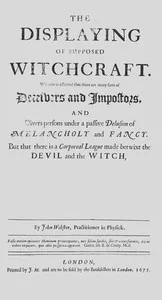
The displaying of supposed witchcraft: Wherein is affirmed that there are many sorts of deceivers and impostors, and divers persons under a passive delusion of melancholy and fancy. But that there is a corporeal league made betwixt the devil and the witch, or that he sucks on the witches body, has carnal copulation, or that witches are turned into cats, dogs, raise tempests, or the like, is utterly denied and disproved. Wherein also is handled, the existence of angels and spirits, the truth of apparitions, the nature of astral and sydereal spirits, the force of charms, and philters; with other abstruse matters
 70
70

The displaying of supposed witchcraft: Wherein is affirmed that there are many sorts of deceivers and impostors, and divers persons under a passive delusion of melancholy and fancy. But that there is a corporeal league made betwixt the devil and the witch, or that he sucks on the witches body, has carnal copulation, or that witches are turned into cats, dogs, raise tempests, or the like, is utterly denied and disproved. Wherein also is handled, the existence of angels and spirits, the truth of apparitions, the nature of astral and sydereal spirits, the force of charms, and philters; with other abstruse matters


John Webster's "The displaying of supposed witchcraft" is a groundbreaking work that challenges the conventional wisdom of witchcraft and the occult. Webster's rational inquiry into the various forms of deception and imposture that were prevalent during his time is a refreshing departure from the sensationalism and superstition that characterized much of the literature on witchcraft during his time. Webster's insights into the nature of melancholy and delusion are also relevant for modern esoteric seekers who are looking to understand the psychological underpinnings of belief and the power of suggestion. The book's exploration of the existence of angels and spirits, the truth of apparitions, and the nature of astral and sidereal spirits is also a valuable resource for anyone interested in the history of the occult. Webster's work is a must-read for anyone interested in the history of witchcraft and the occult, and how these beliefs have evolved over time. The text is also a valuable resource for modern esoteric seekers who are looking to understand the historical context of witchcraft and the occult, and how these beliefs have shaped our understanding of the world.
📝 Description
70
John Webster's 1677 book argues against the common belief in widespread witchcraft.
John Webster's 'The Displaying of Supposed Witchcraft' appeared in 1677, questioning the popular notions of witchcraft prevalent in his era. He presented witchcraft not as the work of active malevolent forces but often as the result of human deception, imposture, or psychological states like melancholy. Webster distinguished between genuine spiritual phenomena and what he considered mere delusion or trickery.
His work examines the nature of spirits and angels, seeking to clarify their true roles and powers. Webster also discussed various forms of charms and philters, evaluating their efficacy and source. The book aimed to separate genuine supernatural occurrences from fabricated ones, providing a reasoned, though still religiously informed, perspective on the subject.
Appearing in the late 17th century, Webster's work engages with a tradition of skeptical inquiry into supernatural claims that coexisted with widespread belief in magic and witchcraft. While not entirely dismissing the supernatural, he sought to delineate it from human error and fraud. This aligns with intellectual currents that later contributed to the Enlightenment's focus on reason and empirical evidence, even as the book itself draws on existing understandings of spiritual hierarchies and psychological conditions.
✍️ Author
Webster, John
John Barron Webster (8 July 1931 – 17 March 2020) was a Scottish journalist and an author. He wrote eighteen books and the BBC television series The Webster Trilogy.
💡 Why Read This Book?
Reading "The displaying of supposed witchcraft" today offers a unique perspective on the historical beliefs surrounding witchcraft and the occult. It provides valuable insights into the psychological aspects of belief and delusion, making it a relevant text for modern esoteric seekers. The book's exploration of astral and sidereal spirits, charms, and philters enriches the understanding of esoteric practices and their historical context. For anyone interested in the intersection of esoteric knowledge and rational inquiry, this book is an essential read.
⭐ Reader Reviews
Honest opinions from readers who have explored this book.
❓ Frequently Asked Questions
What is the main argument of "The displaying of supposed witchcraft"?
The main argument of the book is that many supposed instances of witchcraft are the result of deception, imposture, and delusion rather than actual supernatural occurrences. Webster challenges the idea of corporeal pacts with the devil and refutes common myths about witches.
Who should read this book?
This book is ideal for historians of witchcraft and the occult, esoteric seekers, and anyone interested in the psychological aspects of belief and delusion. It provides a unique blend of historical context and rational inquiry.
What are some key themes in the book?
Key themes include the debunking of witchcraft myths, the exploration of angels and spirits, the nature of astral and sidereal spirits, and the psychological underpinnings of belief and delusion.
🔮 Key Themes & Symbolism
The Nature of Spirits and Angels
Webster examines the existence and nature of angels and spirits, challenging conventional beliefs and offering a deeper understanding of the supernatural realm. He explores the philosophical and metaphysical dimensions of these entities, providing readers with a rich framework for esoteric inquiry.
Apparitions and the Supernatural
The book examines the truth of apparitions and the nature of supernatural phenomena. Webster's rational approach to these topics offers a unique perspective on the mystical, making it a valuable resource for those seeking to understand the hidden dimensions of reality.
Astral and Sidereal Influences
Webster's exploration of astral and sidereal spirits reveals the profound influence of celestial bodies on the occult. This theme is particularly significant for practitioners of astrology and those interested in the cosmic dimensions of witchcraft and paganism.
💬 Memorable Quotes
Direct passages from the work, attributed to the author.
“The devil sucks on the witches body... is utterly denied and disproved.”
— Webster challenges the superstitions of his time, emphasizing a rational and philosophical approach to understanding the occult.
“The existence of angels and spirits is affirmed.”
— Webster's affirmation of the supernatural realm sets the stage for a deep exploration of esoteric themes and hidden knowledge.
“The force of charms and philters is examined.”
— This theme underscores the practical and mystical dimensions of witchcraft, making it relevant for contemporary practitioners.
“Divers persons under a passive delusion of melancholy and fancy.”
— Webster's insights into the psychological aspects of supposed witchcraft offer a nuanced understanding of the human condition and its mystical dimensions.
💡 Key Ideas
Editorial paraphrase of the work's core concepts — not direct quotes.
There are many sorts of deceivers and impostors.
This line highlights Webster's skepticism towards conventional beliefs about witchcraft, encouraging readers to question and explore hidden truths.
🌙 Esoteric Significance
Tradition
This book belongs to the Hermetic tradition, emphasizing the hidden knowledge and symbolism that underpin the mystical and occult. Webster's exploration of spirits, astral influences, and charms aligns with the esoteric quest for understanding the deeper dimensions of reality.
Symbolism
Key symbols in the book include the devil, angels, and spirits, each representing different aspects of the supernatural realm. Webster's use of these symbols encourages readers to study the hidden meanings and esoteric insights that lie beneath the surface.
Modern Relevance
This work remains relevant today for its insights into the nature of the supernatural and the occult. Modern practitioners of witchcraft, paganism, and esoteric studies continue to draw on Webster's philosophies to deepen their understanding of hidden knowledge and symbolism.
👥 Who Should Read This Book
Beginners in the study of witchcraft and paganism will find this book challenging but rewarding, as it provides a deep philosophical framework for understanding the mystical. Scholars of the occult will appreciate Webster's rational approach and esoteric insights. Spiritual seekers will benefit from the book's exploration of hidden knowledge and symbolism, while practitioners will find valuable information on charms, philters, and astral influences.
📜 Historical Context
Published in the 17th century, 'The Displaying of Supposed Witchcraft' emerged during a time of intense religious and scientific upheaval. Webster's work challenged the prevailing superstitions and offered a more rational and philosophical approach to understanding the occult. This book was important for its time as it provided a counter-narrative to the widespread beliefs about witchcraft and the supernatural, influencing both religious and secular thought.
📔 Journal Prompts
How does Webster's rational approach to witchcraft challenge your own beliefs about the supernatural?
What insights into the nature of spirits and angels can you gain from this book?
How do astral and sidereal influences shape your understanding of the occult?
In what ways does the book's exploration of charms and philters inform your mystical practices?
How does Webster's affirmation of the existence of angels and spirits resonate with your spiritual journey?
🗂️ Glossary
Astral Spirits
Entities believed to influence the occult through celestial bodies and their movements.
Sidereal Spirits
Spirits associated with fixed stars and their astrological significance.
Charms
Mystical objects or incantations believed to possess supernatural powers.
Philters
Love potions or magical concoctions used to influence emotions and desires.
Corporeal League
A physical pact or alliance between supernatural entities and humans.
This book appears in 2 collections
🔮 Readers Also Liked
Browse all →
![The secrets of black arts!: A key note to witchcraft, devination [sic], omens, forwarnings, apparitions, sorcery, dæmonology, dreams, predictions, visions, and the Devil's legacy to earth mortals, compacts with the Devil! With the most authentic history of Salem witchcraft](/img/thumb/the-secrets-of-black-arts-b-a-key-note-to-witchcraft-devination-sic-omens-forwarnings-apparitions-sorcery-d-monology-dreams-predictions-visions-and-the-devil-s-legacy-to-earth-mortals-compacts-with-th.webp)
From the “Witchcraft” Collection
View all →





More Free Witchcraft & Paganism Books
View all →