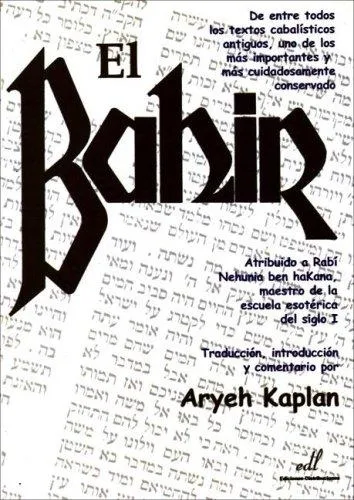
The Bahir
 74
74

The Bahir
Kaplan's 1989 translation and commentary on the Bahir offers a crucial entry point into one of Kabbalah's most enigmatic early texts. The strength lies in Kaplan's extensive knowledge of Jewish mysticism, which illuminates the dense symbolic language and historical context for the modern reader. His annotations provide essential scaffolding for navigating the book’s esoteric pronouncements. However, the Bahir itself, by its very nature, resists easy comprehension. Kaplan’s rendition, while scholarly, cannot fully dispel the inherent obscurity. A particular passage discussing the divine chariot through the lens of colors and forms, while fascinating, exemplifies the text’s demanding, allegorical style. The Bahir, through Kaplan's efforts, remains a challenging but rewarding exploration of nascent Kabbalistic ideas. It is an indispensable resource for understanding the roots of Jewish mystical thought.
📝 Description
74
First published in English by Aryeh Kaplan in 1989, The Bahir is an early Kabbalistic text.
The Bahir, likely written in Provence around the turn of the 13th century, is not a systematic theological work but a collection of mystical interpretations and allegories. Its enigmatic style and symbolic discussions illuminate the early stages of Kabbalah. It predates the Zohar, offering insight into the intellectual world of medieval Jewish mysticism. The text's origins and exact authorship are subjects of ongoing study.
This work is intended for individuals seriously engaged with Kabbalah and esoteric traditions. Its dense symbolism and cryptic nature might challenge readers looking for straightforward historical accounts or devotional material. A background in Jewish mystical philosophy or a strong interest in its historical development is beneficial for appreciating its abstract content.
The Bahir uses rich imagery to discuss theological ideas. Key concepts include the Sefirot, divine emanations often represented by colors and forms, and the different worlds of creation, known as Olamot. The text also touches upon reincarnation, referred to as gilgul neshamot, and other mystical themes.
Emerging in 12th or 13th century France, The Bahir is a formative document in Jewish mysticism, or Kabbalah. It represents an early expression of concepts that would later be elaborated in more extensive works like the Zohar. The text's focus on divine emanations and symbolic language provides a window into the development of medieval Jewish esoteric thought. Its mysterious origins and authorship have contributed to its reputation as a text of ancient wisdom, crucial for understanding the initial phases of Kabbalistic conceptualization.
💡 Why Read This Book?
• Learn about the early Kabbalistic concept of the Sefirot, exploring their symbolic representation through colors and forms as described in the Bahir, offering a foundational understanding of divine emanation. • Understand the historical emergence of Kabbalah in 12th-century Provence, France, by examining the Bahir's position as a precursor to later, more widely known Kabbalistic works like the Zohar. • Gain insight into early discussions of reincarnation (*gilgul neshamot*) and the mystical significance of Hebrew letters, concepts that became central to Jewish esoteric traditions, as presented in the Bahir.
⭐ Reader Reviews
Honest opinions from readers who have explored this book.
❓ Frequently Asked Questions
What is the primary focus of Aryeh Kaplan's English translation of The Bahir?
Aryeh Kaplan's 1989 translation focuses on making the early Kabbalistic text accessible to an English-speaking audience, providing extensive commentary and annotations to clarify its complex symbolism and theological concepts.
When and where did The Bahir likely originate?
The Bahir is believed to have originated in Provence, France, during the late 12th or early 13th century, making it one of the earliest significant works of Kabbalistic literature.
What are some key esoteric concepts discussed in The Bahir?
Key concepts include the Sefirot (divine emanations), Olamot (worlds), gilgul neshamot (reincarnation of souls), and the mystical properties of Hebrew letters and divine names.
Is The Bahir considered a difficult text to understand?
Yes, The Bahir is known for its enigmatic, allegorical, and often cryptic style, making it a challenging text that requires careful study and often relies on expert commentary for interpretation.
What role does The Bahir play in the history of Kabbalah?
The Bahir is a foundational text that predates the Zohar, offering crucial insights into the early development of Kabbalistic thought, its symbolic language, and its core theological ideas.
Who is Aryeh Kaplan and why is his translation important?
Aryeh Kaplan (1934-1995) was a prolific scholar and translator of Jewish mystical texts. His translation of The Bahir is significant for its scholarly approach and detailed explanations, making this ancient text available to a wider audience.
🔮 Key Themes & Symbolism
The Sefirot as Divine Emanations
The Bahir presents a complex and early conceptualization of the Sefirot, the ten divine attributes or emanations through which God interacts with creation. Unlike later, more structured Kabbalistic diagrams, the Bahir discusses them through a body of metaphors, often linking them to colors, celestial bodies, and specific scriptural interpretations. It explores how these emanations function as channels of divine energy, shaping the reality of the cosmos and the spiritual lives of beings. Understanding these early formulations is key to tracing the development of Kabbalistic cosmology and its symbolic language.
Symbolic Interpretation of Scripture
A core method within The Bahir is its highly symbolic interpretation of the Hebrew Bible. It moves beyond literal readings to uncover deeper, mystical meanings embedded within the text, particularly focusing on the significance of individual Hebrew letters, words, and grammatical structures. The book uses allegorical narratives and midrashic techniques to reveal hidden layers of divine wisdom. This approach highlights how early Kabbalists saw scripture not just as a historical record but as a living, dynamic code containing the secrets of creation and divine revelation.
Reincarnation and the Soul's Journey
The Bahir is notable for its early explicit discussion of *gilgul neshamot*, the concept of the transmigration or reincarnation of souls. This theme suggests a belief in a cyclical process of spiritual purification and evolution, where souls return to the physical world to complete their spiritual development or rectify past transgressions. This doctrine, presented within the context of divine justice and mercy, offers a unique perspective on the soul's destiny and its ongoing relationship with the divine, diverging from simpler notions of linear afterlife progression.
The Nature of Divine Names
The text places significant emphasis on the power and mystery inherent in the various divine names mentioned in the Hebrew Bible. It suggests that these names are not mere labels but potent conduits of divine energy and revelation. The Bahir explores how understanding and contemplating these names can lead to spiritual illumination and a deeper connection with the divine. This focus underscores the importance of sacred language in Kabbalistic practice and theory, viewing Hebrew letters and words as fundamental building blocks of reality.
💬 Memorable Quotes
Direct passages from the work, attributed to the author.
“The Bahir interprets the divine name as a ladder.”
— This metaphorical statement suggests that the divine names are not static entities but represent a pathway or process for ascending towards a greater understanding or connection with the divine essence.
“The text likens the Sefirot to colors.”
— This points to the symbolic representation of divine emanations through color, implying that each Sefirah possesses a unique energetic quality or aspect that can be perceived or understood through chromatic symbolism.
“It discusses the soul's return to the world.”
— This refers to the concept of reincarnation (*gilgul neshamot*), suggesting that souls may undergo multiple lifetimes to achieve spiritual completion or atonement, a key doctrine within early Kabbalistic thought.
“The Bahir emphasizes the mystical significance of Hebrew letters.”
— This highlights the belief that the Hebrew alphabet is not merely a system of communication but a fundamental code containing divine secrets and the building blocks of creation itself.
“The work allegorizes creation through natural phenomena.”
— This indicates that The Bahir employs symbolic narratives drawn from the natural world to explain complex theological and cosmological concepts, making abstract ideas more tangible through metaphor.
🌙 Esoteric Significance
Tradition
The Bahir is a cornerstone text of early Kabbalah, a lineage within Jewish mysticism. It predates the more widely known Zohar and provides foundational concepts that shaped subsequent Kabbalistic cosmology and theology. While rooted in Jewish tradition, its Neoplatonic influences and symbolic depth also connect it to broader esoteric currents of the medieval period, offering a unique bridge between different mystical frameworks.
Symbolism
Key symbols include the *Sefirot*, often depicted through colors and natural phenomena, representing divine attributes and creative forces. The Hebrew alphabet is also central, viewed not just as letters but as potent carriers of divine energy and secrets of creation. The Bahir uses allegorical figures and narratives, such as the divine chariot interpreted through symbolic imagery, to convey complex mystical truths about God and the universe.
Modern Relevance
Contemporary Kabbalistic practitioners and scholars continue to study The Bahir for its foundational insights into divine emanations, the nature of the soul, and esoteric scriptural interpretation. Its influence can be seen in modern esoteric schools that draw from Kabbalistic principles, as well as in academic studies of mysticism and comparative religion seeking to understand the origins and evolution of esoteric thought.
👥 Who Should Read This Book
• Students of Kabbalah seeking to understand its earliest textual roots and conceptual development, moving beyond later, more codified systems. • Scholars of comparative religion and mysticism interested in the cross-pollination of ideas in medieval Europe, particularly Jewish esoteric traditions. • Practitioners of esoteric disciplines who wish to explore the symbolic language and cosmological frameworks that underpin many Western mystical practices.
📜 Historical Context
The Bahir, emerging from the vibrant intellectual field of medieval Provence around the late 12th or early 13th century, represents an important early stage in the development of Kabbalah. This period saw a flourishing of Jewish philosophical and mystical inquiry, influenced by Neoplatonism and Gnosticism, as well as a renewed interest in ancient esoteric traditions. While Maimonides’ rationalist philosophy dominated much of Jewish intellectual life, texts like the Bahir signaled a powerful counter-current, prioritizing mystical experience and symbolic interpretation. Its cryptic style and focus on divine emanations (Sefirot) and esoteric interpretations of scripture set it apart from mainstream theological discourse. Its reception was initially limited, but its ideas gradually permeated Kabbalistic circles, influencing later major works such as the Zohar. Scholars like Gershom Scholem later identified its significance in tracing the lineage of Kabbalistic thought.
📔 Journal Prompts
The concept of the Sefirot as divine emanations, as presented through color and form in The Bahir.
Reflect on the symbolic interpretations of Hebrew letters and their role in creation, as explored in The Bahir.
Consider the implications of *gilgul neshamot* (soul reincarnation) for personal spiritual development.
Analyze the allegorical method used in The Bahir to convey mystical truths.
Explore the significance of divine names as pathways to spiritual connection.
🗂️ Glossary
Sefirot
The ten divine attributes or emanations through which God creates and sustains the universe. In The Bahir, they are often described symbolically using colors and natural imagery.
Gilgul Neshamot
A Hebrew term referring to the transmigration or reincarnation of souls. The Bahir is one of the earliest texts to explicitly discuss this concept within a Kabbalistic framework.
Olamot
Hebrew for 'worlds.' In Kabbalah, it refers to the different realms or planes of existence, often associated with the Sefirot and the stages of divine emanation.
Midrash
A method of biblical interpretation in Judaism that seeks to uncover hidden meanings and ethical lessons within the sacred text, often through allegorical or narrative expansion.
Kabbalah
The esoteric and mystical tradition within Judaism, focused on understanding the divine nature, creation, and the relationship between God and humanity through symbolic interpretation and contemplative practices.
Provence
A historical region in southeastern France where significant early Kabbalistic texts, including The Bahir, are believed to have originated in the late 12th and early 13th centuries.
Neoplatonism
A philosophical system derived from Plato's teachings, emphasizing a transcendent, ultimate reality (the One) from which all existence emanates. It significantly influenced early Kabbalistic thought.
🔮 Readers Also Liked
Browse all →







More by Aryeh Kaplan
All books →




More Free Kabbalah & Jewish Mysticism Books
View all →