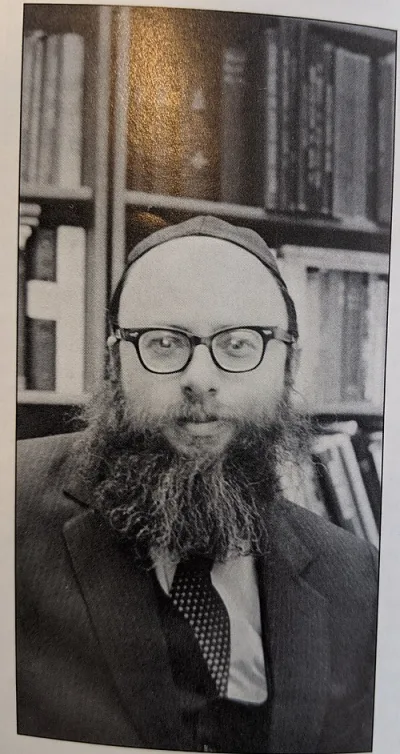
Aryeh Kaplan
Aryeh Kaplan was an Orthodox rabbi and prolific author known for his accessible translations and commentaries on Jewish texts, particularly Kabbalah.
Aryeh Kaplan, born Leonard Martin Kaplan, was an American Orthodox rabbi, author, and translator (1934-1983) renowned for his extensive Kabbalistic commentaries and his edition of the Torah titled "The Living Torah." He was recognized as an original thinker whose numerous writings, including introductory texts on Jewish beliefs and philosophy, significantly contributed to the growth of the baal teshuva movement. Kaplan's early life in the Bronx was marked by a non-religious upbringing and a period of being a "street kid" after his mother's death. His path to religious observance began when he was befriended by a young Hasid, leading him to study Hebrew and Jewish texts, eventually enrolling in yeshivas and receiving rabbinic ordination in Israel.
Kaplan pursued a secular career in physics, earning degrees and working as a research scientist. However, he felt a divine calling and transitioned to a rabbinic career in 1965. His rabbinate included pulpit roles in various Conservative synagogues before he moved to Brooklyn in 1971, where he focused on writing and editing religious publications. He also served as a chaplain and spiritual advisor, notably for NCSY, where his ability to explain complex Jewish concepts simply made him a popular mentor. His literary output spanned diverse topics, integrating scientific understanding with traditional Jewish mysticism, and was characterized by its detailed, systematic approach.
Early Life and Spiritual Awakening
Born Leonard Martin Kaplan in New York City, Aryeh Kaplan's early life was not religiously observant. His mother passed away when he was thirteen, an event that led him to say Kaddish and brought him into contact with a young Hasid named Henoch Rosenberg. This encounter sparked an interest in Judaism, leading to lessons in Hebrew and Torah study. By fifteen, he was studying at Yeshiva Torah Vodaas, and at eighteen, he assisted in establishing Yeshiva Ohr Elchonon in Los Angeles. After brief teaching positions, he traveled to Israel in 1956 to study at the Mir Yeshiva in Jerusalem, where he received rabbinic ordination from prominent rabbis.
Secular Studies and Transition to Rabbinate
Upon returning to the United States in 1956, Kaplan worked as a Hebrew teacher and pursued a bachelor's degree in physics at the University of Louisville, graduating in 1961. He married Tobie Goldstein that same year and they had nine children. He then moved to Maryland to pursue graduate studies in physics at the University of Maryland, earning an M.S. and working as a research scientist at the National Bureau of Standards, focusing on magnetohydrodynamics. In 1965, Kaplan felt a calling to the rabbinate, stating "God had a mission for me," and left his scientific career to dedicate himself to religious work.
Rabbinic Career and Literary Contributions
Kaplan's rabbinic career began with pulpit positions in Conservative synagogues in Iowa, Tennessee, and New Jersey between 1965 and 1969. He then moved to Brooklyn in 1971, where he shifted his focus to writing, editing, and spiritual guidance. He served as a chaplain at New York colleges and held editorial positions with Jewish publications. He was particularly influential as a spiritual advisor for NCSY, where his accessible explanations of complex Jewish thought made him a beloved figure. His writing style, described as concise and detail-oriented, reflected his physics background, and he sought to harmonize scientific inquiry with traditional Jewish sources, including Kabbalah and Hasidism.
Kabbalistic and Mystical Engagement
Aryeh Kaplan made significant contributions to the dissemination of Kabbalistic and Hasidic thought in English. He translated key Breslov works, such as "Rebbe Nachman's Wisdom," at the request of Rabbi Zvi Aryeh Rosenfeld. Kaplan was also instrumental in preserving Rabbi Nachman of Breslov's grave site in Uman, Ukraine, by creating a presentation that helped secure its protection as an international shrine. His own writings often delved into mystical concepts, prayer, meditation, and Jewish marriage, integrating them with a scientific perspective and making them accessible to a wider audience. His work on "The Living Torah" is a testament to his dedication to making Jewish texts understandable and relevant.
Key Ideas
- Harmony between science and Judaism
- Accessible explanations of complex Jewish mysticism and Kabbalah
- Systematic analysis and systematization of religious data using a scientific approach
Notable Quotes
“God had a mission for me”
“I use my physics background to analyze and systematize data, very much as a physicist would deal with physical reality.”
“It is an abomination, but so what?”
Books by Aryeh Kaplan
9 free public domain books · Read online or download