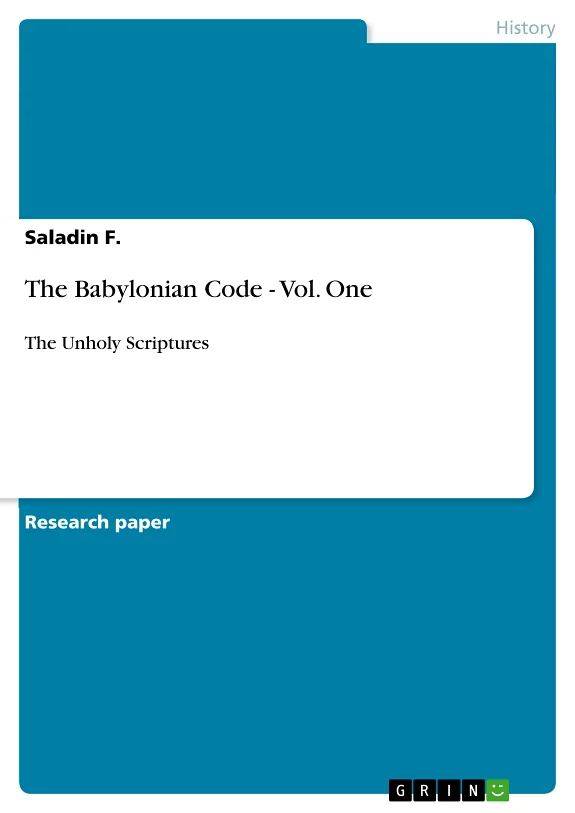
The Babylonian Code - Vol. One
 78
78

The Babylonian Code - Vol. One
Saladin F.'s "The Babylonian Code - Vol. One" attempts a rigorous historical analysis, but its academic origins are apparent in its somewhat dry presentation. The core argument—that a specific "Babylonian Code of Human Conduct" was a primary driver of European antisemitism through alleged Jewish dishonesty—is provocative. The paper's strength lies in its direct confrontation with historical persecution, attempting to unearth specific causes rather than relying on broad generalizations. However, its primary limitation is the singular focus on this alleged code, which risks oversimplifying the multifaceted historical, economic, and religious factors contributing to centuries of persecution. A passage discussing the expulsion of Jews from England in 1290, while factually anchored, could benefit from broader contextualization beyond the singular focus on the "Babylonian Code." The work ultimately serves as a specific case study in historical interpretation, prompting further questions about the framing of historical grievances.
📝 Description
78
Saladin F.'s 2011 paper examines the supposed influence of a 'Babylonian Code' on Jewish history.
Published in 2011, The Babylonian Code - Vol. One by Saladin F. is an academic research paper that focuses on historical theological-political dynamics. The work investigates the alleged role of Jewish adherence to a specific "Babylonian Code of Human Conduct" in historical European expulsions and persecutions. It frames this adherence as a factor contributing to negative societal perceptions and historical violence against Jewish populations in Europe, linking it to accusations of "Lying and Deception."
This paper is intended for students and scholars of world history, particularly those studying the theo-political development of Europe from early to modern periods. It will also interest researchers of comparative religious history and those seeking to understand historical narratives of Jewish diaspora and persecution through a specific, though debated, interpretive framework. The work engages with historiographical discussions on the causes of antisemitism, referencing historical events like expulsions of Jews from European nations, phenomena with roots in antiquity and continuing through the late medieval and early modern eras.
While categorized under Kabbalah & Jewish Mysticism, this work functions more as a historical and theological analysis rather than a direct exploration of mystical practices. It engages with historical interpretations of Jewish identity and its relationship with surrounding cultures and dominant political powers in Europe. The concept of a "Babylonian Code" as presented here is an interpretive framework used to explain historical tensions and antisemitism, rather than a recognized mystical text or practice within traditional Kabbalistic scholarship.
💡 Why Read This Book?
• Gain a specific historical interpretation of European antisemitism by examining Saladin F.'s focus on the "Babylonian Code of Human Conduct," understanding how adherence to perceived ethical frameworks (or deviations from them) was historically used to justify persecution. • Analyze the theological-political history of Europe through the lens of academic research, with the paper detailing the period leading up to and following the early modern era and referencing specific historical expulsions. • Challenge your understanding of historical causality by engaging with a focused argument that attributes Jewish expulsions from European nations to adherence to a specific alleged code of conduct.
⭐ Reader Reviews
Honest opinions from readers who have explored this book.
❓ Frequently Asked Questions
What is the "Babylonian Code of Human Conduct" mentioned in the book?
The "Babylonian Code of Human Conduct" is presented in Saladin F.'s research as a set of principles allegedly followed by Jewish communities, which the author posits as a reason for historical persecution and expulsion from European nations.
When was "The Babylonian Code - Vol. One" first published?
The book, "The Babylonian Code - Vol. One," was first published on June 28, 2011, as an undergraduate research paper.
What historical period does "The Babylonian Code - Vol. One" focus on?
The work primarily examines the theo-political history of Europe from early periods to modern times, with specific attention to historical events involving Jewish populations and their expulsions from various European nations.
What is the author's main argument regarding Jewish expulsions?
The author's main argument is that the tenacious adherence by Jews to the "Babylonian Code of Human Conduct," characterized by alleged persistent lying and deception, were precise reasons for their continuous torture, murder, and expulsion from European nations.
Is "The Babylonian Code - Vol. One" a narrative or an academic paper?
It is an academic research paper, originally an undergraduate work, focusing on historical analysis rather than a fictional narrative.
What is the primary subject area of this book?
The book falls under the category of Esoteric studies, specifically focusing on World History - General and Comparison, with an emphasis on early to modern theo-political history.
🔮 Key Themes & Symbolism
Alleged Babylonian Code of Conduct
The central focus is the author's interpretation of a "Babylonian Code of Human Conduct" as a driving force behind historical events. This section would dissect what Saladin F. posits this code entailed, particularly its alleged emphasis on "Lying and Deception." It explores how adherence to such principles, as perceived by the author, is presented as the precise, direct cause for the severe persecution and expulsion of Jewish communities from various European nations throughout history.
Theo-political History of Europe
This theme frames the research within the broader context of European historical development, specifically the intersection of religious belief and political power. It examines how theological doctrines and their interpretation influenced state policies and societal attitudes towards minority groups. The paper targets the period from early history through to modern times, highlighting specific instances of expulsions and violence as case studies in this theo-political dynamic.
Historical Antisemitism and Expulsion
The work directly confronts the historical reality of antisemitism, presenting a specific causal argument for the continuous torture, murder, and expulsion of Jews from European nations. It moves beyond generalized explanations to pinpoint adherence to the "Babylonian Code" as the primary catalyst, offering a controversial perspective on the motivations behind these historical atrocities and the scapegoating of Jewish populations.
Academic Research Methodology
As an undergraduate research paper, the work exemplifies a particular academic approach to historical inquiry. It demonstrates the process of formulating a thesis, referencing historical events (like expulsions), and constructing an argument based on specific interpretations of cultural and religious texts or practices. The publication year of 2011 situates it within contemporary academic discourse on history and religious studies.
💬 Memorable Quotes
Direct passages from the work, attributed to the author.
“In Europe countless Jews were tortured, murdered continuously.”
— This stark statement from the abstract immediately grounds the work in the brutal reality of historical persecution. It sets a tone of urgency and directness, signaling the paper's intent to confront the violent history faced by Jewish communities.
“The Jews were expelled from all of these European Nations for some precise reasons.”
— This assertion frames the entire research endeavor. It suggests that the author has identified specific, identifiable causes for mass expulsions, moving beyond vague historical forces to pinpoint concrete justifications as perceived by historical persecutors.
“One of the reasons was their tenacious adherence to the dishonest “Babylonian Code of Human Conduct”.”
— This is the crux of the author's thesis. It directly links historical expulsions to a specific, negatively framed "code" and attributes the cause to Jewish "tenacious adherence" to it, implying a deliberate choice with severe consequences.
“especially, their relentless Lying and Deception was”
— This phrase, cut short in the original abstract, highlights the specific accusations leveled against the Jewish people within the context of the "Babylonian Code." It points to perceived moral failings as the core of the author's explanation for historical animosity.
“Research Paper (undergraduate) from the year 2011 in the subject World History”
— This factual description situates the work within its academic context and publication timeframe. It informs the reader about the nature of the text—a scholarly inquiry rather than a popular history or fiction—and its origin as a student project.
🌙 Esoteric Significance
Tradition
While not explicitly tied to a named esoteric lineage like Hermeticism or Kabbalah, "The Babylonian Code - Vol. One" engages with themes that resonate with certain esoteric interpretations of history and human conduct. Its focus on hidden codes of conduct, perceived moral failings, and their supposed direct impact on historical events aligns with Gnostic or dualistic perspectives that view historical suffering as a consequence of adherence to flawed or corrupting principles.
Symbolism
The primary symbolic motif is the "Babylonian Code of Human Conduct" itself, representing a system of ethics or behavior that is deemed corrupting and deceptive. "Babylon" historically symbolizes corruption, excess, and spiritual captivity, a potent symbol in many esoteric traditions. The alleged "Lying and Deception" symbolize a perversion of truth and divine order, key concepts in spiritual corruption narratives.
Modern Relevance
Contemporary esoteric thinkers and historical revisionists might find the work's direct, if controversial, attribution of historical persecution to specific codes of conduct compelling. It could be referenced in discussions on comparative religion, the psychology of prejudice, or alternative historical interpretations that seek hidden causal links between ancient principles and modern societal issues, particularly within fringe historical or conspiracy-oriented circles.
👥 Who Should Read This Book
• Students of comparative religious history seeking to understand academic arguments on the historical roots of persecution, particularly Saladin F.'s specific thesis concerning the "Babylonian Code of Human Conduct." • Researchers of European theo-political history interested in analyses that link religious adherence to state actions and societal attitudes throughout early to modern periods. • Individuals exploring the historical narratives surrounding Jewish diaspora and expulsions, who are prepared to engage with a focused, academic interpretation of alleged causal factors like specific codes of conduct.
📜 Historical Context
Published in 2011, Saladin F.'s "The Babylonian Code - Vol. One" emerged during a period of continued academic engagement with the complexities of historical antisemitism. The paper’s focus on theo-political history and the perceived reasons for Jewish expulsions places it within broader historiographical debates that have spanned centuries, from early Christian polemics to modern critical analyses of religious intolerance. While the abstract does not name specific contemporaries, its approach suggests an engagement with scholars who analyze the intersection of religious dogma and state power in shaping societal attitudes. The work's framing around a specific "Babylonian Code" and accusations of dishonesty represents a particular, and potentially controversial, interpretive lens within the vast field of Jewish history and studies, which has seen numerous schools of thought, including Marxist, social, and cultural historical approaches, offering diverse explanations for historical events.
📔 Journal Prompts
The "Babylonian Code of Human Conduct" as a concept for historical analysis.
Precise reasons for European expulsions of Jewish populations.
The role of "Lying and Deception" in historical narratives of persecution.
Theological-political dynamics in early to modern European history.
Interpreting undergraduate research papers on historical conflicts.
🗂️ Glossary
Babylonian Code of Human Conduct
A term used by Saladin F. in his research to describe a specific set of principles allegedly followed by Jewish communities, which the author posits as a cause for historical persecution and expulsion from European nations.
Theo-political history
The study of the intersection between religious belief, religious institutions, and political power throughout history, examining how they influence each other and shape societal structures and events.
European Nations
Refers to the various countries and states across the continent of Europe, specifically in the context of historical events involving the expulsion and persecution of Jewish populations.
Lying and Deception
Accusations of dishonesty and fraudulent behavior attributed by the author to the adherence to the "Babylonian Code of Human Conduct," presented as a key reason for historical animosity towards Jewish communities.
Undergraduate Research Paper
An academic paper written by a student as part of their undergraduate studies, typically involving research, analysis, and argumentation on a specific subject, in this case, world history.
Expulsion
The act of forcing an individual or group to leave a country or place, often due to political, religious, or social reasons. In this context, it refers to the historical removal of Jewish communities from various European nations.
Adherence
The act of sticking closely to a rule, belief, or plan. In the context of the book, it describes the supposed persistent following of the "Babylonian Code of Human Conduct" by Jewish people.
This book appears in 1 collection
🔮 Readers Also Liked
Browse all →








From the “Bibliomancy” Collection
View all →









More Free Esoteric History & Biography Books
View all →