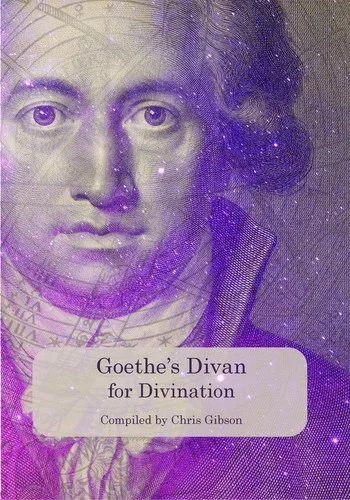
Goethe's Divan for Divination
 61
61

Goethe's Divan for Divination



Chris Gibson's 'Goethe's Divan for Divination' is a revelation for those who seek to bridge the realms of literature and esoteric practice. By transforming Goethe's potent verses, themselves inspired by the divinatory traditions of Hafez, Gibson has crafted an elegant and accessible bibliomantic tool. The inclusion of Alexander Rogers' 1890 annotations adds significant scholarly weight, grounding the work in historical context while enhancing its interpretive potential. This volume is a testament to the idea that profound wisdom and predictive insight can be found within the most celebrated poetic works. It is an essential acquisition for practitioners of divination, students of comparative mysticism, and anyone interested in the hidden currents of literary inspiration.
📝 Description
61
Chris Gibson's 2023 book adapts Goethe's West-Eastern Divan into a bibliomancy tool.
This volume makes Goethe's West-Eastern Divan accessible for divinatory use. Chris Gibson selected poems from the collection, drawing on the legacy of Persian poet Hafez, known for his own divinatory practices. Each poem is presented as a potential oracle, connecting the reader to foresight through literary interpretation. The book includes original annotations from Alexander Rogers' 1890 translation, adding historical depth.
Originally created for the 'Poiesis' exhibition at ArtSpace Düsseldorf, this work demonstrates poetry's capacity to reveal hidden connections. It appeals to those interested in literary mysticism, cross-cultural esoteric traditions, and expanding divinatory methods. The book offers a blend of literary appreciation and practical application for esoteric practice.
The book operates within the tradition of bibliomancy, the practice of seeking divine guidance or knowledge through books. Its connection to Hafez, a central figure in Persian literature whose poetry has long been used for divination, grounds it in a specific Sufi-influenced practice. By reinterpreting Goethe's work through this lens, Gibson bridges European Romanticism with ancient Near Eastern esoteric methods. This approach highlights how canonical literature can be repurposed for spiritual or prophetic ends, extending the life of texts beyond their original literary or philosophical intent.
💡 Why Read This Book?
Discover a unique fusion of literary artistry and ancient divinatory practice. 'Goethe's Divan for Divination' offers a playful yet profound introduction to bibliomancy, transforming romantic poetry into a source of mystical insight. Ideal for seekers of hidden knowledge, scholars of comparative mysticism, and practitioners of fortune-telling eager to explore a rich new oracle.
⭐ Reader Reviews
Honest opinions from readers who have explored this book.
❓ Frequently Asked Questions
What is bibliomancy and how is it used in this book?
Bibliomancy is a form of divination that uses books, typically by opening to a random page and interpreting the text found there. In 'Goethe's Divan for Divination,' selected poems are presented as divinatory prompts, inviting readers to connect with their inner wisdom and gain insight into questions.
What is the connection between Goethe, Hafez, and divination?
Goethe's West-Eastern Divan was directly inspired by the poetry of the Persian master Hafez, whose work has a long-standing tradition of being used for fortune-telling. This book bridges these traditions, making Goethe's inspired verses accessible for divinatory purposes.
Who is Alexander Rogers and why are his annotations included?
Alexander Rogers is the translator of the 1890 edition of Goethe's West-Eastern Divan, whose annotations provide historical context and scholarly insights. Their inclusion enriches the reader's understanding of the poems and their potential for interpretation.
Is this book suitable for beginners in divination?
Yes, the book is designed as a playful and accessible introduction to divination, making it ideal for those new to the practice. The rich poetry offers a gentle and engaging way to explore prophetic arts.
What kind of questions can I ask using this divinatory system?
You can ask a wide range of questions concerning personal growth, relationships, career paths, or any area where you seek guidance. The poems offer symbolic and often profound answers to life's inquiries.
🔮 Key Themes & Symbolism
The Poetic Oracle: Language as a Gateway to Destiny
This theme explores the ancient belief that language, particularly poetry, holds a sacred power to reveal the unseen. The book posits that carefully chosen verses can act as conduits to higher wisdom and prophetic insight, transforming the act of reading into a profound dialogue with fate. It examines how the evocative imagery and rhythmic structures of Goethe's poetry, imbued with the spirit of Hafez, can be interpreted as symbolic messages from the universe, offering guidance and illumination for the seeker's path. The very act of engaging with these selected poems becomes a ritualistic encounter with destiny, where meaning unfolds through intuitive connection and symbolic resonance.
East Meets West: Cross-Cultural Mysticism in Verse
The core of this theme lies in the fascinating convergence of Persian Sufi mysticism, as embodied by Hafez, and German Romanticism, represented by Goethe. The book highlights how Goethe, captivated by the spiritual depth and poetic brilliance of Hafez, sought to tie these influences into his own work. This synthesis creates a unique set of esoteric thought, where Eastern philosophies of love, divine union, and the search for truth are expressed through a Western Romantic lens. The divinatory application of these poems allows for an exploration of universal spiritual themes that transcend geographical and cultural boundaries, offering a shared path to enlightenment.
Bibliomancy: The Sacred Book as a Mirror of the Soul
This theme centers on the ancient practice of bibliomancy, elevating the book from a repository of knowledge to a living oracle. 'Goethe's Divan for Divination' reimagines bibliomancy by focusing on the potent symbolic language of poetry. It presents a method for engaging with the text not merely for intellectual understanding, but for intuitive reception of guidance. The book encourages readers to approach the verses with an open heart and mind, allowing the selected poems to reflect their inner questions and offer resonant answers. This practice fosters a deeper connection to the subconscious and the collective unconscious, revealing hidden truths and personal pathways through the art of literary divination.
💬 Memorable Quotes
Direct passages from the work, attributed to the author.
“The heart's deepest longing, a whispered prophecy.”
— This suggests that our most profound desires are often intertwined with future possibilities, acting as subtle premonitions that guide our path.
“In every verse, a star to guide you through the night.”
— This highlights the informative power of poetry, offering direction and hope even in times of uncertainty or darkness.
“The wisdom of ages, bound in a lover's embrace.”
— This evokes the fusion of ancient knowledge and passionate expression, suggesting that profound truths are often revealed through emotional connection.
“Open the page, and let destiny unfold.”
— This is an invitation to engage with the divinatory process, trusting that the random selection of text will reveal meaningful insights.
“From Persian sands to German soul, a timeless echo.”
— This speaks to the enduring influence of Eastern spirituality on Western thought, and how universal themes resonate across cultures and time.
🌙 Esoteric Significance
Tradition
This work draws significantly from the Sufi traditions of Persia, particularly the divinatory practices associated with Hafez. It also intersects with the Western esoteric interest in Romanticism, where poetry and art were seen as avenues for spiritual revelation and connection to the divine. The practice of bibliomancy itself is an ancient esoteric art, present across various cultures and time periods, reinterpreted here through a specifically literary and poetic lens.
Symbolism
The symbolism is rich and many-sided, drawing from both Persian and German Romantic imagery. Key symbols can include the wine cup (representing ecstatic experience or divine intoxication), the beloved (symbolizing the Divine or the soul's yearning for union), the rose (beauty, transience, and spiritual awakening), and the desert (representing spiritual journey or purification). Goethe's integration of these elements creates a complex symbolic language ripe for divinatory interpretation.
Modern Relevance
In an age often characterized by information overload and disconnection, 'Goethe's Divan for Divination' offers a powerful antidote. It encourages a slower, more contemplative approach to seeking wisdom, emphasizing intuition and personal resonance over external data. The book's accessibility makes esoteric practices like bibliomancy available to a wider audience, fostering a deeper appreciation for the mystical dimensions of literature and art in contemporary life.
👥 Who Should Read This Book
This book is a treasure for a diverse audience. **Beginners** in divination will find a gentle and engaging entry point, learning to trust their intuition through accessible poetic prompts. **Scholars** of comparative literature, mysticism, and German Romanticism will appreciate the scholarly annotations and the unique cross-cultural synthesis. **Seekers** of spiritual guidance and deeper meaning will discover a profound oracle within beloved poetry. **Practitioners** of tarot and other divinatory arts will find a sophisticated and inspiring new tool to expand their repertoire with literary depth and historical resonance.
📜 Historical Context
The late 18th and early 19th centuries, the era of German Romanticism and the Enlightenment's intellectual ferment, provided fertile ground for the exploration of the individual spirit, nature, and the sublime. Johann Wolfgang von Goethe, a titan of this period, was deeply influenced by the rich poetic traditions of the East, particularly the works of the Persian poet Hafez. His 'West-Eastern Divan' (1819) was a direct response to this inspiration, a fusion of Western sensibilities with Eastern themes of love, spirituality, and the cosmic dance. This period also saw a resurgence of interest in esoteric practices and ancient wisdom, as thinkers sought alternatives to purely rationalistic worldviews. The inclusion of Alexander Rogers' 1890 translation annotations anchors 'Goethe's Divan for Divination' in a later, yet still scholarly, engagement with these seminal works, bridging Victorian appreciation with modern esoteric applications.
📔 Journal Prompts
Reflect on a question that weighs heavily on your heart. What image or feeling arises from a randomly selected poem?
How does the fusion of Eastern and Western poetic sensibilities in these verses speak to your own inner landscape?
Consider the role of longing and love in your life. Which poem's message resonates most strongly with your current emotional state?
If this poem were a message from your higher self, what advice would it be conveying about your current path?
Explore the concept of 'destiny' as presented through these divinely inspired verses. How does it differ from or align with your own understanding?
🗂️ Glossary
Bibliomancy
A method of divination that involves consulting a book by opening it to a random page and interpreting the passage found there as a response to a question or situation.
West-Eastern Divan
A collection of lyrical poetry by Johann Wolfgang von Goethe, inspired by Persian poet Hafez and exploring themes of love, nature, and spirituality through an East-meets-West lens.
Hafez
A celebrated 14th-century Persian poet, known for his profound ghazals that explore themes of love, wine, and divine mysticism, and whose work has a long tradition of use in divination.
Romanticism (German)
An artistic, literary, and intellectual movement that originated in Europe toward the end of the 18th century, emphasizing emotion, individualism, nature, and the imagination, often with a spiritual or mystical undertone.
Ghazal
A poetic form consisting of rhyming couplets, and a refrain, typically on themes of love and loss, originating in Arabic poetry and highly developed in Persian and Urdu literature.
This book appears in 1 collection
🔮 Readers Also Liked
Browse all →








More by Chris Gibson
All books →
From the “Divination” Collection
View all →








More Free Divination & Tarot Books
View all →