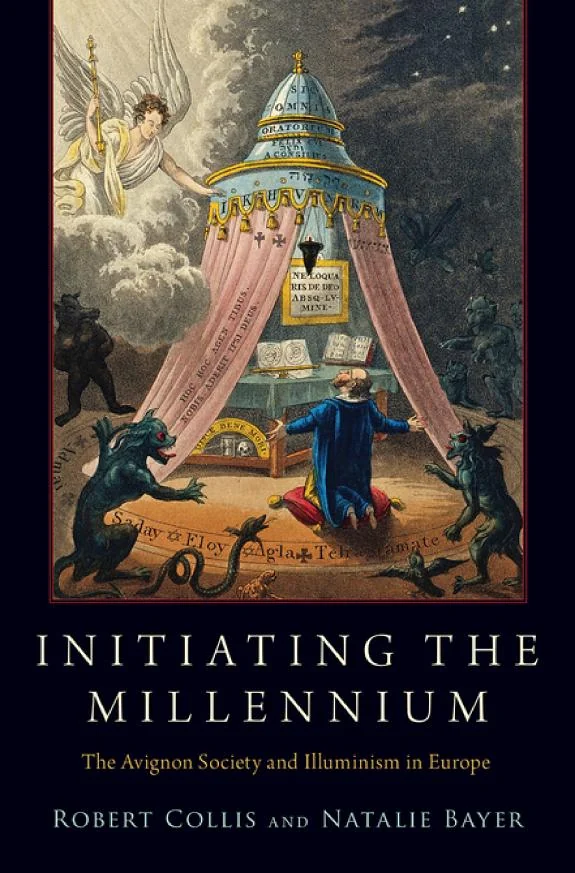
Initiating the Millennium
 71
71

Initiating the Millennium
Robert Collis and Natalie Bayer's "Initiating the Millennium" offers a much-needed scholarly treatment of the Avignon Society, an organization previously obscured in the annals of European esotericism. The work excels in its meticulous reconstruction of the society's operational period (1779-1807) and its intellectual milieu, drawing connections to illuminist Freemasonry without reducing the Avignon Society to a mere derivative. A particular strength lies in the detailed exposition of its unique millenarian framework, a less-explored facet of late 18th-century occultism. However, the book occasionally suffers from dense prose, making some of the more intricate doctrinal discussions challenging for the casual reader. The authors' careful handling of the society's esoteric doctrines, particularly their interpretation of its symbolic language, provides a solid foundation for understanding its distinctiveness. Ultimately, "Initiating the Millennium" stands as a significant contribution to the study of European initiatory orders.
📝 Description
71
Robert Collis and Natalie Bayer's 2019 book examines the Avignon Society, active 1779-1807.
Initiating the Millennium offers a detailed look at the Avignon Society, a European initiatory group that operated from 1779 to 1807. The authors describe how this society blended Western esoteric traditions with a worldview focused on imminent spiritual transformation. The book goes beyond simple categorization, explaining the society's inner workings, its doctrines, and its impact.
The Avignon Society arose during a period of significant intellectual and spiritual change in Europe. This era saw a rise in advanced Freemasonry and various groups inspired by Enlightenment ideas. The society's combination of esoteric philosophy and a belief in an approaching new age set it apart from standard Masonic organizations, though it borrowed from their symbolic systems and tiered structures. The book investigates how this unique mix created a distinct path for initiation.
This book situates the Avignon Society within the late Enlightenment's fascination with spiritual renewal and secret knowledge. It connects the society's practices to the broader currents of Western esotericism, including Rosicrucianism and other hermetic traditions that sought deeper spiritual understanding beyond conventional religious frameworks. The emphasis on millenarianism links it to apocalyptic expectations prevalent in various mystical and heterodox movements of the time, distinguishing it from purely philosophical or political secret societies.
💡 Why Read This Book?
• Understand the Avignon Society's specific millenarian framework, a unique synthesis not widely documented in other 18th-century esoteric studies. • Gain insight into the complex relationship between illuminist Freemasonry and independent esoteric groups active between 1779 and 1807. • Explore the specific esoteric doctrines and symbolic systems developed by the Avignon Society, offering a distinct perspective on Western esotericism.
⭐ Reader Reviews
Honest opinions from readers who have explored this book.
❓ Frequently Asked Questions
What was the primary historical period of the Avignon Society?
The Avignon Society was primarily active as an initiatory society in Europe between the years 1779 and 1807, a period marked by significant intellectual and social upheaval.
What philosophical currents influenced the Avignon Society?
The society was influenced by the burgeoning strand of illuminist high-degree Freemasonry, while simultaneously developing its own unique culture incorporating Western esotericism.
Is "Initiating the Millennium" the only English work on the Avignon Society?
According to the book's introduction, "Initiating the Millennium" is noted as the first English-language work specifically devoted to the Avignon Society.
What distinguishes the Avignon Society from other Masonic groups of its time?
The Avignon Society distinguished itself by incorporating Western esotericism within a pronounced millenarian framework, a combination less common in mainstream Masonic lodges of the era.
Who were the authors of "Initiating the Millennium"?
The book was authored by Robert Collis and Natalie Bayer, with its first publication occurring in 2020.
What type of esoteric traditions did the Avignon Society integrate?
The society integrated various strands of Western esotericism, blending them with its unique millenarian perspective and influences from illuminist Freemasonry.
🔮 Key Themes & Symbolism
Millenarian Framework
The book extensively details the Avignon Society's unique millenarian framework, positioning it as a group anticipating a significant spiritual transformation of the world. This eschatological focus permeated their initiatory system, distinguishing them from contemporary esoteric orders. The authors explore how this anticipation of a coming era shaped the society's doctrines and rituals, moving beyond simple reformist ideas to a more radical reimagining of spiritual and societal order, particularly within the context of late 18th-century European thought and its anxieties.
Illuminist Freemasonry Synthesis
"Initiating the Millennium" situates the Avignon Society within the broader field of late 18th-century esoteric movements, particularly its relationship with illuminist high-degree Freemasonry. The work elucidates how the society absorbed and adapted elements from these Masonic currents, such as hierarchical structures and symbolic language, while forging its own distinct path. It avoids portraying the society as merely a Masonic offshoot, instead highlighting its unique cultural synthesis that integrated these influences into a novel initiatory structure.
Western Esoteric Integration
A core theme is the Avignon Society's sophisticated integration of various strands of Western esotericism. The book examines how the society's founders and members drew upon diverse mystical and occult traditions to construct their initiatory system. This synthesis created a unique esoteric culture, offering adherents a path that combined philosophical inquiry with spiritual aspiration, all framed by their overarching millenarian vision, differentiating their practice from more narrowly defined occult schools.
European Initiatory Societies
The work serves as a detailed case study of the Avignon Society as one of Europe's most remarkable initiatory societies between 1779 and 1807. It explores the function and significance of such societies in a period of intense societal change and intellectual ferment. By focusing on the Avignon Society, the authors illuminate the diverse forms esoteric organizations took, their internal dynamics, and their contribution to the intellectual and spiritual history of the late Enlightenment era.
💬 Memorable Quotes
Direct passages from the work, attributed to the author.
“The Avignon Society developed a unique culture that incorporated strands of Western esotericism within a millenarian framework.”
— This statement expresses the core thesis of the book, highlighting the society's innovative synthesis of esoteric thought and apocalyptic expectation, setting it apart from contemporary groups.
“Influenced by the burgeoning strand of illuminist high-degree freemasonry...”
— This points to the specific lineage and intellectual currents that shaped the society's structure and initial development, placing it within the context of late 18th-century Masonic and quasi-Masonic movements.
“One of the most remarkable and influential initiatic societies in Europe between 1779 and 1807.”
— This assertion underscores the historical significance attributed to the Avignon Society by the authors, positioning it as a key player in the esoteric field of its time.
“This is the first English-language work devoted to the Avignon Society.”
— This fact emphasizes the book's contribution to scholarship, filling a gap in the English-language literature concerning this particular esoteric organization.
“The society incorporated strands of Western esotericism...”
— This phrase indicates the broad range of mystical and occult traditions that the Avignon Society drew upon, suggesting a syncretic approach to spiritual knowledge.
🌙 Esoteric Significance
Tradition
The Avignon Society fits within the broad tradition of Western Esotericism, drawing from Hermetic, Gnostic, and Kabbalistic streams, but its primary distinction lies in its integration of these within a pronounced millenarian framework. This positions it uniquely, not solely as a philosophical society or a magical order, but as one actively anticipating and preparing for a world-altering spiritual event, a characteristic often seen in chiliastic movements but less explicitly tied to structured initiatory systems in the Masonic mold.
Symbolism
The work explores motifs likely drawn from Masonic symbolism, but recontextualized within the society's millenarian vision. Specific symbols might include representations of divine light, cosmic cycles, or apocalyptic imagery. For instance, symbols related to the transition from one age to another (the 'millennium') would be central, perhaps using numerological or alchemical allegories to represent spiritual purification and the dawn of a new spiritual epoch.
Modern Relevance
Contemporary esoteric scholars and practitioners interested in the historical development of millenarian thought within Western Esotericism find the Avignon Society a crucial case study. Thinkers exploring the intersection of occultism and social transformation, or those examining the legacy of illuminist movements, might draw parallels or contrasts with modern esoteric organizations. The society's unique synthesis offers a historical precedent for integrating diverse esoteric traditions into a cohesive, future-oriented spiritual path.
👥 Who Should Read This Book
• Scholars of Western Esotericism: Those researching the evolution of occult thought, secret societies, and their philosophical underpinnings in the late 18th century will find this a foundational text. • Students of Freemasonry: Individuals interested in the more esoteric and less conventional branches of Freemasonry and illuminist movements will gain a deeper understanding of their historical context and diversity. • Readers interested in Millenarian Movements: Anyone fascinated by the history of apocalyptic thought and its manifestation in organized spiritual movements will find the Avignon Society's unique framework compelling.
📜 Historical Context
"Initiating the Millennium" emerges from a period of intense occult revival and philosophical exploration in late 18th-century Europe. The years between 1779 and 1807 saw the flourishing of various secret societies, often branching from or inspired by Freemasonry, such as the Bavarian Illuminati founded by Adam Weishaupt. This era was characterized by a fervent interest in Gnosticism, Hermeticism, and Kabbalah, frequently reinterpreted through an illuminist lens. The Avignon Society, as detailed by Collis and Bayer, navigated this complex milieu, developing its distinct millenarian ideology. While figures like Cagliostro and Martinism also captured public and esoteric attention, the Avignon Society carved its own niche. Its reception is largely understood through its historical footprint rather than direct contemporary critiques, as many such societies operated with a degree of secrecy, making their influence often inferred from their existence and membership rather than explicit public discourse.
📔 Journal Prompts
The Avignon Society's millenarian framework: How might an anticipated global transformation influence personal spiritual practice?
Illuminist high-degree Freemasonry: Reflect on the appeal of hierarchical esoteric structures in periods of societal change.
Western esotericism's integration: Consider how diverse spiritual traditions can coalesce into a unique initiatory path.
The period 1779-1807: Analyze the socio-political climate that fostered the growth of influential initiatic societies like the Avignon Society.
The concept of 'initiation': How does the Avignon Society's approach differ from or align with other forms of spiritual or philosophical initiation?
🗂️ Glossary
Avignon Society
An influential initiatory society operating in Europe between approximately 1779 and 1807, known for its unique synthesis of Western esotericism and a millenarian worldview.
Millenarian Framework
A belief system centered on the anticipation of a major, transformative event, often a spiritual or cosmic renewal leading to a new era (the millennium), influencing the society's doctrines and goals.
Illuminist High-Degree Freemasonry
A branch of Freemasonry during the late 18th century that emphasized more complex philosophical, mystical, and esoteric teachings beyond the basic craft degrees, often incorporating Gnostic or Hermetic elements.
Western Esotericism
A broad category encompassing various mystical, spiritual, and philosophical traditions originating in the Western world, including Hermeticism, Kabbalah, Gnosticism, and alchemy.
Initiatory Society
An organization structured around a system of degrees or stages of progression, through which members receive teachings, symbolic knowledge, and spiritual training.
1779-1807
The specific period during which the Avignon Society was most active and influential, representing a significant era for European esoteric movements preceding and overlapping with the French Revolution.
Esoteric Doctrines
Hidden or secret teachings, particularly those related to spiritual, mystical, or occult knowledge, often reserved for initiates within a specific tradition or society.
This book appears in 1 collection
🔮 Readers Also Liked
Browse all →





From the “Western Esotericism” Collection
View all →






More Free Esoteric History & Biography Books
View all →