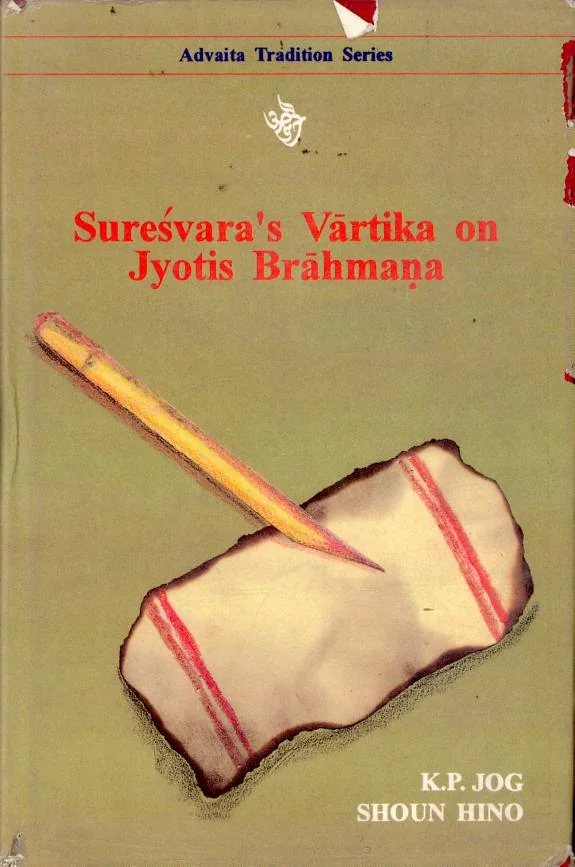
Sureśvara's Vārtika on Jyotis Brāhmaṇa
 75
75

Sureśvara's Vārtika on Jyotis Brāhmaṇa
The Vārtika on Jyotis Brāhmaṇa offers a dense, yet rewarding, immersion into the dialectical method of Advaita Vedanta. Sureśvara's commentary is less about poetic flourish and more about the precise dismantling of counterarguments, a characteristic that distinguishes it from more devotional texts. The strength lies in its rigorous exposition of Brahman as the sole illuminating principle, demonstrated through detailed scriptural analysis. A limitation for the uninitiated reader is the sheer technicality; without prior familiarity with the Brihadaranyaka Upanishad and Vedantic terminology, the text can appear impenetrable. The exposition of BU 4.3 as a *pariksa grantha* is particularly illuminating, showcasing the Upanishad's own internal critical examination. This work is an indispensable resource for serious students of Indian philosophy, demanding careful study but yielding significant clarity on core Vedantic tenets.
📝 Description
75
Sureśvara's Vārtika on Jyotis Brāhmaṇa meticulously analyzes the Brihadaranyaka Upanishad's chapters 2.1 and 4.3.
This work is a detailed commentary on a specific section of the Upanishads, functioning as a *laksana grantha*. It aims to define Brahman, the ultimate reality, by closely examining the philosophical arguments within the Brihadaranyaka Upanishad, especially chapters 2.1 and 4.3. The text clarifies Brahman's identity and role.
The Vārtika tradition, which Sureśvara exemplifies, emerged in the early centuries CE. Its purpose was to defend and clarify Upanishadic teachings against other philosophical schools. Sureśvara, a student of Gaudapada, wrote to explain the Brihadaranyaka Upanishad's statements. His commentaries helped solidify Advaita Vedanta, building its logical structure against schools like Nyaya and Mimamsa that had different views on scripture and reality.
Sureśvara's Vārtika belongs to a tradition of philosophical commentary that emerged in early centuries CE India. This tradition sought to clarify and defend the core teachings of the Upanishads, particularly for the emerging Advaita Vedanta school. Sureśvara, a direct disciple of Gaudapada, used the *vārtika* form to provide detailed explanations and refutations, solidifying the logical framework of Vedanta against challenges from other systems like Nyaya and Mimamsa. His work engaged deeply with specific scriptural passages, aiming to establish a coherent metaphysical understanding.
💡 Why Read This Book?
• Gain a foundational understanding of Advaita Vedanta's epistemological approach by studying Sureśvara's *pariksa grantha* method, which critically examines rival theories to establish the nature of Brahman. • Grasp the Upanishadic concept of Brahman as the singular 'light of all lights' through Sureśvara's detailed exegesis of the Jyotis Brāhmaṇa, illuminating its role as the ultimate source of knowledge. • Understand the historical development of Indian philosophical discourse by exploring Sureśvara's Vārtika, which clarifies Upanishadic teachings against the backdrop of early CE intellectual currents and competing schools of thought.
⭐ Reader Reviews
Honest opinions from readers who have explored this book.
❓ Frequently Asked Questions
What is the primary Upanishadic text commented on in Sureśvara's Vārtika?
The Vārtika focuses on the Jyotis Brāhmaṇa, a section within the Brihadaranyaka Upanishad (BU), particularly chapters 2.1 and 4.3, to define and examine the nature of Brahman.
What does 'laksana grantha' mean in the context of this book?
'Laksana grantha' refers to a work that establishes the definition or essential characteristics of a subject. In this Vārtika, it means the text defines the nature of Brahman as expounded in the Upanishads.
Who was Sureśvara and what was his philosophical affiliation?
Sureśvarācārya was a prominent early commentator on the Upanishads and a disciple of Gaudapada. He is a key figure in the development and systematization of Advaita Vedanta philosophy.
How does this work address rival philosophical theories?
The Vārtika employs the *pariksa grantha* method, critically examining and refuting competing philosophical viewpoints to demonstrate the superiority and truth of the Vedanta perspective on Brahman.
What is the significance of Brahman being the 'light of all lights'?
This concept signifies that Brahman is not merely one light among many, but the ultimate source and substratum of all illumination, consciousness, and existence, both within and beyond the individual.
When was the original publication date of this specific edition?
The original publication date for this edition of Sureśvara's Vārtika on Jyotis Brāhmaṇa is January 1, 2001.
🔮 Key Themes & Symbolism
Brahman as Ultimate Light
The Vārtika meticulously unpacks the Upanishadic declaration of Brahman as the 'light of all (external) lights' and the revealer of the 'true nature of one's inner self.' This theme posits Brahman not as an object to be perceived, but as the very principle of perception and consciousness that enables all knowing. Sureśvara argues that without Brahman, no other light or knowledge would be possible, establishing its primacy and all-pervasiveness as the sole reality.
The Pariksa Grantha Method
A central methodological concept is the *pariksa grantha*, or critical examination text. Sureśvara applies this to the Brihadaranyaka Upanishad (BU 4.3), demonstrating how the Upanishad itself engages in a dialectical process. This involves presenting arguments and counter-arguments concerning the nature of Brahman and the Atman, ultimately leading to the refutation of erroneous views and the affirmation of the Advaitic standpoint. It highlights the intellectual rigor inherent in Vedantic scriptural interpretation.
Atman-Brahman Identity
The Vārtika strongly affirms the non-dualistic identity between the individual self (Atman) and the ultimate reality (Brahman). By analyzing the Jyotis Brāhmaṇa, Sureśvara seeks to demonstrate that the inner light of consciousness within each being is indistinguishable from the cosmic consciousness. This identity is not presented as a mere philosophical proposition but as the fundamental truth of existence, revealed through proper scriptural inquiry and understanding.
Scriptural Authority and Commentary
This work exemplifies the crucial role of *vārtika* (commentary) in classical Indian philosophy. Sureśvara's text is not an independent treatise but a detailed explanation and defense of the Upanishadic teachings. It underscores the importance of authoritative scripture and the necessity of rigorous commentary to elucidate its profound meanings, particularly in the face of interpretive challenges and differing philosophical schools prevalent during the early centuries CE.
💬 Memorable Quotes
Direct passages from the work, attributed to the author.
“BU 4.3 is to be understood as pariksa grantha”
— This highlights the Upanishadic text's function not just as a statement of doctrine, but as a critical inquiry. It examines the pros and cons of different views on Brahman, establishing the Vedantic perspective through reasoned debate and refutation.
“Atman (viz. the Brahman) is the (internal) light of all (external) lights”
— This core tenet asserts Brahman's role as the fundamental consciousness. It is the source and sustainer of all awareness, including the awareness of sensory perceptions and mental processes, making it the ultimate illuminator.
“reveals to one the true nature of one's inne”
— The ultimate goal of understanding Brahman, as expounded here, is self-realization. It leads to the direct apprehension of the Atman's true essence, which is identical with Brahman, dispelling ignorance and suffering.
“necessary after BU 2.1, as an laksana portion of the Upanisad, has stated the definition of the brahman”
— This points to the sequential nature of Vedantic teaching. BU 2.1 establishes the initial definition of Brahman, and subsequent sections, like those commented on here, provide deeper analysis and clarification of that definition.
“detailed discussion of the theories rivalling the Vedanta”
— Sureśvara's work is characterized by its engagement with opposing philosophical systems. This detailed discussion serves to strengthen the Advaita position by systematically dismantling alternative metaphysical frameworks.
🌙 Esoteric Significance
Tradition
Sureśvara's Vārtika is deeply rooted in the Advaita Vedanta lineage, a prominent school within the broader Hindu philosophical tradition. While not typically categorized alongside Western esoteric traditions like Hermeticism or Kabbalah, Advaita Vedanta possesses profound esoteric dimensions focused on the direct realization of non-dual consciousness. This work fits within the tradition by offering systematic philosophical exposition designed to lead practitioners towards *moksha* (liberation) through intellectual understanding and contemplative insight into the nature of reality.
Symbolism
The central symbol explored is 'light.' Brahman is described as the 'light of all lights,' symbolizing pure consciousness, awareness, and the ultimate source of existence. This transcends mere physical illumination; it represents the inner radiance of the Atman that dispels ignorance (*avidya*). The contrast between 'internal' and 'external' lights further emphasizes the non-dual nature, suggesting that the source of all perception is singular and identical with the self.
Modern Relevance
Contemporary Advaita Vedanta practitioners and scholars continue to draw upon Sureśvara's Vārtikas for their authoritative exegesis. Thinkers and teachers in the modern Vedanta movement, as well as those exploring comparative philosophy of mind and consciousness, find value in Sureśvara's rigorous argumentation. His work remains a touchstone for understanding the philosophical underpinnings of non-dualistic contemplative practices and the path to self-realization within the Indian spiritual landscape.
👥 Who Should Read This Book
• Advanced students of Indian philosophy seeking to deepen their understanding of Advaita Vedanta's foundational texts and commentaries. • Scholars of comparative religion and metaphysics interested in the epistemological methods used to explore ultimate reality in classical Indian thought. • Contemplative practitioners aiming to grasp the philosophical framework supporting non-dualistic paths, particularly those focused on the nature of consciousness and self-realization.
📜 Historical Context
The Vārtika tradition, to which Sureśvara's work belongs, emerged as a vital intellectual force in India during the early centuries CE, a period marked by intense philosophical debate. Sureśvara, a key disciple of Gaudapada, wrote during a time when the Upanishads were being systematically studied and their teachings consolidated into distinct philosophical schools. His Vārtikas served as crucial elaborations on foundational Upanishadic texts, particularly the Brihadaranyaka Upanishad. This era saw the flourishing of various Indian philosophical systems, including the Nyaya (logic), Mimamsa (ritual interpretation), and early forms of Buddhism, all of which offered different metaphysical and epistemological frameworks. Sureśvara's work was instrumental in establishing the logical coherence and scriptural validity of Advaita Vedanta, directly engaging with and refuting the tenets of these rival schools. His commentaries provided a robust defense of Upanishadic non-dualism, solidifying Advaita's position within the broader range of Indian philosophical thought.
📔 Journal Prompts
The concept of Brahman as the 'light of all lights' in relation to personal illumination.
Sureśvara's application of the *pariksa grantha* method to Upanishadic inquiry.
The 'internal light' of Atman versus 'external lights' of perception.
The role of rigorous commentary in understanding ultimate truths.
The philosophical refutation of rival theories as a path to clarity.
🗂️ Glossary
Brahman
The ultimate, unchanging reality or absolute consciousness that is the source and substratum of all existence in Hindu philosophy, particularly in Vedanta.
Atman
The individual self or soul; in Advaita Vedanta, the Atman is ultimately identical with Brahman.
Vārtika
A specific type of detailed commentary on earlier scriptural texts or philosophical works in Sanskrit, often elaborating on, clarifying, and defending the original author's arguments.
Jyotis Brāhmaṇa
A section within the Brihadaranyaka Upanishad that deals with the theme of light, often interpreted as referring to Brahman or consciousness.
Laksana Grantha
A text that serves to define or establish the characteristics of a particular subject matter; a work of definition.
Pariksa Grantha
A text that critically examines, or analyzes the pros and cons of, a subject; a text of critical inquiry or examination.
Advaita Vedanta
A major school of Hindu philosophy emphasizing the non-dualistic nature of reality, asserting that Atman and Brahman are one.
This book appears in 1 collection
🔮 Readers Also Liked
Browse all →







From the “Upanishads” Collection
View all →







More Free Sacred Texts & Gnosticism Books
View all →