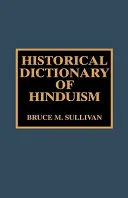
Historical Dictionary of Hinduism
 81
81

Historical Dictionary of Hinduism
Sullivan's Historical Dictionary of Hinduism functions precisely as its title suggests: a rigorously compiled reference work. Its strength lies in its encyclopedic scope and chronological ordering, allowing users to trace the historical lineage of concepts and practices. For instance, the entries on the Vedic period and subsequent Upanishadic thought clearly delineate intellectual shifts. A limitation, however, is the sheer density of information, which, while accurate, can sometimes feel overwhelming for the uninitiated. The entry on Advaita Vedanta, while informative, assumes a baseline familiarity that might not be present in all readers. Despite this, the dictionary serves its intended purpose as a scholarly tool with commendable fidelity.
📝 Description
81
Bruce M. Sullivan's 1997 dictionary offers an alphabetical guide to Hindu concepts, deities, and history.
Published in 1997, Bruce M. Sullivan's Historical Dictionary of Hinduism provides an alphabetical compilation of the religion's core elements. It covers deities, philosophical schools, ritual practices, and significant historical periods, contextualizing the evolution of Hindu thought and practice. The book aims to clarify the diverse aspects of Hinduism for a scholarly audience.
This dictionary is a useful resource for scholars of religious studies, Indologists, and students seeking a structured overview. It helps readers quickly reference specific terms, historical events, or key figures within the tradition. Its academic approach suits researchers, while its clear organization also benefits lay readers interested in a factual, historical account. The work emerged during a time of growing academic interest in comparative religion, offering a tool to understand Hinduism beyond simplified views and situating its development across distinct historical phases.
While not strictly an esoteric text itself, this dictionary situates Hindu traditions within their historical and philosophical development, a necessary precursor for understanding the subtler, more mystical aspects often associated with esoteric practices. By detailing concepts like Samsara and Moksha, and outlining the various philosophical systems, it provides the foundational knowledge required to engage with later or more specialized studies of Hindu yoga, Tantra, or Advaita Vedanta.
💡 Why Read This Book?
• Gain a precise understanding of the historical development of Hinduism, referencing specific periods like the Vedic era (c. 1500-500 BCE) to see how doctrines evolved. • Quickly define and contextualize complex philosophical terms such as Samsara, learning their specific meanings within the tradition's historical trajectory. • Identify and understand the significance of key figures like Adi Shankara, recognizing their impact on specific philosophical schools and historical movements.
⭐ Reader Reviews
Honest opinions from readers who have explored this book.
❓ Frequently Asked Questions
What historical periods does the Historical Dictionary of Hinduism cover?
The dictionary addresses Hinduism's historical development through various periods, from its ancient origins, including the Vedic and Upanishadic eras, to its later classical and medieval developments up to the late 20th century.
Are major deities like Vishnu and Shiva explained in the dictionary?
Yes, major deities such as Vishnu, Shiva, and Devi are covered, with entries explaining their significance, iconography, and role within different sects and historical contexts.
Does the book explain core philosophical concepts?
Absolutely. Core concepts like Dharma, Karma, Samsara, Moksha, and the various schools of Vedanta are explained, providing their historical and philosophical underpinnings.
Is this dictionary useful for academic research on Hinduism?
Yes, it is designed as a scholarly resource, providing factual information and historical context crucial for academic research and study of religious traditions.
What kind of sects or traditions are included?
The dictionary covers a wide array of sects and traditions within Hinduism, detailing their historical emergence, key figures, and distinctive beliefs or practices.
When was the Historical Dictionary of Hinduism first published?
The first edition of Bruce M. Sullivan's Historical Dictionary of Hinduism was published in 1997.
🔮 Key Themes & Symbolism
Historical Evolution of Dharma
The work traces the concept of Dharma, a core part of Hindu ethics and cosmic order, through its various interpretations across millennia. It highlights how notions of righteous conduct and societal duty evolved from early Vedic injunctions to complex philosophical discussions in the Upanishads and later Puranic traditions, demonstrating the adaptive nature of this central tenet.
Deities and Iconography
Sullivan's dictionary provides detailed entries on the vast pantheon of Hindu deities, from the Trimurti (Brahma, Vishnu, Shiva) to various goddesses and regional figures. It explains their mythological roles, symbolic representations, and the devotional practices associated with them, offering insight into the complex relationship between the divine and the human in Hindu practice.
Samsara and Moksha Cycles
Central to Hindu soteriology, the concepts of Samsara (the cycle of birth, death, and rebirth) and Moksha (liberation from this cycle) are meticulously detailed. The dictionary explores the philosophical underpinnings of these ideas, tracing their development through different schools of thought and their significance in the pursuit of spiritual freedom.
Philosophical Schools and Sects
The book offers clear explanations of major philosophical systems like Vedanta, Yoga, Nyaya, and Vaisheshika, alongside details on various sectarian traditions such as Shaivism, Vaishnavism, and Shaktism. This provides a structured understanding of the diverse intellectual and devotional currents that constitute Hinduism.
💬 Memorable Quotes
Direct passages from the work, attributed to the author.
“The work explores the historical development of Hindu religious traditions.”
— This statement underscores the dictionary's core function: to situate Hinduism not as a static belief system, but as a dynamic tradition shaped by centuries of change, adaptation, and intellectual discourse.
“Entries cover major events, individuals, texts, sects, and concepts.”
— This highlights the encyclopedic breadth of the dictionary, indicating that it serves as a comprehensive reference point for understanding the complex nature of Hindu religious expression.
“The dictionary aims to clarify the diverse range of Hinduism.”
— This points to the book's utility in clarifying the often-complex and varied practices and beliefs within Hinduism, making it accessible to students and researchers.
“Hinduism is presented in the context of its historical development.”
— This emphasizes the chronological and evolutionary approach Sullivan takes, framing Hindu traditions as evolving entities rather than unchanging doctrines.
“The work details philosophical schools like Vedanta.”
— This specific mention indicates the dictionary's depth in explaining the major intellectual frameworks that have guided Hindu thought and practice over time.
🌙 Esoteric Significance
Tradition
While primarily a scholarly reference, the dictionary touches upon esoteric dimensions by detailing practices and beliefs often considered esoteric within mainstream Hinduism. It provides historical context for yogic traditions, tantric practices, and devotional cults that engage with subtle energies, cosmology, and liberation from mundane existence, aligning with broader esoteric interests in hidden knowledge and spiritual transformation.
Symbolism
Key symbols like the Om (Aum) mantra, representing the primordial sound and the essence of consciousness, and the Lotus flower, symbolizing purity, spiritual awakening, and cosmic creation, are implicitly or explicitly discussed within their textual and ritual contexts. The dictionary explains their significance in understanding the visual and sonic language of Hindu traditions.
Modern Relevance
Contemporary practitioners and scholars of yoga, meditation, and comparative spirituality frequently draw upon historical dictionaries like Sullivan's to understand the roots of their practices. Thinkers exploring consciousness studies and cross-cultural psychology also find value in the precise historical and philosophical grounding it offers for concepts like Karma and Samsara.
👥 Who Should Read This Book
• Students of comparative religion: Gain a foundational understanding of Hindu doctrines, deities, and historical movements to contextualize your studies. • Academic researchers of Indology: Access a reliable, alphabetically organized source for quick verification of names, dates, and concepts crucial for scholarly work. • Serious lay readers interested in Hinduism: Obtain a clear, factual overview of the religion's historical trajectory and its complex philosophical underpinnings, moving beyond simplistic interpretations.
📜 Historical Context
Published in 1997, Bruce M. Sullivan's Historical Dictionary of Hinduism emerged during a critical period for the academic study of South Asian religions. Western scholarship on Hinduism had long grappled with colonial biases and Orientalist tropes, and works like Sullivan's sought to provide a more empirically grounded, historically contextualized understanding. It offered a structured counterpoint to earlier, often generalized accounts, and contributed to the increasing sophistication of Indological studies. At the time, scholars like Wendy Doniger were also publishing influential works that deconstructed traditional narratives, and Sullivan's dictionary provided a vital reference tool for navigating this evolving academic landscape. The work's systematic approach was particularly valuable in a field often characterized by vast textual traditions and diverse regional practices, helping to map out the intellectual and historical terrain for a new generation of scholars.
📔 Journal Prompts
The concept of Dharma, its historical shifts, and personal application.
Significance of the Trimurti: Brahma, Vishnu, and Shiva in Hindu cosmology.
The cyclical nature of Samsara and the pursuit of Moksha.
Evolution of Upanishadic thought and its impact on later philosophy.
Key figures like Adi Shankara and their contributions to Advaita Vedanta.
🗂️ Glossary
Dharma
A fundamental concept in Hinduism, encompassing duty, righteousness, cosmic law, and moral order. Its interpretation varies significantly across different texts and philosophical schools.
Karma
The principle of cause and effect, where actions (karma) in this life and previous lives determine one's future circumstances and rebirths within the cycle of Samsara.
Samsara
The continuous cycle of birth, death, and rebirth, driven by karma and ignorance. It is a fundamental concept that Hindus seek to transcend.
Moksha
Liberation or release from the cycle of Samsara. It represents the ultimate spiritual goal in many Hindu traditions, achieved through various paths like knowledge, devotion, or action.
Upanishads
A collection of philosophical texts that form the theoretical basis for much of Hindu philosophy. They represent the culmination of Vedic thought and explore concepts like Brahman and Atman.
Vedanta
A major school of Hindu philosophy that focuses on the Upanishads. Its various sub-schools (like Advaita, Vishishtadvaita, Dvaita) offer different interpretations of reality, the self, and God.
Adi Shankara
An influential 8th-century philosopher and theologian who consolidated the Advaita Vedanta school, emphasizing the non-dualistic nature of reality and the identity of Atman (individual soul) with Brahman (ultimate reality).

![The Byrhtferth's Manuscript (MS 17) † Saint John’s College † Oxford † [1111]](/img/thumb/the-byrhtferth-s-manuscript-ms-17-saint-john-s-college-oxford-1111-the-monk-byrhtferth.webp)