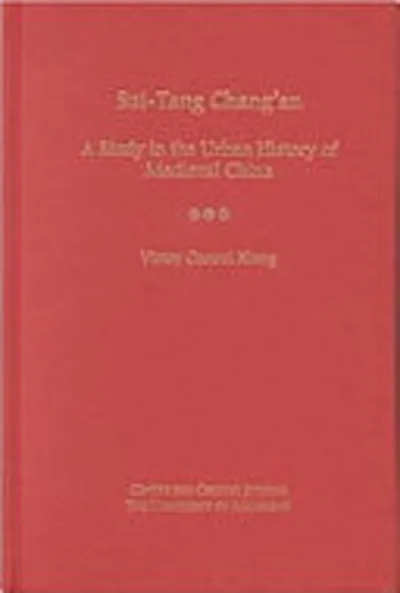
Sui-Tang Changʻan
 77
77

Sui-Tang Changʻan
Victor Cunrui Xiong's *Sui-Tang Chang'an* is a monumental achievement in detailing a city that was, for centuries, the undisputed center of Chinese imperial power. The work's primary strength lies in its exhaustive cataloging of the city's physical components—from the Grand Palace to the residential wards and marketplaces—grounded in meticulous scholarship. Xiong's methodical approach, tracing the city's layout from its Han predecessors and analyzing its geomantic underpinnings, provides a clear picture of deliberate urban planning. A notable limitation, however, is the text's occasional density, which might challenge readers unfamiliar with detailed Chinese administrative structures or classical Chinese urban theory. The section detailing the various monasteries, for instance, while informative, could benefit from more direct engagement with their socio-spiritual impact beyond their physical presence. Nevertheless, the book stands as the most thorough English-language study of its subject available, indispensable for serious Sinologists. It offers an unparalleled architectural and administrative blueprint of a lost world.
📝 Description
77
Victor Cunrui Xiong's 2019 book examines the Sui-Tang Chang'an, a capital city built on cosmological beliefs.
Victor Cunrui Xiong's *Sui-Tang Chang'an* is a detailed study of the Chinese capital during the Sui (581-618 CE) and Tang (618-907 CE) dynasties. The book reconstructs the city's physical layout and administrative structure, showing how Chang'an functioned as a central hub for political, economic, and cultural activities for many centuries. It discusses the urban planning, which drew on classical texts and geomancy, setting a standard for later imperial cities.
The study breaks down the key elements of Chang'an's urban identity. It looks at the imperial palaces, the organization of government offices, and sites for rituals. The book also covers the city's markets, its residential wards, and the presence of religious institutions, reflecting the era's social and religious diversity. The focus stays on the tangible structures and spatial organization that defined this large urban center.
Xiong's research compares the Sui-Tang capital with earlier urban centers, like the Han dynasty's Chang'an, to show what was new and what continued. The analysis examines the theories behind the city's design, including how it aligned with cosmological ideas and geomantic practices. This reveals how these concepts shaped the placement of important buildings and the city's overall plan, underscoring the ideological and practical reasons for its construction.
This book situates the construction of Chang'an within the context of traditional Chinese cosmology and geomancy, known as *feng shui*. These practices were not merely aesthetic but were seen as vital for harmonizing human settlements with natural forces and cosmic principles. The alignment of the city's grid, the placement of palaces, and the orientation of major thoroughfares were believed to influence the prosperity and stability of the empire. By examining these elements, the book touches upon a tradition where the built environment was understood as a reflection of universal order and a tool for maintaining political and spiritual equilibrium.
💡 Why Read This Book?
• Gain a precise understanding of imperial Chinese urbanism by exploring the specific layout and geomantic principles behind Chang'an's design, as detailed in the analysis of its palaces and administrative quarters. • Discover the multifaceted social and economic life of the Tang dynasty capital through specific examinations of its bustling marketplaces and distinct residential wards, revealing city functions. • Comprehend the foundational role of Chang'an by contrasting its Sui-Tang iteration with earlier Han dynasty urban planning, as presented in the background sketch, to grasp historical urban evolution.
⭐ Reader Reviews
Honest opinions from readers who have explored this book.
❓ Frequently Asked Questions
What was the primary purpose of Chang'an's geomantic design?
Chang'an's geomantic design was intended to align the capital with cosmological principles and ensure auspicious fortune for the empire. This influenced the city's grid layout, cardinal orientation, and placement of significant structures, reflecting a belief in the interconnectedness of the celestial and terrestrial realms.
How did Sui-Tang Chang'an differ from its Han dynasty predecessor?
While sharing a similar grid plan and cardinal orientation, Sui-Tang Chang'an was significantly larger and more systematically organized than its Han counterpart. The Sui dynasty's reconstruction involved ambitious imperial projects and a more centralized administrative structure, influencing the capital's scale and function.
What role did monasteries play in Sui-Tang Chang'an?
Monasteries in Sui-Tang Chang'an were not merely religious centers but also significant cultural and economic institutions. They occupied designated areas within the city, contributing to its religious landscape and sometimes acting as centers for learning, art, and even commerce.
Who was Victor Cunrui Xiong and what is his expertise?
Victor Cunrui Xiong is a historian specializing in Chinese history, particularly the Sui and Tang dynasties. His work on Chang'an demonstrates deep expertise in Chinese urban history, political structures, and cultural practices of the period.
What kind of administrative structures are discussed in the book?
The book discusses both central and local administrative quarters within Chang'an. This includes the imperial palaces and government offices responsible for governing the empire, as well as the administrative divisions within the city's wards and districts.
Can this book help understand the daily life of ordinary citizens?
While primarily focused on the city's structure and administration, the book offers insights into daily life through its descriptions of marketplaces, residential wards, and the presence of various institutions like monasteries, providing a context for citizen activities.
🔮 Key Themes & Symbolism
Imperial Urban Planning
This theme centers on the deliberate and systematic construction of Chang'an as the seat of Sui and Tang imperial power. It examines the city's grid layout, its alignment with cosmological principles and geomantic theories, and the strategic placement of key structures like palaces and administrative centers. The work emphasizes how urban design served as a tool for projecting imperial authority and maintaining social order, drawing parallels and distinctions with earlier capitals like Han Chang'an to highlight evolutionary trends in Chinese urbanism.
City as Cosmological Diagram
The book explores how Chang'an's physical form was conceived as a reflection of the cosmos and imperial ideology. Its adherence to cardinal directions, the meticulous division into wards, and the symbolic importance of its axes demonstrate a belief system where the earthly capital mirrored celestial order. This perspective highlights how esoteric concepts, particularly geomancy (feng shui), were integrated into the practicalities of urban development, shaping the city into a powerful symbol of the emperor's mandate and the unified empire.
Infrastructure of Governance
This theme focuses on the tangible elements that facilitated the administration and functioning of the vast Sui-Tang empire from its capital. It dissects the spatial organization of administrative quarters, the logistics of imperial palaces, the flow of goods and people through marketplaces, and the social structuring provided by residential wards. By detailing these components, the work illustrates the intricate mechanisms of imperial control and the urban systems necessary to support a complex, centralized state.
Religious and Social Landscape
The presence and organization of monasteries within Chang'an are examined as integral aspects of the city's social and religious fabric. These institutions, alongside secular administrative and commercial zones, contributed to the diverse character of the capital. The book implicitly touches upon how religious life coexisted with imperial power and daily commerce, reflecting the many-sided nature of urban existence in early imperial China.
💬 Memorable Quotes
Direct passages from the work, attributed to the author.
“Chang'an was the most important city in early imperial China.”
— This statement establishes the book's central premise: Chang'an's outstanding significance as the political, cultural, and economic heart of the Sui and Tang dynasties, setting the stage for a detailed exploration of its urban structure.
“Based on canonical and geomantic bases of the layout of the Sui-Tang capital.”
— This highlights the theoretical underpinnings of Chang'an's design, indicating that its physical arrangement was not arbitrary but consciously shaped by established texts and cosmological beliefs prevalent in ancient China.
“Following a background sketch of the earlier Han dynasty Chang'an.”
— This points to the book's comparative approach, situating the Sui-Tang capital within a broader historical context by first examining its predecessor, the Han dynasty's Chang'an, to understand continuity and change.
“This is the first comprehensive study of the Sui-Tang capital in the English language.”
— This assertion underscores the book's scholarly contribution, positioning it as a foundational and authoritative resource for English-speaking readers seeking in-depth knowledge of Chang'an.
💡 Key Ideas
Editorial paraphrase of the work's core concepts — not direct quotes.
The volume focuses on the essential components of the city—its palaces, central and local administrative quarters, ritual centers, marketplaces, residential wards, and monasteries.
This quote outlines the book's comprehensive scope, detailing the specific elements of urban infrastructure that Xiong meticulously analyzes to reconstruct the city's physical and functional dimensions.
🌙 Esoteric Significance
Tradition
While not explicitly a work of esoteric doctrine, *Sui-Tang Chang'an* details the profound integration of geomancy (feng shui) into the urban planning of imperial China. This practice, deeply rooted in Taoist cosmology and ancient Chinese metaphysics, sought to harmonize human environments with natural and cosmic forces. The book's analysis of Chang'an's layout demonstrates how these principles were applied on a grand scale to ensure imperial prosperity and stability, aligning the capital with auspicious terrestrial and celestial energies.
Symbolism
Key symbols explored through the city's design include the cardinal directions, representing cosmic order and imperial authority, and the grid pattern itself, symbolizing rationality and control imposed upon the landscape. The precise alignment of palaces and administrative centers reflects the emperor's position at the center of the universe, both politically and cosmologically. The designated ritual centers also symbolize the state's connection to Heaven and Earth, reinforcing the emperor's role as mediator.
Modern Relevance
Contemporary practitioners and scholars of feng shui and traditional Chinese metaphysics find *Sui-Tang Chang'an* important for understanding the historical application of these principles in large-scale urban planning. The book serves as a case study for how ancient cosmological beliefs were translated into physical structures, influencing modern approaches to environmental design and spatial harmony that draw inspiration from historical precedents.
👥 Who Should Read This Book
• Scholars of Chinese history and urban studies seeking the definitive English-language resource on the Sui-Tang capital, offering meticulous detail on its physical and administrative layout. • Students of comparative urbanism interested in understanding the principles of imperial city planning, including the role of geomancy and cosmological alignment in ancient metropolises. • Researchers of pre-modern East Asian political structures and statecraft who wish to examine how urban design facilitated governance and projected imperial power during a central era.
📜 Historical Context
Published in 2000, Victor Cunrui Xiong's *Sui-Tang Chang'an* emerged at a time when scholarship on Chinese urbanism was maturing, building upon foundational works by scholars like Arthur F. Wright and Denis Twitchett. The late 20th century saw increasing interest in the material culture and spatial organization of pre-modern Chinese cities. Xiong's work filled a significant lacuna by providing the first comprehensive English study specifically dedicated to the Sui-Tang capital, moving beyond general dynastic histories. While not directly engaging with a specific contemporary author's critique within its initial publication, its detailed analysis of urban planning, geomancy, and administrative structures implicitly contributed to broader academic discussions on imperial statecraft and cosmological influences in Chinese governance, offering a counterpoint to purely political or economic interpretations of the era.
📔 Journal Prompts
The geomantic bases of Chang'an's layout, and their influence on imperial authority.
The specific functions of the marketplaces within the residential wards of Sui-Tang Chang'an.
The contrast between Han dynasty Chang'an and its Sui-Tang successor, as presented in the background sketch.
The spatial organization of the central and local administrative quarters and their relation to city governance.
The symbolic significance of the ritual centers within the urban fabric of the capital.
🗂️ Glossary
Sui Dynasty
The imperial Chinese dynasty that reunified China from 581 to 618 CE, initiating significant infrastructure projects, including the reconstruction of the capital Chang'an.
Tang Dynasty
The imperial Chinese dynasty that followed the Sui, ruling from 618 to 907 CE. This era is considered a golden age in Chinese history, with Chang'an serving as its magnificent capital.
Chang'an
The capital city of the Sui and Tang dynasties, renowned as one of the largest and most cosmopolitan cities in the world during its time. Its layout and structure are the central focus of the book.
Geomancy
The ancient Chinese practice of harmonizing human existence with the surrounding environment, often referred to as feng shui. It involves principles of siting, orientation, and arrangement to harness auspicious energies.
Residential Wards
The systematically planned residential districts within Chang'an, often enclosed by walls, which organized the city's populace and reflected social stratification.
Canonical Bases
Refers to the foundational principles derived from classical Chinese texts and philosophical traditions that informed the planning and symbolic meaning of the capital city's design.
Imperial Palaces
The grand complexes that served as the residences of the emperor and the primary centers for state administration and court life within the capital city.