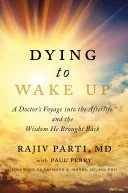
Dying to Wake Up
 71
71

Dying to Wake Up
Rajiv Parti’s "Dying to Wake Up" presents a compelling personal narrative that challenges the reader to consider consciousness beyond the confines of the physical brain. As an anesthesiologist, Parti’s professional skepticism provides a fascinating counterpoint to the extraordinary events he describes. His account of communicating with deceased individuals and experiencing what he interprets as past lives offers a uniquely grounded, albeit subjective, perspective on the afterlife. A notable strength is his detailed description of the transition state and the subsequent reintegration into his former life, now imbued with new meaning. However, the book occasionally leans into widely held NDE tropes without deep, novel analysis, such as the ubiquitous "light" or "guardian angels." The passage describing his interactions with spiritual entities during the NDE is particularly vivid, illustrating the directness of his perceived communication. While not a rigorous scientific treatise, "Dying to Wake Up" serves as a potent personal testimony that encourages open inquiry into the nature of existence.
📝 Description
71
In 2016, anesthesiologist Rajiv Parti published 'Dying to Wake Up,' detailing his own near-death experience.
Rajiv Parti, an anesthesiologist, recounts his profound near-death experience (NDE) in "Dying to Wake Up." Trained in empirical observation, Parti describes his perceptions during an event that fundamentally changed his life and understanding of consciousness. The book presents a first-hand account from a medical professional, detailing his encounter with awareness beyond the physical body. Parti addresses the nature of reality and consciousness, suggesting possibilities beyond our ordinary sensory limits. This work is suitable for those interested in the intersection of science and spirituality, especially regarding NDEs. It may resonate with individuals who have had NDEs or supported others through them. Skeptics looking for detailed personal accounts that question purely materialist views of consciousness will also find value, as will readers interested in quantum physics' implications for reality.
Published in 2016, "Dying to Wake Up" enters a continuing conversation about consciousness and the afterlife, building on earlier research into near-death experiences from figures like Raymond Moody. Parti's account from within the medical field offers a contemporary perspective that contrasts with more philosophical or purely anecdotal earlier works. The book participates in a broader modern discussion concerning consciousness, spirituality, and the current limits of scientific understanding. It aligns with traditions that posit non-physical dimensions of existence and explore altered states of awareness.
💡 Why Read This Book?
• Gain insight into the anesthesiologist's perspective on NDEs, understanding how his professional background frames his experience as detailed in "Dying to Wake Up" (2016). • Explore specific concepts like guardian angels and past lives as presented through a medical professional's direct encounter, offering a unique lens beyond typical spiritual literature. • Discover how a near-death event can lead to a radical reorientation of one's life, as exemplified by Rajiv Parti's shift in career and beliefs following his 2016 experience.
⭐ Reader Reviews
Honest opinions from readers who have explored this book.
❓ Frequently Asked Questions
What is Rajiv Parti's professional background before his near-death experience?
Rajiv Parti was an anesthesiologist, a medical professional specializing in pain management and sedation during surgery. This background informed his analytical approach to his own near-death experience, detailed in his 2016 book 'Dying to Wake Up'.
Does 'Dying to Wake Up' discuss reincarnation or past lives?
Yes, the book explores the concept of past lives as part of the author's near-death experience. Rajiv Parti recounts perceptions that he interprets as glimpses into previous existences, adding a layer to his spiritual insights.
What are some of the spiritual entities mentioned in the book?
The book mentions encounters with spiritual guides and deceased loved ones. These entities appear to offer comfort, guidance, and profound understanding during the author's near-death experience, as described in 'Dying to Wake Up'.
How did the near-death experience affect Rajiv Parti's lifestyle and beliefs?
The experience led to a profound transformation, causing Parti to reevaluate his priorities, career, and fundamental beliefs. He describes a shift away from material concerns towards a deeper spiritual understanding and purpose.
Is 'Dying to Wake Up' based on scientific research?
While written by a medical professional, 'Dying to Wake Up' is primarily a personal narrative and spiritual exploration. It draws on the author's subjective experience rather than presenting empirical scientific research, though it engages with the phenomenon of NDEs.
What is the original publication year of 'Dying to Wake Up'?
The book 'Dying to Wake Up' by Rajiv Parti was first published on August 23, 2016. This date marks its initial release to the public.
🔮 Key Themes & Symbolism
Consciousness Beyond the Body
Parti's narrative deeply explores the concept of consciousness persisting independently of the physical form. As an anesthesiologist, he was intimately familiar with states of unconsciousness induced by medical procedures. His near-death experience, however, presented a vivid, conscious awareness detached from his body, offering a unique perspective from someone trained in empirical observation. The book details his perceptions of a spiritual realm, interactions with non-physical entities, and a profound sense of peace and interconnectedness, suggesting that consciousness is not merely an epiphenomenon of brain activity.
Spiritual Guidance and Visitation
A significant aspect of 'Dying to Wake Up' involves the author's encounters with spiritual guides and deceased loved ones during his near-death experience. These interactions are portrayed not as abstract theological concepts but as direct, personal communications offering insight and reassurance. Parti describes receiving guidance that profoundly impacted his understanding of life, death, and the afterlife. The presence of departed family members suggests a continuity of relationships beyond physical death, a common theme in NDE literature but presented here through the lens of a medical professional grappling with extraordinary phenomena.
Reevaluation of Life Purpose
The near-death experience catalyzed a radical reevaluation of Rajiv Parti's life, career, and values. The narrative illustrates how an encounter with a non-physical reality can dismantle materialistic preoccupations and foster a deeper appreciation for spiritual and interpersonal connections. Parti recounts a profound shift away from the status and financial rewards of his medical career towards a life dedicated to exploring and sharing his spiritual discoveries. This transformation highlights the potential for NDEs to serve as catalysts for profound personal growth and a realignment with a perceived higher purpose.
The Energetic Impact of Violence
Parti's account extends to observations on the energetic or spiritual consequences of violence. The work suggests that violent actions generate negative energetic imprints that can affect individuals and collective consciousness. This concept moves beyond a purely psychological or sociological understanding of violence, proposing a metaphysical dimension to its impact. His near-death experience provided him with a framework to perceive these energetic residues, influencing his views on conflict resolution, compassion, and the interconnectedness of all beings at a vibrational level.
💬 Memorable Quotes
Direct passages from the work, attributed to the author.
“The experience offered insight into spiritual elements ranging from guardian angels and the spirits of the dead to past lives.”
— This summary highlights the core metaphysical elements Parti encountered, moving beyond a simple description of dying to discussing specific spiritual phenomena like angelic presences and the concept of reincarnation.
“As a wealthy anesthesiologist, the author's transformation challenged his materialist worldview.”
— This emphasizes the striking contrast between Parti's former life of privilege and scientific training and the profound spiritual revelations he experienced, suggesting a significant rethinking.
“He describes encounters with spiritual guides during his near-death event.”
— This focuses on the active role of spiritual entities in his experience, portraying them not as passive observers but as interacting beings who provided direction or understanding.
“The book explains how the event transformed his career, lifestyle, and fundamental beliefs.”
— This underscores the comprehensive nature of the life changes that resulted from his NDE, indicating that the impact was not superficial but deeply affected his core identity and life path.
“Parti perceived the toxic influence of violence on a spiritual level.”
— This points to a unique aspect of his account, suggesting that his NDE provided him with insights into the energetic or spiritual repercussions of harmful actions, extending beyond conventional understanding.
🌙 Esoteric Significance
Tradition
Parti's work engages with a broad, modern esoteric synthesis, drawing heavily on themes prevalent in New Age spirituality and contemporary NDE literature. While not strictly adhering to a single historical lineage like Hermeticism or Kabbalah, it echoes Gnostic concerns with the nature of consciousness and the soul's journey beyond the material world. Its emphasis on personal revelation and direct experience aligns with mystical traditions, but it lacks the structured cosmology or ritualistic practices of older esoteric orders. It represents a more individualized, experiential approach to spirituality that gained prominence in the late 20th and early 21st centuries.
Symbolism
The primary symbolic motif is the near-death experience itself, representing a threshold between the material and spiritual realms. Other symbols include 'guardian angels' and 'spirits of the dead,' which function as archetypal guides and communicators, signifying a non-physical support system and the continuity of consciousness. The concept of 'past lives' symbolizes the soul's enduring journey and the accumulation of experience across lifetimes, suggesting a karmic or developmental process that transcends individual physical existence.
Modern Relevance
Parti's account speaks to contemporary discussions in consciousness studies, transpersonal psychology, and quantum mysticism. Thinkers and practitioners exploring the mind-body problem, the potential for consciousness to exist independently of the brain, and the nature of subjective reality find validation in such NDE testimonies. His work is relevant to modern spiritual seekers who prioritize direct experience over dogma, and it informs discussions around the therapeutic potential of altered states of consciousness and the philosophical implications of scientific findings that challenge materialist assumptions.
👥 Who Should Read This Book
• Individuals interested in near-death experiences (NDEs) from a professional's viewpoint, particularly those who seek to understand the phenomenon through the lens of medical expertise. • Spiritual seekers exploring concepts like past lives, guardian angels, and the nature of consciousness beyond the physical body, looking for personal testimonies that bridge science and spirituality. • Those who have had their own NDEs or are supporting loved ones through such experiences, seeking relatable accounts that may offer comfort, validation, and a framework for understanding.
📜 Historical Context
Published in 2016, Rajiv Parti's "Dying to Wake Up" arrived during a period of significant public and academic interest in near-death experiences (NDEs). The late 20th century saw pioneers like Dr. Raymond Moody popularize the study of NDEs, and by the 2010s, NDE research had gained more traction within certain scientific and spiritual circles. Parti's work distinguishes itself by its author's professional background as an anesthesiologist, offering a perspective from within the medical establishment that was often skeptical of such phenomena. While figures like Dr. Eben Alexander were also publishing accounts from medical professionals around this time, Parti's narrative provides a specific focus on spiritual elements like past lives and guardian angels. The reception of such accounts often navigates between validation within spiritual communities and skepticism from mainstream scientific discourse, a dynamic present in the discourse surrounding NDE literature.
📔 Journal Prompts
The perceived presence of guardian angels during the near-death event.
Past life recollections experienced by Rajiv Parti.
The anesthesiologist's perspective on consciousness.
Reevaluation of lifestyle post-NDE.
The energetic influence of violence.
🗂️ Glossary
Near-Death Experience (NDE)
A profound personal experience associated with being close to death, often involving altered perceptions, feelings of peace, spiritual encounters, and a sense of leaving the physical body.
Anesthesiologist
A medical doctor specializing in anesthesiology, responsible for administering anesthesia and monitoring patients' vital signs during surgical procedures.
Guardian Angels
Spiritual beings believed to watch over and guide individuals, often perceived as benevolent entities offering protection and wisdom during significant life events or transitions.
Past Lives
The concept that an individual soul or consciousness has lived previous existences in different bodies, with memories or impressions from these lives sometimes accessible through altered states or spiritual experiences.
Spiritual Guides
Non-physical entities or beings that are believed to offer wisdom, support, and direction to individuals on their spiritual path, often encountered during meditation, dreams, or profound experiences like NDEs.
Materialist Worldview
A philosophical perspective that asserts that matter is the fundamental substance in nature, and that all phenomena, including consciousness, are results of material interactions.
Consciousness
The state or quality of awareness, or of being aware of an external object or something within oneself. In metaphysical contexts, it may refer to a universal or fundamental aspect of reality.
This book appears in 1 collection
🔮 Readers Also Liked
Browse all →









From the “Reincarnation” Collection
View all →






More Free Esoteric History & Biography Books
View all →