SmART
 73
73

SmART
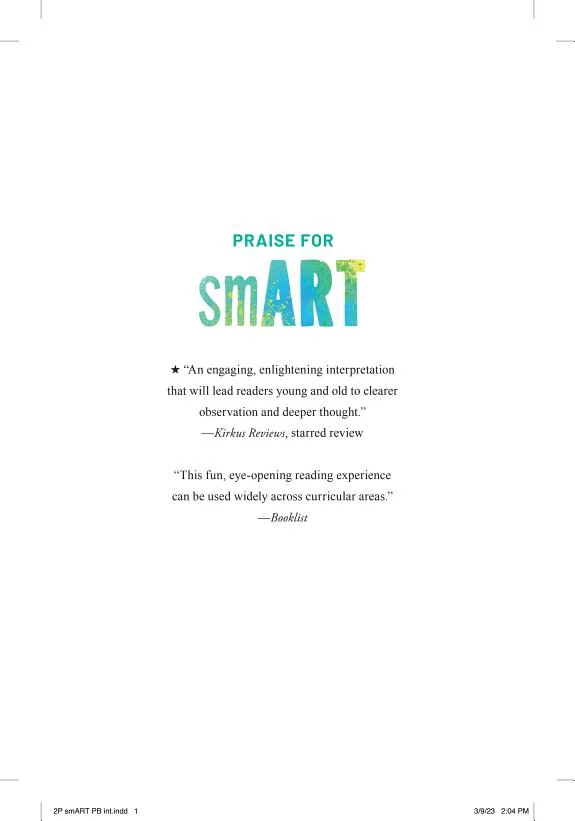
Amy E. Herman’s "smART" presents a compelling case for the power of focused observation, adapted for a younger demographic. The book’s strength lies in its direct, actionable approach, using seemingly simple examples like abstract art and the history of donuts to illustrate sophisticated cognitive training. The adaptation successfully distills Herman's core argument from "Visual Intelligence" into digestible lessons. A particular highlight is the explanation of how the CIA trains analysts, a concept that anchors the abstract idea of visual intelligence in a tangible, intriguing context. However, while aiming for accessibility, the adaptation occasionally simplifies the nuances of art interpretation, potentially losing some of the intellectual rigor that defined the original. The connection between observing abstract art and gaining confidence in speaking up, for instance, could benefit from more detailed exploration of the psychological mechanisms involved. Despite this, "smART" offers a valuable toolkit for young learners to sharpen their analytical and creative faculties.
📝 Description
73
Published in 2016, SmART adapts complex visual perception theories for young readers.
SmART is an adaptation for young readers of Amy E. Herman's "Visual Intelligence: Sharpen Your Analytical and Detective Skills." The book translates complex ideas about how we see and think into language accessible to a younger audience. It shows how careful observation, a skill developed by looking closely at art and everyday images, can improve cognitive abilities.
This edition is for middle-grade and young adult readers, their educators, and parents. It aims to foster critical thinking and creativity. The book is especially useful for students who find traditional learning difficult or for anyone curious about developing better observational skills. Its format suits independent reading or classroom use.
"Visual Intelligence" originally appeared in 2016, a time when discussions about "fake news" and media literacy were growing. Herman's method, drawing from art history and intelligence analysis, offered a new way to build analytical skills. It connected to educational shifts emphasizing skills like critical thinking and problem-solving, sometimes referencing methods used by intelligence agencies.
While not strictly esoteric, SmART draws on the tradition of contemplative practices that emphasize focused attention and deep observation. The act of closely examining art or any visual field to discern meaning mirrors practices found in various contemplative traditions. These traditions often suggest that developing an acute awareness of the present moment and one's surroundings can lead to a more profound understanding of oneself and the world. The book's emphasis on 'seeing' beyond the surface aligns with meditative approaches that seek deeper truths through sustained, non-judgmental observation.
💡 Why Read This Book?
• You will learn to actively analyze visual information, a skill directly applicable to understanding abstract art and historical artifacts, as discussed in the book's exploration of art history. • You will gain practical methods for developing critical thinking, inspired by techniques used by intelligence agencies like the CIA, as detailed in the "train like the CIA" section. • You will discover how focused observation can build confidence in expressing ideas, illustrated through examples like speaking up in class after engaging with visual stimuli.
⭐ Reader Reviews
Honest opinions from readers who have explored this book.
❓ Frequently Asked Questions
What is the main idea behind Amy E. Herman's 'smART'?
'smART' teaches young readers how to develop critical thinking and confidence by actively observing and analyzing visual information, drawing parallels to methods used by art historians and intelligence analysts.
How does 'smART' relate to the book 'Visual Intelligence'?
'smART' is a young reader's adaptation of Amy E. Herman's 'Visual Intelligence,' making its core concepts about visual perception and analytical skills more accessible to a younger audience.
What kind of examples does 'smART' use to teach visual intelligence?
The book uses diverse examples, including analyzing abstract paintings, learning about the history of donuts, and understanding the training methods of organizations like the CIA.
Who is the target audience for 'smART'?
The book is primarily aimed at middle-grade and young adult readers, as well as educators and parents looking to enhance children's critical thinking and observational skills.
What age range is 'smART' generally recommended for?
While not strictly defined, the book's accessible language and engaging examples suggest it is suitable for readers roughly aged 8-14, or those seeking an introduction to visual analysis concepts.
Does 'smART' provide practical exercises for readers?
Yes, the book encourages readers to actively engage their brains through observation and analysis, providing a framework for developing these skills in everyday life and academic pursuits.
🔮 Key Themes & Symbolism
Visual Analysis as Cognitive Training
The central theme posits that the act of closely observing visual stimuli, such as abstract paintings, functions as a rigorous workout for the brain. This practice sharpens analytical capabilities, enabling individuals to process information more effectively. By deconstructing visual elements, readers learn to identify patterns, infer meaning, and develop a more nuanced understanding of the world, mirroring the meticulous observation required in fields like art criticism and intelligence analysis.
The Intelligence Agency Model
Herman draws a compelling connection between the skills honed through art observation and the rigorous training methodologies employed by intelligence agencies, notably the CIA. The book explores how analysts are taught to observe details, detect anomalies, and synthesize information from various sources to form coherent assessments. This parallel highlights the universality of sharp observation as a critical skill across diverse, high-stakes professions.
Confidence Through Perception
A significant outcome explored is the development of self-assurance that stems from enhanced observational and analytical skills. By learning to actively engage with visual information and form reasoned interpretations, individuals, particularly young readers, can gain the confidence to articulate their thoughts and contribute meaningfully to discussions. This is framed as a direct benefit of training one's 'visual intelligence.'
Everyday Objects as Learning Tools
The book demonstrates that the capacity for developing visual intelligence is not confined to galleries or classified documents. It illustrates how even mundane subjects, like the history and cultural evolution of donuts, can serve as rich learning opportunities. By applying analytical frameworks to everyday phenomena, readers are encouraged to see the potential for cognitive growth in all aspects of their environment.
💬 Memorable Quotes
Direct passages from the work, attributed to the author.
“Abstract paintings could give you the confidence you need to speak up in class.”
— This highlights the book's core premise: engaging with art isn't just aesthetic appreciation; it's a practical method for developing self-assurance and communication skills through enhanced perception.
“Learning the history of donuts could help you think like a super spy.”
— This intriguing example suggests that analytical skills can be cultivated from any subject matter, framing even culinary history as a potential training ground for the sharp, pattern-seeking mind of an intelligence operative.
“smART teaches readers how to think critically and creatively, a skill that only requires you to open your eyes and actively engage your brain.”
— This expresses the book's accessible approach, emphasizing that the foundational tools for critical and creative thought are inherent observational abilities, activated through focused attention.
“This young reader's adaptation is based on VISUAL INTELLIGENCE by Amy E. Herman.”
— This factual statement clarifies the origin of the content, indicating that the principles of visual intelligence, as detailed in Herman's adult work, have been specifically tailored for a younger audience.
“The original work explores how to train like the CIA.”
— This refers to the pedagogical approach in the source material, suggesting that the book introduces methods and disciplines comparable to those used in intelligence agency training for analytical prowess.
🌙 Esoteric Significance
Tradition
While "smART" is presented as a secular educational tool, its emphasis on rigorous observation and the uncovering of hidden meanings aligns with traditions valuing deep perception. It echoes Gnostic pursuits of hidden knowledge (gnosis) through attentive examination, or Hermetic principles of "as above, so below" by finding universal patterns in diverse phenomena. The book encourages a form of active meditation through focused visual engagement, a practice found in various contemplative disciplines seeking to heighten awareness beyond superficial appearances.
Symbolism
The abstract paintings mentioned serve as potent symbols of the unknown or the multi-layered. Their ambiguity invites the viewer to project meaning, akin to how esoteric traditions interpret symbols as keys to unlocking deeper truths. The 'super spy' motif symbolizes the hidden agent of perception, one who sees what others miss, representing the cultivated intellect capable of discerning subtle patterns and concealed realities within the mundane world.
Modern Relevance
Contemporary thinkers and practitioners in fields ranging from mindfulness and cognitive psychology to design thinking and even critical media studies find resonance in Herman's work. The book's focus on active observation and analytical interpretation provides a foundational skill set applicable to navigating complex information landscapes, identifying biases, and fostering creative problem-solving in an increasingly visually saturated and information-dense world.
👥 Who Should Read This Book
• Young readers (ages 8-14) seeking to improve their focus and analytical abilities in school subjects like art, history, and science. • Educators and parents looking for engaging resources to foster critical thinking, creativity, and confidence in children and teenagers. • Individuals interested in understanding how observational skills, similar to those used by intelligence analysts, can be developed through accessible, everyday practices.
📜 Historical Context
Published in 2023 as an adaptation, "smART" draws from Amy E. Herman's 2016 book "Visual Intelligence." The original work emerged during a period of heightened public discourse on misinformation and the critical need for enhanced media literacy. Herman's unique methodology, bridging art history and the analytical practices of intelligence agencies like the CIA, offered a novel approach to cognitive skill development. It appeared within an educational landscape increasingly focused on cultivating 21st-century competencies such as critical thinking, problem-solving, and creativity. While not directly engaging with a specific competing school of thought in the same way as, for instance, a philosophical treatise, Herman's work implicitly challenged more passive learning models by advocating for active, observation-based cognitive training. The reception of "Visual Intelligence" highlighted a growing interest in applying structured observational techniques, previously confined to specialized fields, to broader educational and professional contexts.
📔 Journal Prompts
The application of abstract art observation to developing confidence in class participation.
Analyzing the CIA's training methods for spies as a model for cognitive enhancement.
Interpreting the historical journey of a common food item, like donuts, through a critical lens.
Developing active engagement with visual information beyond passive looking.
Connecting the act of seeing details in art to understanding complex real-world situations.
🗂️ Glossary
Visual Intelligence
The ability to analyze and interpret visual information effectively, utilizing keen observation skills to understand details, patterns, and underlying meanings.
Active Engagement
The process of consciously interacting with information, involving focused attention, critical questioning, and analytical interpretation rather than passive reception.
Critical Thinking
The objective analysis and evaluation of an issue or information in order to form a judgment, involving logical reasoning and evidence-based assessment.
Abstract Painting
Art that does not attempt to represent external reality accurately, instead using shapes, colors, and forms to achieve its effect, requiring interpretation.
CIA Training
Refers to the methods and disciplines used by the Central Intelligence Agency to develop analytical, observational, and interpretive skills in its personnel.
Observation Skills
The capacity to notice and pay attention to details, patterns, and nuances in one's surroundings, forming the basis for analysis and understanding.
Cognitive Abilities
Mental processes that include learning, remembering, problem-solving, reasoning, and decision-making, which can be enhanced through targeted practice.
This book appears in 1 collection
🔮 Readers Also Liked
Browse all →







From the “Visualization” Collection
View all →






More Free Occult Philosophy Books
View all →