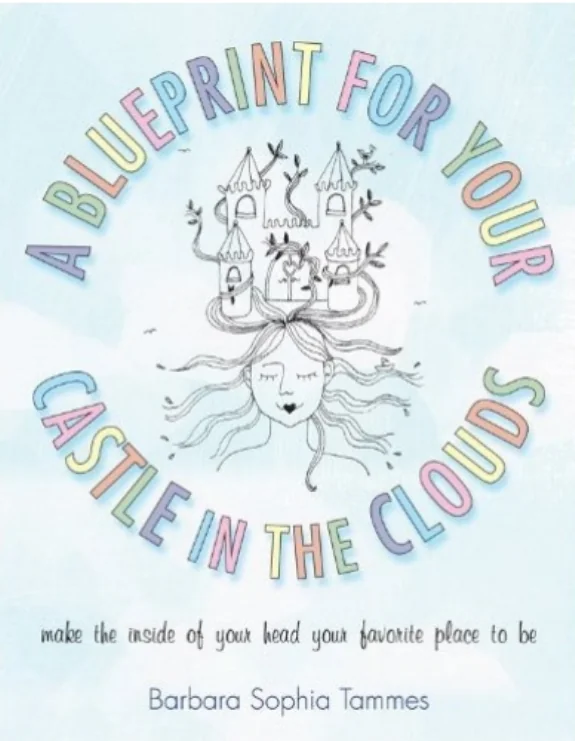
A Blueprint for Your Castle in the Clouds
 81
81

A Blueprint for Your Castle in the Clouds
Barbara Sophia Tammes’s approach in *A Blueprint for Your Castle in the Clouds* is refreshingly concrete for a book dealing with abstract mental states. The central metaphor of constructing a personal sanctuary, divided into distinct conceptual rooms, provides a tangible structure for introspection. I found 'The Room of Unburdening' particularly striking; its depiction of shedding mental clutter felt less like a platitude and more like an actionable design challenge. However, the book occasionally leans towards a slightly repetitive presentation of its core idea across the twenty-five rooms, which, while reinforcing the concept, could have benefited from more varied illustrative techniques. Despite this, the book offers a novel way to visualize and re-architect one's inner world. It serves as a practical guide for those wishing to visualize their way out of mental stagnation.
📝 Description
81
Barbara Sophia Tammes published "A Blueprint for Your Castle in the Clouds" in 2013, proposing a method for personal development through imaginative design.
This 2013 book presents a unique framework for personal growth using imaginative design. Tammes structures the work around twenty-five conceptual rooms, each intended to cultivate mental clarity and unlock new life possibilities. The central idea is to guide readers in building an internal sanctuary, a 'Castle in the Clouds.' This mental space serves as a retreat for re-evaluation and perspective shifts. The book is for those who find traditional self-help lacking and seek a more creative path to self-understanding.
It appeals to individuals desiring a structured yet imaginative approach to self-discovery and problem-solving. Readers interested in using architectural metaphors for psychological states will find particular resonance. The work encourages the active design and inhabitation of these internal spaces to achieve mental unburdening and foster new opportunities for growth.
Tammes's work, published in the early 21st century, engages with a contemporary interest in mindfulness and the application of creative visualization. It follows an esoteric tradition that employs symbolic landscapes for inner exploration. This lineage includes Renaissance alchemists and 20th-century Jungian psychology, where internal maps and structures are used to understand the psyche. The 'Castle in the Clouds' functions as such a symbolic landscape for introspection.
💡 Why Read This Book?
• Understand the concept of the 'Castle in the Clouds' as a personal mental sanctuary, a core idea first articulated by Barbara Sophia Tammes in 2013, to create a dedicated space for introspection. • Learn to design and inhabit twenty-five distinct 'rooms' within your mental castle, each representing a unique psychological function or perspective, as detailed in the book's chapters. • Develop new strategies for mental clarity and opportunity creation by applying the architectural metaphors presented, offering a creative alternative to conventional self-help techniques.
⭐ Reader Reviews
Honest opinions from readers who have explored this book.
❓ Frequently Asked Questions
What is the primary purpose of 'A Blueprint for Your Castle in the Clouds'?
The book's primary purpose is to guide readers in designing and utilizing an internal 'Castle in the Clouds'—a mental sanctuary—to foster clarity, unburden the mind, and generate new life opportunities through imaginative design.
How does Barbara Sophia Tammes use the concept of rooms in this book?
Tammes conceptualizes twenty-five distinct rooms within the 'Castle in the Clouds.' Each room represents a specific psychological function or perspective, offering a symbolic space for readers to explore and reframe their thinking.
Is this book for beginners in self-help?
Yes, it is suitable for beginners, particularly those who are drawn to creative visualization and architectural metaphors. The book provides a structured yet imaginative approach to personal development.
What kind of insights can one expect from the 'Castle in the Clouds' concept?
Readers can expect insights into their own thought patterns and mental habits by assigning meaning to each room. The book encourages looking at oneself in new ways, fostering self-awareness and potential for change.
When was 'A Blueprint for Your Castle in the Clouds' first published?
The book was first published on January 1, 2013, placing it within the contemporary wave of literature exploring creative visualization and personal architecture for mental well-being.
Does the book require artistic or architectural skill?
No, the book uses architectural metaphors conceptually. Readers do not need artistic or architectural skills; the focus is on the imaginative design and symbolic meaning of the 'rooms' for psychological benefit.
🔮 Key Themes & Symbolism
Mental Architecture
The work posits the mind as a space that can be designed and renovated, much like a physical building. The 'Castle in the Clouds' is not just a retreat but a structure built from thoughts, beliefs, and perspectives. Each of the twenty-five rooms serves as a specific architectural feature for housing different mental states or functions, encouraging a tangible approach to internal landscape management.
Unburdening and Renewal
A central theme is the process of mental 'unburdening.' The book provides conceptual spaces, like 'The Room of Unburdening,' where readers are invited to visualize shedding psychological weight. This act of clearing space within the mental architecture is presented as essential for creating new opportunities and fostering a lighter, more expansive state of being.
Perspective Shifting
By inhabiting different conceptual rooms within the Castle, readers are encouraged to adopt new perspectives. Each room offers a unique vantage point from which to view oneself and one's life circumstances. This systematic exploration of different mental 'locations' aims to unlock novel ways of thinking and problem-solving, moving beyond habitual cognitive patterns.
Creative Visualization as Tool
The entire framework relies on creative visualization as the primary tool for personal transformation. The book guides the reader through the active construction and experience of their inner castle. This emphasizes the power of imagination not just for escapism, but as a practical method for psychological restructuring and personal empowerment.
💬 Memorable Quotes
Direct passages from the work, attributed to the author.
“Every room in your Castle in the Clouds has a special meaning and offers new insights.”
— This highlights the symbolic depth of each conceptual space. It suggests that by understanding the 'meaning' of a mental room, one gains a new perspective on their internal world and potential.
“Design twenty-five mind expanding rooms to uncloud your thinking.”
— This expresses the book's core directive: to actively create mental spaces that foster clarity and break down cognitive fog. It positions the reader as an architect of their own consciousness.
“A safe haven where you can disappear from the world for awhile.”
— This speaks to the 'Castle in the Clouds' as a sanctuary. It emphasizes the importance of creating internal space for retreat, reflection, and psychological respite from external pressures.
“Lighten up your life by showing you how to design rooms.”
— This suggests a direct correlation between the act of designing these conceptual rooms and achieving a state of greater ease and joy in one's life. It frames personal development as a creative, architectural endeavor.
“Create new opportunities in your life.”
— This points to the practical outcome of the book's exercises. By redesigning one's inner mental landscape, the book promises the generation of tangible new possibilities and pathways in the external world.
🌙 Esoteric Significance
Tradition
The work draws implicitly from traditions that utilize symbolic architecture for inner exploration, such as Hermeticism's concept of 'as above, so below' applied to the psyche, and Kabbalistic mapping of spiritual worlds. It reframes these ideas into a modern, accessible framework focused on personal psychological architecture rather than strict adherence to ancient doctrines.
Symbolism
The core symbolism is the 'Castle in the Clouds' itself, representing the mind's potential for elevation and imaginative construction. Each of the twenty-five rooms symbolizes distinct psychological functions or states—for example, 'The Room of Unburdening' symbolizes release, while 'The Room of Infinite Possibilities' symbolizes potentiality and openness. These rooms act as symbolic containers for specific mental energies or concepts.
Modern Relevance
This book's approach to mental architecture speaks to modern practices in cognitive behavioral therapy (CBT) and positive psychology that emphasize reframing thoughts and creating supportive mental environments. It also finds echoes in modern manifestation and law of attraction teachings, where visualization is key to creating desired realities.
👥 Who Should Read This Book
• Individuals seeking a creative and structured approach to self-improvement who feel conventional methods are too abstract or uninspiring. • Aspiring practitioners of visualization and mental mapping who wish to build a personal 'inner world' for introspection and problem-solving. • Readers interested in psychological metaphors and conceptual frameworks for understanding their own minds and expanding their perspectives.
📜 Historical Context
Barbara Sophia Tammes's *A Blueprint for Your Castle in the Clouds* emerged in 2013, a period marked by widespread interest in mindfulness, positive psychology, and the application of creative visualization techniques. The book aligns with a contemporary trend of reframing personal development through metaphorical frameworks, moving beyond purely analytical self-help. Its approach echoes earlier esoteric traditions that utilized symbolic landscapes, such as those found in Hermeticism or certain interpretations of Jungian archetypes, where inner states are mapped onto external structures. While not directly engaging with specific academic debates, the work taps into a popular understanding of the mind-body connection and the power of belief, influenced by figures like placebo researchers and positive psychology proponents. The early 21st century saw a proliferation of such books, distinguishing Tammes's work by its specific architectural metaphor and the structured presentation of twenty-five distinct 'rooms' for mental exploration, differentiating it from more generalized visualization guides.
📔 Journal Prompts
Reflect on the foundational structure of your own 'Castle in the Clouds.'
Consider the purpose and design of 'The Room of Unburdening.'
Visualize a new opportunity manifesting within 'The Room of Infinite Possibilities.'
Map the emotional range of your mental architecture.
How does the concept of 'unclouding your thinking' apply to a current challenge?
🗂️ Glossary
Castle in the Clouds
A conceptual mental sanctuary designed by the reader, serving as a safe space for introspection, psychological unburdening, and the exploration of new perspectives.
Mind Expanding Rooms
Twenty-five distinct conceptual spaces within the 'Castle in the Clouds,' each designed to represent and foster specific mental functions, insights, or opportunities.
Uncloud Your Thinking
The process of clearing mental fog, biases, and limiting beliefs through the structured design and inhabitation of conceptual rooms within one's inner sanctuary.
Mental Architecture
The metaphorical construction and organization of one's inner psychological landscape, analogous to the design and structure of a physical building.
Room of Unburdening
A specific conceptual room within the 'Castle in the Clouds' designated for releasing psychological weight, past regrets, or limiting beliefs.
Room of Infinite Possibilities
A conceptual room in the 'Castle in the Clouds' designed to foster openness to new ideas, opportunities, and creative solutions.
Lighten Up Your Life
Achieving a state of greater ease, joy, and reduced psychological burden through the practices outlined in the book, primarily the design of one's mental castle.
This book appears in 1 collection
🔮 Readers Also Liked
Browse all →









From the “Visualization” Collection
View all →





More Free Occult Philosophy Books
View all →