The Illustrated Tao Te Ching

 74
74

The Illustrated Tao Te Ching
Stephen Hodge’s 2002 edition of The Illustrated Tao Te Ching offers a commendable effort to re-contextualize this ancient Chinese classic. The inclusion of recent manuscript discoveries is a significant strength, providing scholars and general readers alike with a more grounded understanding of the text's origins and potential meanings, moving beyond centuries of established, though sometimes misinformed, interpretations. Hodge’s commentary, while generally lucid, occasionally leans towards over-simplification when explaining complex philosophical tenets. For instance, the discussion around *wu wei* could benefit from deeper exploration of its practical implications beyond mere passivity. The illustrations, while visually appealing, sometimes feel tangential rather than integral to the philosophical exposition. Nevertheless, this version serves as a valuable gateway for those seeking a scholarly yet accessible entry into the Tao Te Ching, particularly for its engagement with new archaeological findings.
📝 Description
74
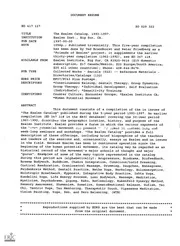
Published in 2002, Stephen Hodge's illustrated edition of the Tao Te Ching incorporates recent manuscript discoveries.
This edition of Laozi's Tao Te Ching, published in 2002, offers a new reading of the classic text. Stephen Hodge's work draws on recent manuscript findings and current scholarship to challenge older interpretations. It aims to present the text's wisdom clearly for contemporary readers, focusing on meanings often lost in translation and using visual aids to deepen understanding.
The book is for a general audience interested in Chinese philosophy, esoteric studies, or comparative religion. It provides an alternative perspective to standard commentaries. Scholars and students of classical texts will also find its research and integration of new discoveries valuable. It serves as a good introduction for newcomers to Taoist thought and a useful reference for those already familiar with it.
The Tao Te Ching, attributed to Laozi, emerged in China during a period of philosophical activity, becoming a core text of Taoism. Its concepts, such as the ineffable Tao and *wu wei*, influenced Chinese culture for centuries. This edition engages with that tradition by examining the text through modern scholarship and manuscript evidence, seeking to clarify its original intent and esoteric meanings for a contemporary audience.
💡 Why Read This Book?
• Gain a nuanced understanding of the Tao, the ineffable principle central to Taoist philosophy, as presented through the lens of recent manuscript discoveries from 20th-century China. • Explore the concept of *wu wei* (non-action) with fresh interpretations that challenge traditional views and highlight its application in contemporary life, moving beyond simple passivity. • Appreciate the interplay of *yin* and *yang* as depicted in the text, understanding these fundamental complementary forces as illustrated through the specific imagery and commentary within the 2002 edition.
⭐ Reader Reviews
Honest opinions from readers who have explored this book.
❓ Frequently Asked Questions
What makes this 2002 edition of the Tao Te Ching different from older versions?
This edition incorporates findings from very recent manuscript discoveries made in China and advances in modern scholarship, challenging traditional interpretations of Laozi's work that have persisted for centuries.
Who is Laozi and when did he live?
Laozi is traditionally credited as the author of the Tao Te Ching. While his historical existence is debated, he is generally placed in the Spring and Autumn period of Chinese history (771–476 BCE).
What is the meaning of 'Tao' in the Tao Te Ching?
The Tao, often translated as 'the Way,' is the fundamental, ineffable principle underlying all existence. It is the natural order of the universe, which the text encourages followers to align with.
What is the concept of 'wu wei'?
'Wu wei' is a central Taoist concept, often translated as 'non-action' or 'effortless action.' It signifies acting in harmony with the natural flow of the Tao, without forcing or striving.
Are there illustrations in The Illustrated Tao Te Ching?
Yes, the title indicates the presence of illustrations. These are intended to complement the text and aid the reader's comprehension of the philosophical concepts presented.
Is this book suitable for beginners in Taoism?
Absolutely. This edition is specifically designed for the general reader, aiming to provide a deeper understanding of the text's ancient and contemporary significance, making it accessible for newcomers.
🔮 Key Themes & Symbolism
The Nature of the Tao
This edition critically examines the concept of the Tao, moving beyond simplistic definitions. It highlights the text's portrayal of the Tao as the ultimate, ineffable source and governing principle of reality, which cannot be fully grasped by the intellect alone. Hodge's interpretation, informed by recent scholarship, emphasizes the Tao's ceaseless, natural flow and its role in cosmic and human affairs, urging a return to naturalness and simplicity as a path to spiritual understanding.
Wu Wei: Effortless Action
The work re-evaluates the principle of *wu wei*, often mistranslated as 'non-action.' Instead, it is presented as spontaneous, natural action that arises from alignment with the Tao. This perspective challenges the conventional emphasis on striving and ambition, advocating for a mode of being where actions are effective precisely because they are not forced. The illustrations often depict natural phenomena, reinforcing the idea of action arising organically from underlying principles.
The Interplay of Opposites
A significant theme explored is the dynamic relationship between complementary forces, particularly *yin* and *yang*. The text illustrates how these seemingly opposite energies are interdependent and essential for balance within the universe. This edition uses its visual and textual elements to demonstrate how understanding and embracing this duality, rather than seeking to eliminate one aspect, leads to harmony and wisdom.
Simplicity and Humility
The Tao Te Ching, as presented here, champions a return to fundamental simplicity and profound humility. It critiques societal complexities, artificial desires, and the pursuit of status, suggesting that true fulfillment lies in embracing a natural, unadorned existence. The book argues that by shedding these artificial layers, individuals can reconnect with their innate nature and the wisdom of the Tao.
💬 Memorable Quotes
Direct passages from the work, attributed to the author.
“The Tao that can be told is not the eternal Tao.”
— This opening statement immediately establishes the ineffable nature of the Tao. It asserts that any verbal or conceptual definition of the ultimate reality is inherently limited and cannot capture its true, eternal essence.
“To know others is intelligence; to know yourself is wisdom.”
— This highlights a core tenet of self-awareness and introspection within Taoist philosophy. True understanding, the text suggests, comes not from external observation but from deep internal exploration and self-knowledge.
“The sage acts without acting.”
— This is a concise expression of the principle of *wu wei*. It suggests that the enlightened individual operates in perfect harmony with the natural order, achieving results effortlessly and without conscious striving.
“Nature does not hurry, yet everything is accomplished.”
— This memorable line illustrates the power of natural processes and patience. It serves as a metaphor for *wu wei*, implying that effectiveness comes from working with the inherent rhythms of existence, not against them.
“When you are content with what you have, you are rich.”
— This reflects the Taoist emphasis on detachment from material possessions and external validation. True wealth is found in inner peace and contentment, a state independent of worldly accumulation.
🌙 Esoteric Significance
Tradition
The Tao Te Ching is a foundational text within Taoism, a philosophical and religious tradition with deep roots in ancient Chinese mysticism. While not directly part of Western esoteric lineages like Hermeticism or Kabbalah, its emphasis on the ineffable Tao, the power of emptiness, and the cultivation of inner harmony shares common ground with Gnostic and Neoplatonic ideas regarding ultimate reality and the path to enlightenment.
Symbolism
Key symbols include water, representing adaptability, yielding strength, and the flow of the Tao; the uncarved block (*pu*), symbolizing original simplicity and the natural state before societal corruption; and the valley, signifying receptivity, depth, and the feminine principle (*yin*). These symbols collectively point towards a way of being that is humble, natural, and in tune with the fundamental forces of the universe.
Modern Relevance
Contemporary thinkers and practitioners in fields ranging from mindfulness and personal development to leadership studies and environmentalism draw heavily on the Tao Te Ching. Its principles of non-striving (*wu wei*), balance, and living in accordance with natural cycles offer a potent antidote to the pressures of modern achievement culture and ecological imbalance.
👥 Who Should Read This Book
• Students of Eastern philosophy seeking a scholarly yet accessible introduction to Taoism, particularly those interested in the impact of recent archaeological findings on textual interpretation. • Practitioners of mindfulness and meditation who wish to deepen their understanding of concepts like *wu wei* and natural living, as presented in a historically grounded context. • Comparative religion scholars and those interested in mystical traditions looking for a foundational text that explores universal themes of existence, balance, and the nature of reality.
📜 Historical Context
The Tao Te Ching, attributed to Laozi, emerged during China's Spring and Autumn period (771–476 BCE), a time of intense philosophical and social upheaval. It stands as a foundational text for Taoism, offering a counterpoint to more socially engaged philosophies like Confucianism, which emphasized hierarchy and ritual. While Confucianism sought to order society through ethical conduct and governance, the Tao Te Ching advocated for a return to naturalness, simplicity, and *wu wei* (effortless action). The text's influence is profound, shaping Chinese art, medicine, martial arts, and political thought for over two millennia. Despite its ancient origins, its concepts have been continually reinterpreted, with modern scholarship, including findings from the late 20th century, offering new perspectives on its historical development and original meaning.
📔 Journal Prompts
The Tao's ineffability: reflecting on experiences that transcend verbal description.
The practice of *wu wei*: identifying instances where effortless action yielded the best results.
The symbol of water: considering its properties of yielding and persistent strength in personal challenges.
The concept of the 'uncarved block': contemplating the value of simplicity and innate potential.
The balance of *yin* and *yang*: analyzing a situation where seemingly opposing forces were integrated.
🗂️ Glossary
Tao (Dao)
The fundamental, ineffable principle that underlies all existence in Taoist philosophy. It is often translated as 'the Way' and represents the natural order of the universe.
Te (De)
Often translated as 'virtue' or 'power,' it refers to the manifestation of the Tao in individual beings and things. It is the inherent quality or character that arises from alignment with the Tao.
Wu Wei
A central concept meaning 'non-action' or 'effortless action.' It signifies acting in accordance with the natural flow of the Tao, without force, striving, or excessive effort.
Yin
The feminine, passive, dark, and receptive principle in Taoist cosmology, representing qualities like yielding, intuition, and coolness.
Yang
The masculine, active, light, and assertive principle in Taoist cosmology, representing qualities like strength, logic, and heat.
Pu
Literally 'uncarved block,' symbolizing the original, natural state of simplicity and potential before being shaped by external influences or desires.
Spring and Autumn period
A period in Chinese history (771–476 BCE) characterized by political fragmentation and intellectual flourishing, during which many foundational Chinese philosophies, including Taoism and Confucianism, emerged.
This book appears in 1 collection
🔮 Readers Also Liked
Browse all →








From the “Taoism” Collection
View all →





More Free Occult Philosophy Books
View all →