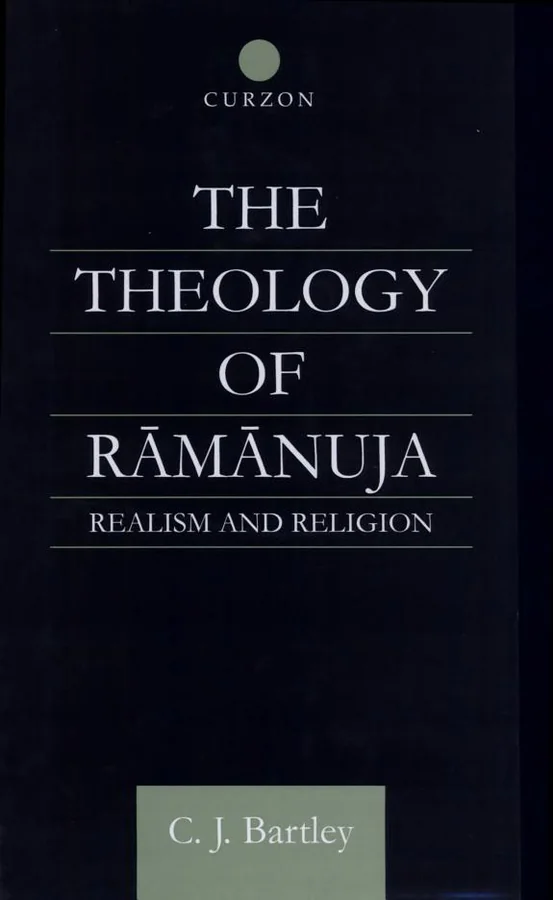
The Theology of Rāmānuja
 80
80

The Theology of Rāmānuja
Bartley’s meticulous dissection of Rāmānuja’s theological architecture provides a valuable service to those navigating the intricate currents of Indian philosophical history. The book excels in placing Rāmānuja's system, Vishishtadvaita, within its precise intellectual milieu, showing how it responded to and challenged contemporary schools. Bartley’s strength lies in his detailed analysis of Rāmānuja's scriptural exegesis, particularly concerning the Brahma Sutras, demonstrating the philosopher’s innovative hermeneutics. A notable passage is the exploration of Rāmānuja’s critique of the Advaita concept of *nirguna Brahman*, arguing for a personal, qualified deity as the ultimate reality. While the dense scholarly prose can be demanding, the work’s limitation is perhaps its accessibility to those without prior immersion in Vedanta. Nevertheless, for its rigorous scholarship and clear exposition of a complex theological framework, this study remains an important contribution to understanding medieval Indian thought.
📝 Description
80
C. J. Bartley's 2002 study examines the theological system of the Indian philosopher Rāmānuja.
Published in 2002, C. J. Bartley's work provides a scholarly analysis of Rāmānuja's theological system. The book situates Rāmānuja within the wider context of Indian philosophy, moving beyond simple explanation to critically assess his arguments in relation to other philosophical schools. Bartley's study is aimed at a rigorous engagement with Rāmānuja's specific contributions to Vishishtadvaita Vedanta, rather than serving as a basic introduction.
Rāmānuja, who lived circa 1017 to 1137 CE, engaged with a dynamic intellectual environment. Bartley's study highlights Rāmānuja's defense of qualified non-dualism (Vishishtadvaita) against the monistic views of Advaita Vedanta. This scholarly exchange is important for understanding the development of Hindu theological thought. The book unpacks Rāmānuja's specific ideas about Brahman, Atman, and Prakriti. A central point is Brahman as a personal God, qualified by souls and the material world. Bartley also looks at Rāmānuja's doctrine of prapatti, or self-surrender, as a path to liberation.
This book engages with the complex philosophical and theological tradition of Vedanta, a major school of Hindu philosophy. Rāmānuja is a key figure within the Vishishtadvaita, or qualified non-dualism, tradition. His work sought to provide a sophisticated philosophical basis for devotional theism, emphasizing a personal God qualified by the universe. Bartley's study situates Rāmānuja's thought within this lineage, contrasting it with other Vedanta interpretations and exploring its specific doctrines concerning God, the self, and the cosmos. It is a scholarly examination of a tradition with deep roots in Indian spiritual practice and thought.
💡 Why Read This Book?
• Gain clarity on Rāmānuja's unique interpretation of qualified non-dualism (Vishishtadvaita), contrasting it with Shankara’s Advaita, to understand the philosophical underpinnings of devotional traditions. • Comprehend the significance of *prapatti* (self-surrender) as a soteriological path within Rāmānuja’s theology, as detailed in Bartley's analysis of its scriptural basis. • Appreciate the historical context of Rāmānuja's thought, specifically his engagement with opposing schools of thought in medieval India, as presented in Bartley’s scholarly framework.
⭐ Reader Reviews
Honest opinions from readers who have explored this book.
❓ Frequently Asked Questions
What is Vishishtadvaita Vedanta as presented in Bartley's book?
Bartley's work defines Vishishtadvaita, Rāmānuja's philosophy, as qualified non-dualism. It posits Brahman as the supreme reality, but one that is 'qualified' by the sentient souls (chit) and non-sentient matter (achit) as its inseparable attributes or body.
Who was Rāmānuja and when did he live?
Rāmānuja was a prominent Indian philosopher and theologian of the Vedanta school, active roughly between the late 11th and early 12th centuries CE. Bartley places his theological system within this historical period.
How does Bartley's book explain Rāmānuja's approach to liberation (Moksha)?
The book details Rāmānuja's emphasis on *prapatti*, or absolute self-surrender to God, as a primary means to achieve Moksha. This contrasts with other paths discussed in Vedanta, focusing on divine grace.
What are the key texts Bartley analyzes in relation to Rāmānuja's theology?
Bartley's study extensively engages with Rāmānuja's commentary on the Brahma Sutras, known as the Sri Bhasya, as well as his interpretations of the Upanishads and the Bhagavad Gita.
Does this book discuss Rāmānuja's views on devotional practices?
Yes, while primarily a theological and philosophical study, Bartley's work implicitly covers the devotional aspects inherent in Rāmānuja's emphasis on a personal God and the path of *prapatti*.
What is the primary philosophical debate Rāmānuja engaged with, according to Bartley?
Bartley highlights Rāmānuja's critical engagement with the monistic Advaita Vedanta of Adi Shankara. Rāmānuja defended a qualified non-dualism against Shankara's absolute non-dualism.
🔮 Key Themes & Symbolism
Qualified Non-Dualism
Bartley elucidates Rāmānuja's core doctrine of Vishishtadvaita, or qualified non-dualism. Unlike absolute monism, this system posits Brahman as a unified reality that nonetheless possesses distinct modes or attributes—namely, the multitude of souls (chit) and the material universe (achit). This framework allows for a personal God who is both transcendent and immanent, forming the philosophical bedrock for Rāmānuja's devotional theology.
Soteriology and Prapatti
A significant focus of Bartley's study is Rāmānuja's path to liberation (Moksha). The work details the doctrine of *prapatti*, or self-surrender, as the supreme means of attaining spiritual freedom. This involves complete reliance on God's grace, a concept intricately woven into the fabric of Rāmānuja's theistic interpretation of Vedanta, distinguishing it from other paths like *karma yoga* or *jnana yoga* alone.
Scriptural Authority and Hermeneutics
Bartley examines Rāmānuja's rigorous approach to interpreting sacred texts, particularly the Brahma Sutras, Upanishads, and Bhagavad Gita. Rāmānuja's method of exegesis is presented as crucial for establishing his theological system, offering a counterpoint to earlier interpretations and demonstrating how scriptural passages can support a devotional and qualified monistic worldview.
Theistic Brahman
Central to Rāmānuja's theology, as explored by Bartley, is the understanding of Brahman not as an impersonal absolute, but as a personal, sentient Lord. This personal God is the inner controller of all beings and the universe, providing the object of devotion and the source of grace essential for the path of *prapatti*.
💬 Memorable Quotes
Direct passages from the work, attributed to the author.
“Rāmānuja's system is built upon the concept of Brahman as qualified by the universe.”
— This highlights the fundamental departure from strict monism; God is not a singular, undifferentiated entity, but a composite whole, encompassing all existence as its body or attributes.
“The necessity of grace is paramount in Rāmānuja's path to Moksha.”
— This emphasizes the devotional aspect of Rāmānuja's theology, where liberation is not solely achieved through personal effort but is fundamentally dependent on the divine benevolence granted through self-surrender.
“Engagement with opposing schools shaped Rāmānuja's philosophical formulations.”
— Bartley's work underscores that Rāmānuja's theology did not emerge in a vacuum but was a dynamic response and critique of prevalent philosophical viewpoints of his time.
“Scriptural interpretation is key to understanding Rāmānuja's theism.”
— This points to the scholarly focus of the book, showing how Rāmānuja's specific readings of ancient texts like the Brahma Sutras provide the textual evidence for his qualified non-dualistic system.
💡 Key Ideas
Editorial paraphrase of the work's core concepts — not direct quotes.
The soul is intrinsically related to Brahman as a part to a whole.
This paraphrases a core tenet of Vishishtadvaita, illustrating the relationship between individual consciousness and the divine, where separation is ultimately illusory within the qualified non-dual framework.
🌙 Esoteric Significance
Tradition
While Rāmānuja's system is primarily theological and philosophical within the orthodox Hindu Vedanta, its emphasis on direct divine communion, grace, and the soul's ultimate union with a personal God holds resonance with certain esoteric traditions. Specifically, its devotional core aligns with mystical paths found across various religions that seek intimate relationship with the divine, moving beyond mere intellectual assent to experiential realization.
Symbolism
The concept of Brahman as the 'body' of the universe is a potent symbolic representation of divine immanence. The soul (*Atman*) itself, as an inseparable attribute of Brahman, symbolizes the inherent divine spark within all beings. The path of *prapatti* (self-surrender) can be seen as a symbolic shedding of ego, a ritualistic dissolution of the individual self into the divine will, mirroring initiatory processes in other traditions.
Modern Relevance
Contemporary thinkers in comparative theology and philosophy of religion frequently engage with Rāmānuja's synthesis of devotion and philosophy. His model of qualified non-dualism offers an alternative to Western dualistic thinking and offers a robust theological framework for devotional practices in modern Hinduism. Scholars and practitioners interested in the intersection of mysticism, metaphysics, and the nature of divine love find Rāmānuja's thought enduringly relevant.
👥 Who Should Read This Book
• Advanced students of Indian philosophy and comparative religion seeking a deep dive into Rāmānuja's specific theological system and its historical context. • Scholars of Vedanta interested in the philosophical debates between Vishishtadvaita and Advaita Vedanta, particularly the hermeneutical strategies employed. • Theologians and mystics exploring devotional paths across traditions, looking for a sophisticated articulation of theistic grace and divine immanence.
📜 Historical Context
The theology of Rāmānuja, as analyzed by C. J. Bartley, emerged in a period of intense philosophical ferment in India, roughly spanning the late 11th and early 12th centuries CE. Rāmānuja (c. 1017–1137 CE) operated within the Vedanta tradition but significantly diverged from the prevailing Advaita Vedanta of Adi Shankara. Bartley's study focuses on this dialectical engagement, particularly Rāmānuja's refutation of Shankara's doctrine of an impersonal, undifferentiated Brahman. Rāmānuja championed a qualified non-dualism (Vishishtadvaita), asserting Brahman as a personal God qualified by sentient and non-sentient existence. This intellectual contestation occurred against a backdrop where various schools, including rival Vedanta traditions and heterodox philosophies, vied for philosophical dominance. The reception of Rāmānuja’s work was significant, laying the groundwork for numerous devotional movements within Hinduism and influencing subsequent generations of thinkers.
📔 Journal Prompts
Rāmānuja's concept of Brahman as qualified by the universe: how does this differ from absolute monism?
The doctrine of *prapatti*: reflect on the philosophical implications of absolute self-surrender.
Rāmānuja's engagement with opposing schools: identify a key point of contention.
The role of grace in Rāmānuja's soteriology: compare with other theological frameworks.
The Brahma Sutras as interpreted by Rāmānuja: explore the challenges of scriptural exegesis.
🗂️ Glossary
Brahman
The ultimate reality or supreme cosmic spirit in Hindu philosophy. Rāmānuja interprets Brahman as a personal God, qualified by the universe of souls and matter.
Vishishtadvaita
A school of Vedanta philosophy, meaning 'qualified non-dualism'. It posits Brahman as the supreme reality, but one that is composed of sentient (chit) and non-sentient (achit) aspects as its body.
Advaita Vedanta
A prominent school of Vedanta philosophy, meaning 'non-dualism'. It asserts that Brahman is the sole reality, and the perceived world of multiplicity is ultimately illusory (maya).
Atman
The individual soul or self. In Rāmānuja's system, the Atman is an attribute or mode of Brahman, distinct yet inseparable from it.
Moksha
Liberation or release from the cycle of birth, death, and rebirth (samsara). It is the ultimate goal in many Indian spiritual traditions.
Prapatti
A Sanskrit term meaning 'self-surrender' or 'entrustment'. It refers to Rāmānuja's path to liberation through complete devotion and reliance on God's grace.
Brahma Sutras
A foundational text of the Vedanta school, consisting of aphorisms that systematically expound the Upanishadic teachings. Rāmānuja wrote a major commentary on it.
This book appears in 1 collection
🔮 Readers Also Liked
Browse all →






From the “Vedanta” Collection
View all →






More Free Sacred Texts & Gnosticism Books
View all →