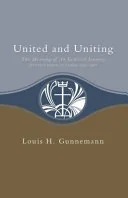
United and Uniting
 78
78

United and Uniting
Gunnemann’s 1987 treatise, United and Uniting, provides a bracingly direct critique of institutional inertia within the United Church of Christ. It’s not a book that offers easy platitudes; instead, it demands serious engagement with the practical and theological work required for denominational health. The strength lies in its unflinching focus on the necessity of active "uniting" as a process, a concept that cuts through the often-static language of church mergers and affiliations. A limitation, however, is that its specific context within the UCC might make its prescriptive elements less directly applicable to readers outside that particular tradition without significant adaptation. The discussion surrounding the "urgent tasks" for developing new forms of denominational life, particularly in Chapter 3, highlights the book's core argument for intentional spiritual and structural development. While dense, the work offers a valuable case study in applied ecclesiology. It serves as a critical examination of how religious institutions can adapt without sacrificing their foundational identity.
📝 Description
78
Louis H. Gunnemann's 1987 book argues for an organically arising unity in the United Church of Christ.
Published in 1987, United and Uniting addresses the structural and spiritual challenges within the United Church of Christ. Gunnemann moves past simple administrative fixes to suggest a fundamental rethinking of denominational life. He advocates for a deliberate cultivation of unity, one that emerges naturally from shared purpose and theological inquiry, rather than being imposed.
The book is intended for theologians, church leaders, and members involved in denominational governance and ecumenical discussions. It speaks to those questioning institutional identity, spiritual cohesion, and the practical application of shared values in a religious organization. Readers interested in the forces shaping modern Protestant church structures, especially the United Church of Christ, will find substantial content here.
Emerging during a period of introspection for mainline Protestant denominations, Gunnemann's work responds to declining membership and questions of relevance. It engages with the ongoing conversation about church unity and institutional adaptation, providing a specific theological framework for these complex issues within the United Church of Christ's history.
While not strictly esoteric in the occult sense, Gunnemann's work engages with the spiritual and structural underpinnings of a religious body, a concern shared by many esoteric traditions. These traditions often examine the inner workings of community, the nature of collective consciousness, and the methods for fostering spiritual coherence among individuals. The book’s focus on 'uniting' as an active, conscious process, requiring disciplined theological reflection and intentional spiritual practice, resonates with esoteric approaches to personal and communal transformation.
💡 Why Read This Book?
• Gain practical strategies for fostering active denominational unity, moving beyond passive affiliation, as detailed in Gunnemann's analysis of "uniting" processes. • Understand the specific historical and theological landscape of the United Church of Christ in the late 20th century, informed by the 1987 publication date and its context. • Discover actionable methods for developing new forms of denominational life that sustain diversity while strengthening collective identity, as advocated in the book's core arguments.
⭐ Reader Reviews
Honest opinions from readers who have explored this book.
❓ Frequently Asked Questions
What specific challenges did the United Church of Christ face when United and Uniting was published in 1987?
In 1987, the United Church of Christ, like many mainline denominations, grappled with questions of relevance, declining membership, and the need to adapt its institutional structures to a changing social and religious landscape. Gunnemann addresses these pressures directly.
How does Gunnemann differentiate between 'united' and 'uniting' in his book?
Gunnemann posits that 'united' can imply a static state of togetherness, while 'uniting' signifies an ongoing, active process of coming together, requiring conscious effort, theological reflection, and intentional community building.
Is United and Uniting only relevant for members of the United Church of Christ?
While the book is specifically framed around the United Church of Christ, its core arguments about institutional development, spiritual cohesion, and active unity hold significant relevance for any denomination or religious organization facing similar challenges of adaptation and identity.
What kind of 'new forms of denominational life' does Gunnemann propose?
The book calls for intentional development of communal practices and theological frameworks that can support both diversity and a unified identity, moving beyond traditional hierarchical or purely administrative models of denominational life.
Who is Louis H. Gunnemann?
Louis H. Gunnemann was a theologian and scholar whose work focused on ecclesiology and the life of the United Church of Christ. United and Uniting is one of his key contributions to understanding denominational structures.
Can I find this book readily available online?
As a 1987 publication, availability may vary. Checking academic libraries, specialized theological bookstores, or reputable used book platforms is recommended for acquiring a copy.
🔮 Key Themes & Symbolism
Active Denominational Uniting
Gunnemann argues that denominational unity is not a passive state but an ongoing, dynamic process. He emphasizes the 'urgent tasks' required to foster this active 'uniting,' distinguishing it from mere structural consolidation. This involves intentional theological reflection, shared spiritual practices, and the creation of new communal forms that allow for both diversity and coherence within the United Church of Christ. The work challenges readers to move beyond inertia and actively participate in the ongoing formation of their church's identity and mission.
Reimagining Church Structures
The book critically examines existing denominational frameworks, suggesting they are often insufficient for the demands of contemporary religious life. Gunnemann calls for the development of 'new forms of denominational life' that are more responsive, flexible, and spiritually grounded. This theme explores how institutions can adapt to maintain vitality and relevance without compromising core theological commitments, focusing on the practical implications for governance and community building within the United Church of Christ.
Theological Foundations for Unity
Central to Gunnemann's thesis is the idea that true unity arises from shared theological understanding and commitment. He advocates for a return to and renewal of the core theological tenets that can serve as a stable foundation for a diverse denomination. The book underscores the importance of disciplined theological discourse and spiritual formation in sustaining and guiding the process of uniting, ensuring that institutional changes are rooted in profound spiritual purpose.
Institutional Adaptation and Identity
United and Uniting addresses the perennial challenge faced by religious institutions: how to adapt to external changes and internal pressures while preserving a distinct identity. Gunnemann's work provides a framework for understanding this dynamic, suggesting that adaptation should be a conscious, theologically informed process. It explores the delicate balance between evolving institutional practices and maintaining the essential character and mission of the church.
💬 Memorable Quotes
Direct passages from the work, attributed to the author.
“The urgent tasks necessary for the United Church of Christ to develop a new form of denominational life.”
— This foundational statement from the original blurb highlights the book's direct and prescriptive nature. It signals that Gunnemann is not merely observing but is actively proposing concrete steps for institutional and spiritual renewal within a specific religious body.
“The need for new forms of communal life to sustain diversity.”
— This interpretation points to the book's focus on structural and relational innovation. It suggests that traditional models may be inadequate and that the United Church of Christ must explore novel ways of organizing itself to embrace its varied expressions while fostering a cohesive identity.
“Theology as the bedrock for denominational cohesion.”
— This captures the essence of Gunnemann's belief that shared theological understanding is the primary force that can bind a diverse denomination. It implies that institutional reforms must be anchored in robust theological reflection and commitment.
“Moving beyond administrative solutions to spiritual and structural renewal.”
— This highlights the book's depth, indicating that it addresses issues beyond mere organizational efficiency. It calls for a holistic approach, integrating spiritual vitality with necessary structural adaptations for the United Church of Christ.
💡 Key Ideas
Editorial paraphrase of the work's core concepts — not direct quotes.
Unity is not a static achievement but an ongoing, intentional process.
This paraphrased concept underscores Gunnemann's central argument. It challenges passive notions of togetherness, emphasizing that maintaining and deepening denominational bonds requires continuous effort, theological engagement, and active participation from its members.
🌙 Esoteric Significance
Tradition
While not overtly esoteric in the Hermetic or Gnostic sense, Gunnemann's work operates within the broad tradition of applied theology and ecclesiology concerned with the spiritual and organizational health of a religious body. Its focus on the *process* of 'uniting' and the development of 'new forms of life' can be seen as exploring the dynamic, emergent qualities of collective consciousness within a spiritual community, akin to how alchemical processes or initiatory traditions emphasize transformation.
Symbolism
The core symbolism lies in the conceptual distinction between 'united' and 'uniting.' 'United' suggests a static, perhaps rigid, structure, while 'uniting' embodies flow, dynamism, and ongoing creation – akin to the alchemical concept of *solve et coagula* (dissolve and combine). The 'new forms of denominational life' can be interpreted as seeking emergent structures that reflect a more fluid, adaptable spiritual organism, moving beyond fixed, material forms.
Modern Relevance
Contemporary thinkers and practitioners in church leadership, denominational studies, and even organizational psychology interested in fostering resilient communities draw on Gunnemann's foundational insights. His emphasis on intentional process and the theological grounding of institutional change remains relevant for any religious or secular organization grappling with adaptation, identity, and collective purpose in the 21st century.
👥 Who Should Read This Book
• Clergy and denominational leaders within the United Church of Christ seeking to understand and implement strategies for institutional renewal and deeper spiritual cohesion. • Scholars of American religious history and ecclesiology interested in the internal dynamics and theological discourse of mainline Protestant denominations in the late 20th century. • Individuals involved in ecumenical or interfaith dialogue who are exploring models for fostering unity and shared purpose across diverse religious bodies.
📜 Historical Context
Published in 1987, Louis H. Gunnemann's United and Uniting emerged during a complex period for mainline Protestantism in America. The preceding decades had seen significant ecumenical movements and shifts in social structures, leading many denominations, including the United Church of Christ (formed in 1957), to re-evaluate their identity and mission. Gunnemann's work engaged directly with internal discussions about church growth, institutional relevance, and theological coherence. It responded to a climate where questions of denominational identity were paramount, particularly in the wake of the social upheavals and the questioning of traditional religious authority. While not engaging directly with the burgeoning New Religious Movements of the era, Gunnemann's focus on deliberate, theologically grounded institutional adaptation offered a counterpoint to both secularization trends and more radical critiques of established religion, providing a framework for internal renewal within the UCC.
📔 Journal Prompts
The concept of 'uniting' as an active process.
The necessity of developing 'new forms of denominational life'.
The role of theological foundations in sustaining institutional identity.
Reflecting on the distinction between static unity and dynamic uniting.
Identifying urgent tasks for fostering spiritual cohesion in a collective.
🗂️ Glossary
Denominational Life
Refers to the collective structures, practices, theological expressions, and communal identity that characterize a specific branch of a religious tradition, such as the United Church of Christ.
Uniting
As distinct from 'united,' this term signifies an ongoing, active, and intentional process of coming together, requiring conscious effort, dialogue, and spiritual development to build and maintain cohesion.
New Forms of Denominational Life
Gunnemann's proposal for innovative structures and communal practices designed to address the challenges of modern religious institutions, fostering both diversity and a unified identity.
Ecclesiology
The theological study of the nature, mission, and structure of the Christian Church, focusing on its doctrines, organization, and spiritual life.
Cohesion
The act or state of sticking together; the tendency to cling or bind together. In a denominational context, it refers to the spiritual, theological, and relational bonds that hold the body together.
Institutional Adaptation
The process by which a religious or other organization modifies its structures, policies, or practices in response to changing social, cultural, or internal conditions.
Theological Reflection
The disciplined and critical examination of religious beliefs, doctrines, and practices, aimed at deepening understanding and guiding action within a faith tradition.
This book appears in 1 collection
🔮 Readers Also Liked
Browse all →







From the “Affirmations” Collection
View all →








More Free Sacred Texts & Gnosticism Books
View all →