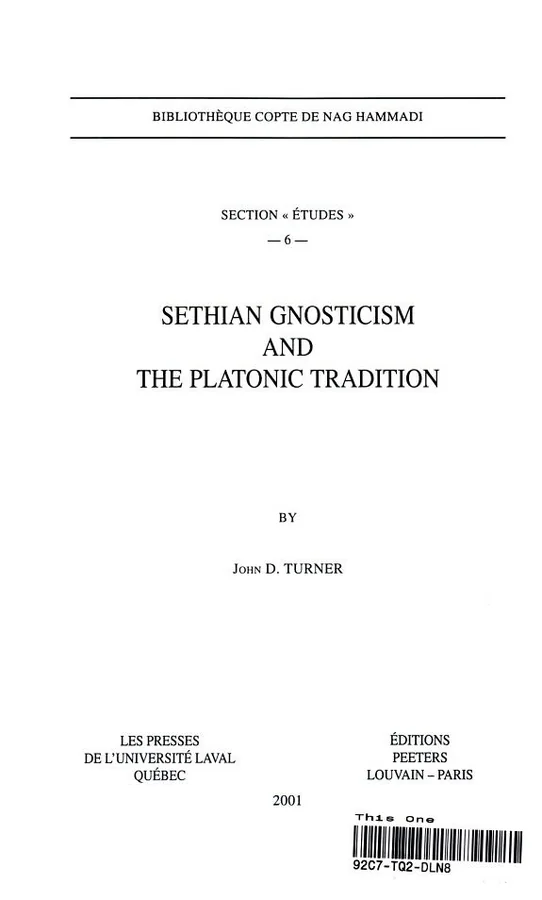
Sethian Gnosticism and the Platonic Tradition
 77
77

Sethian Gnosticism and the Platonic Tradition
John Douglas Turner’s "Sethian Gnosticism and the Platonic Tradition" presents a formidable scholarly argument for the deep entanglement of Gnostic thought with Platonic philosophy, a connection often obscured by historical polemic. The strength of the work lies in its meticulous dissection of theological and cosmological concepts, demonstrating how Gnostic systems, particularly Sethianism, can be understood as radical reinterpretations rather than outright rejections of Platonic frameworks. Turner’s analysis of the Sethian emanation schemes, for instance, effectively highlights their philosophical scaffolding, drawing clear lines to figures like Plotinus. A limitation, however, is the book's dense academic prose, which can make it less accessible to those without a strong background in classical philosophy and theological history. The chapter discussing the Sethian interpretation of the Valentinian system is particularly illuminating, showcasing Turner’s ability to draw nuanced distinctions. This is essential reading for specialists, less so for the general esoteric enthusiast.
📝 Description
77
John Douglas Turner's 2001 book connects Sethian Gnosticism to the Platonic tradition.
Published in 2001, John Douglas Turner's Sethian Gnosticism and the Platonic Tradition offers a scholarly examination of the Gnostic movement, focusing on its Sethian branch and its roots in Neoplatonism. Turner traces the intellectual lineage of Gnostic ideas, showing how they both differed from and engaged with Platonic philosophy. The book moves beyond simple labels to analyze the complex interplay of Gnostic concepts and cosmology.
This work is suited for academic readers, graduate students, and serious practitioners of esoteric studies who have a background in ancient philosophy and early Christian history. Readers interested in the philosophical bases of Gnosticism, the development of dualistic thought, and how Plato's ideas were received in antiquity will find substantial material. It is not an introduction for the casual reader but a study for those committed to rigorous academic inquiry.
The early 21st century saw renewed academic interest in Gnosticism, following the Nag Hammadi discoveries. Turner's book emerged in a period where scholars sought to understand Gnostic texts as complex philosophical and religious systems, not just heretical offshoots. It places Sethian Gnosticism within the context of Hellenistic religions and philosophies, particularly the renewed focus on Plotinus and Neoplatonism.
Turner's study situates Sethian Gnosticism within the broader currents of Hellenistic philosophy and religion. It highlights the significant philosophical dialogue between Gnostic thinkers and the Platonic tradition, particularly Neoplatonism. The book examines how Gnostic ideas about creation, divinity, and salvation were shaped by, and in turn reacted against, Platonic concepts like the One, the Good, and the Forms. This places Sethian Gnosticism not as an isolated phenomenon but as a complex intellectual current within antiquity.
💡 Why Read This Book?
• Gain a nuanced understanding of Sethian Gnosticism's philosophical architecture, learning how concepts like the Pleroma are discussed through the lens of Platonic emanations, a perspective crucial for understanding early Christian and Hellenistic thought. • Explore the intricate relationship between Gnostic cosmology and Neoplatonic metaphysics, specifically how thinkers like Plotinus influenced or were engaged by Gnostic interpretations of reality, as detailed in the book's comparative analysis. • Grasp the historical positioning of Sethian Gnosticism relative to other early religious movements, understanding its unique development within the intellectual currents of the 2nd and 3rd centuries CE.
⭐ Reader Reviews
Honest opinions from readers who have explored this book.
❓ Frequently Asked Questions
What is the primary focus of Sethian Gnosticism as discussed in the book?
The book focuses on Sethian Gnosticism as a distinct branch of Gnosticism, emphasizing its cosmological myths, the figure of Seth as a salvific intermediary, and its intricate relationship with Platonic and Neoplatonic philosophical concepts.
How does John Douglas Turner connect Gnosticism to the Platonic tradition?
Turner demonstrates how Gnostic ideas often represent reinterpretations or radical extensions of Platonic concepts, particularly concerning emanation, the nature of the divine, and the structure of the cosmos, as seen in thinkers like Plotinus.
What are 'aeons' in the context of Sethian Gnosticism presented in this book?
Aeons, as explored in the book, are divine beings or spiritual emanations originating from the ultimate Godhead in Gnostic cosmology, forming the Pleroma or fullness of the divine realm.
When was 'Sethian Gnosticism and the Platonic Tradition' first published?
The book was first published in 2001, placing it within a period of significant scholarly engagement with Gnostic studies following the Nag Hammadi discoveries.
Does the book discuss the Nag Hammadi library?
While not solely focused on it, the book implicitly engages with the scholarly understanding of Gnostic texts, many of which were brought to light by the Nag Hammadi discoveries, providing context for the materials analyzed.
Who is Plotinus and why is he relevant to this book?
Plotinus (c. 204/5 – 270 CE) was a philosopher who founded Neoplatonism. His ideas on emanation and the divine hierarchy are critically examined in the book for their parallels and divergences with Sethian Gnostic cosmology.
🔮 Key Themes & Symbolism
Gnostic Cosmology and Platonic Emanation
The work intricately maps Sethian Gnostic cosmogonies, such as the creation of the Pleroma and the role of Sophia, onto the framework of Platonic and Neoplatonic emanation theories. It details how the Sethian system, with its divine aeons and ultimate unknowable Godhead, can be seen as a philosophical elaboration or radical critique of concepts found in Plato's Timaeus and Plotinus' Enneads. The book highlights the shared emphasis on hierarchical structures of reality emanating from a supreme principle.
The Figure of Seth
A central theme is the Sethian Gnostic reverence for Seth, the third son of Adam and Eve, as a primordial salvific figure. Turner analyzes Sethian texts to understand his role as an intermediary between the divine and the material realm, often positioned as an instructor or revealer of true knowledge (gnosis). This contrasts with other Gnostic traditions and highlights a specific lineage within Gnosticism that connects humanity to the divine through this ancestral figure.
Demiurgic Intellect and Material World
The book scrutinizes the Gnostic concept of the Demiurge, the flawed creator of the material universe, and its relationship with Platonic ideas of the 'demiurgic' craftsman. Turner explores how Sethian thought often reconfigures the Demiurge not as purely malevolent but as an ignorant or lesser divine power, echoing debates within Platonic philosophy regarding the status of the material world and its architect, particularly as discussed in Plato's Republic.
Knowledge (Gnosis) and Salvation
The core Gnostic pursuit of gnosis—direct, intuitive knowledge of the divine—is examined within the Platonic context. The work illustrates how Sethian Gnosticism offered a path to salvation through this spiritual enlightenment, often achieved by understanding one's true divine origin and escaping the material prison. This aligns with Platonic ideals of the soul's ascent through philosophical understanding, albeit with distinct Gnostic theological conclusions.
💬 Memorable Quotes
Direct passages from the work, attributed to the author.
“The concept of the Pleroma in Sethian thought shares conceptual space with Platonic ideas of fullness.”
— This points to the overlap in terminology and conceptualization between the Sethian divine 'fullness' and similar ideas of completeness or perfection found within the Platonic philosophical tradition.
“Plotinus' emphasis on emanation provides a philosophical parallel to Gnostic cosmogonies.”
— This interpretation underscores the significant philosophical resonance between the Neoplatonist Plotinus' system of divine outflow and the creation narratives found in Gnostic texts.
“Seth's role is often that of a revealer of hidden divine truth.”
— This succinctly captures the salvific function attributed to Seth within Sethian Gnosticism, positioning him as a key figure for imparting esoteric knowledge necessary for spiritual liberation.
💡 Key Ideas
Editorial paraphrase of the work's core concepts — not direct quotes.
The Sethian Gnostic cosmology is often structured by a hierarchical system of divine beings.
This paraphrase highlights the organized, layered nature of Sethian divine realms, emphasizing the importance of understanding these hierarchies to grasp their theological framework and its relation to philosophical models.
The material world is understood as a product of lesser divine agencies.
This paraphrase expresses the Gnostic dualistic view of the material cosmos, distinguishing its creation from the ultimate, transcendent Godhead and linking it to imperfect or ignorant divine powers.
🌙 Esoteric Significance
Tradition
This work firmly places Sethian Gnosticism within the broader Gnostic tradition, a lineage often characterized by dualism and the pursuit of esoteric knowledge for salvation. It specifically highlights its unique relationship with the Platonic and Neoplatonic philosophical schools, demonstrating how these traditions were not mutually exclusive but often intertwined, with Gnostics engaging and reinterpreting Platonic concepts such as emanation and the nature of the Good.
Symbolism
Key symbols explored include the Pleroma, representing the fullness of the divine realm, and the Aeons, divine emanations that populate this realm. The figure of Seth himself acts as a potent symbol of divine lineage and salvific knowledge, a revealer of gnosis. The book also examines the concept of the Demiurge, often symbolized as a flawed creator, and its complex relationship to the perfect, transcendent Godhead, mirroring discussions on divine craftsmanship in Platonic dialogues.
Modern Relevance
Contemporary esoteric thinkers and scholars of comparative religion continue to draw on Turner's meticulous scholarship. His work informs modern interpretations of Gnosticism that seek to understand its philosophical sophistication rather than viewing it solely as a heretical sect. Thinkers exploring the intersections of ancient philosophy, mysticism, and the psychology of consciousness find value in the book's detailed exposition of Gnostic cosmology and its Platonic parallels.
👥 Who Should Read This Book
• Students of comparative religion and ancient philosophy seeking to understand the intellectual links between Gnosticism and Hellenistic thought, particularly Neoplatonism. • Advanced practitioners of esoteric studies interested in the cosmological frameworks and salvific paths proposed by Sethian Gnosticism, grounded in philosophical analysis. • Academic researchers specializing in early Christian history, Gnosticism, or the reception of Plato, who require a scholarly treatment of the subject.
📜 Historical Context
Published in 2001, John Douglas Turner's "Sethian Gnosticism and the Platonic Tradition" emerged during a robust period of academic inquiry into Gnosticism, significantly influenced by the mid-20th century discovery of the Nag Hammadi library. The work engaged with scholars who were moving Gnostic studies beyond mere theological polemic and into the field of complex philosophical and religious systems. Turner's analysis positioned Sethian Gnosticism within the broader Hellenistic intellectual milieu, demonstrating its deep engagement with the philosophical currents of Neoplatonism. This was particularly relevant as scholars like Pierre Hadot were re-examining ancient philosophy as a way of life, a perspective that offered new angles on Gnostic soteriology. The book implicitly addressed debates concerning the originality of Gnostic thought versus its reliance on existing philosophical traditions, particularly the ideas of Plato and later Neoplatonists such as Plotinus.
📔 Journal Prompts
The Sethian concept of the Pleroma and its Platonic parallels.
Seth's role as a revealer of gnosis within the Gnostic tradition.
The philosophical underpinnings of the Demiurge in Sethian cosmology.
Reflections on the nature of salvation through knowledge (gnosis).
The hierarchical structure of divine emanations in Sethian thought.
🗂️ Glossary
Sethian Gnosticism
A branch of Gnosticism that venerates Seth, the third son of Adam and Eve, as a key figure in salvation history and a revealer of true divine knowledge.
Platonism
A philosophical system originating with Plato, emphasizing the theory of Forms and the soul's journey toward understanding the Good and the divine.
Neoplatonism
A later development of Platonic philosophy, most notably associated with Plotinus, focusing on emanation from the One and the ascent of the soul through intellectual and spiritual disciplines.
Aeon
In Gnostic cosmology, a divine being or spiritual emanation that exists within the Pleroma, representing aspects of the ultimate Godhead.
Pleroma
The Gnostic concept of the fullness of the Godhead, a spiritual realm inhabited by Aeons, from which the material world is seen to have originated imperfectly.
Demiurge
In Gnosticism, the creator of the material universe, often depicted as ignorant of or separate from the true, supreme Godhead.
Gnosis
A Greek term meaning 'knowledge,' referring in Gnosticism to intuitive, experiential, and salvific knowledge of the divine, necessary for spiritual liberation.
This book appears in 1 collection
🔮 Readers Also Liked
Browse all →









From the “Neoplatonism” Collection
View all →






More Free Occult Philosophy Books
View all →