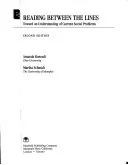
Reading Between the Lines
 76
76

Reading Between the Lines
Konradi and Schmidt's "Reading Between the Lines" presents a solid, if somewhat conventional, academic approach to dissecting social problems. Its strength lies in its systematic integration of race, class, and gender analysis, a framework that remains crucial for understanding contemporary societal stratification. The selection of readings offers a broad overview, though at times it feels more like a curated syllabus than a cohesive argument. A limitation is the text's accessibility; while aiming for clarity, some of the theoretical discussions can remain dense for readers not already versed in critical social theory. The section on conceptual frameworks, however, is particularly useful for establishing a baseline understanding of how to approach these complex issues. Ultimately, the book serves as a functional, if not groundbreaking, academic tool for its intended audience.
📝 Description
76
Published in 2001, 'Reading Between the Lines' uses diverse readings to dissect social problems.
This academic anthology, by Amanda Konradi and Martha Schmidt, offers a structured framework for analyzing social issues. It compiles various readings that employ different conceptual lenses to examine societal problems. The text specifically advocates for an integrated approach that considers the intersection of race, class, and gender.
The book is primarily for students and scholars in sociology, gender studies, and critical theory. It provides foundational understanding for analyzing social problems theoretically. Researchers and activists seeking to develop deeper perspectives on inequality and social justice will find its analytical tools useful.
'Reading Between the Lines' emerged in the early 2000s, a time of active scholarly discussion on identity politics and intersectionality. The work draws from existing research, reflecting a climate where single-axis analyses were increasingly seen as insufficient. It builds on concepts from thinkers like Kimberlé Crenshaw, engaging with academic conversations on representing and addressing complex social inequalities.
While framed as an academic anthology, 'Reading Between the Lines' engages with concepts that resonate with esoteric traditions' concern for hidden structures and power dynamics. Its focus on deconstructing interconnected systems of power, privilege, and inequality, particularly through the lens of intersectionality, echoes esoteric inquiries into the underlying forces shaping human experience and society. The book's method of revealing how seemingly separate elements (race, class, gender) combine to create complex social realities can be seen as a secular counterpart to esoteric traditions that seek to understand hidden correspondences and the interconnectedness of all things.
💡 Why Read This Book?
• Gain a structured method for analyzing social problems by learning the integrated race, class, and gender framework presented by Konradi and Schmidt, moving beyond simplistic explanations. • Understand the historical development of intersectional analysis by engaging with readings that contextualize the work within the intellectual currents of the late 20th century, referencing scholars like Kimberlé Crenshaw. • Develop critical thinking skills applicable to current events by applying the book's conceptual tools to contemporary issues, fostering a deeper comprehension of systemic inequalities.
⭐ Reader Reviews
Honest opinions from readers who have explored this book.
❓ Frequently Asked Questions
What is the primary analytical framework used in 'Reading Between the Lines'?
The book champions an integrated race, class, and gender analysis. This approach posits that these social categories are not independent but interwoven, shaping individual experiences and societal structures in complex ways.
Who are the main authors of 'Reading Between the Lines'?
The book was co-authored by Amanda Konradi and Martha Schmidt. It was first published in 2001, drawing on a wide array of research and writings.
What kind of social issues does the book address?
It addresses a broad spectrum of social problems. The focus is on providing a conceptual framework to understand these issues comprehensively, considering multiple intersecting dimensions of identity and power.
Is 'Reading Between the Lines' suitable for beginners in sociology?
While it provides a conceptual framework, some sections assume prior familiarity with sociological and critical theory concepts. However, its clear structure makes it a valuable resource for dedicated beginners aiming for a deeper understanding.
What is the significance of the 2001 publication date?
Published in 2001, the book reflects academic discourse on social issues from the turn of the millennium, integrating research and perspectives prevalent at that time.
Does the book offer practical solutions to social problems?
The book's primary aim is analytical and conceptual; it provides frameworks for understanding social problems rather than offering direct, prescriptive solutions.
🔮 Key Themes & Symbolism
Intersectional Analysis
The core of the book lies in its advocacy for intersectional analysis, moving beyond single-axis examinations of social issues. It demonstrates how race, class, and gender are inextricably linked, creating unique experiences of privilege and oppression. This approach, influenced by thinkers like Kimberlé Crenshaw, allows for a more nuanced understanding of complex social phenomena, such as systemic inequality and discrimination, by considering the overlapping and interdependent nature of social identities and power structures.
Conceptual Frameworks for Social Problems
Konradi and Schmidt provide readers with a robust conceptual toolkit for deconstructing social problems. This involves understanding how different theoretical perspectives can shape our perception and analysis of societal issues. The book guides readers in identifying the underlying assumptions and analytical approaches within various academic writings, enabling them to critically evaluate different explanations for social phenomena and construct their own informed analyses.
Critique of Power Structures
The anthology implicitly critiques dominant power structures by highlighting how systems of race, class, and gender perpetuate inequality. By examining social problems through an intersectional lens, the work exposes the ways in which societal institutions and norms can disadvantage certain groups while benefiting others. This critical perspective encourages readers to question existing social hierarchies and consider the historical and ongoing impact of these structures on lived experiences.
Integration of Diverse Readings
A significant aspect of the book is its compilation of varied academic writings. This diversity ensures that readers are exposed to multiple conceptual approaches and research findings related to social problems. The integration aims to demonstrate the breadth of scholarship available and to show how different disciplinary perspectives can contribute to a more holistic understanding of complex societal challenges.
💬 Memorable Quotes
Direct passages from the work, attributed to the author.
“The text provides a conceptual framework for understanding social problems and enables an integrated race, class, and gender analysis.”
— This central tenet outlines the book's purpose: to equip readers with analytical tools that consider the simultaneous influence of race, class, and gender, moving beyond isolated perspectives.
“Drawing from a wide selection of current research and writings, 'Reading Between the Lines' brings together accessible readings.”
— This highlights the anthology's pedagogical aim, synthesizing contemporary scholarship into a format designed for comprehension and study by students and researchers.
“The work examines a broad range of social problems and reflects different conceptual approaches.”
— This emphasizes the book's comprehensive scope, showcasing how diverse theoretical lenses can be applied to understand a wide array of societal issues.
“An integrated race, class, and gender analysis is crucial for a complete understanding.”
— This statement underscores the book's core argument: that a holistic view of social issues necessitates the simultaneous consideration of these interconnected identity categories.
“The readings provide different conceptual approaches to social problems.”
— This points to the variety of theoretical perspectives included, offering readers multiple ways to conceptualize and analyze societal challenges.
🌙 Esoteric Significance
Tradition
While not explicitly esoteric in the traditional sense, "Reading Between the Lines" engages with the metaphysical underpinnings of social constructs. Its focus on race, class, and gender as interwoven systems of power can be seen as exploring the 'invisible architectures' that shape collective reality. In this sense, it touches upon traditions that examine the hidden dynamics of societal manifestation and the energetic or symbolic forces that maintain social hierarchies, akin to how certain occult philosophies analyze the subtle planes of existence.
Symbolism
The 'lines' in the title can be interpreted symbolically. They represent the boundaries, divisions, and classifications that society imposes. 'Reading between the lines' suggests an esoteric practice of discerning the unspoken truths, the hidden connections, and the underlying energetic currents that operate beneath the surface of social discourse. The concepts of race, class, and gender themselves function as potent societal symbols, representing deeply ingrained archetypes and power dynamics that, when understood holistically, reveal deeper truths about human collective consciousness.
Modern Relevance
Contemporary scholars and activists in fields like critical pedagogy, decolonial studies, and intersectional feminism continue to draw on the principles championed in this book. Thinkers exploring systemic inequality in digital spaces, environmental justice, and global economic disparities find the integrated analytical framework essential. The work's emphasis on understanding complex oppression remains highly relevant for contemporary social justice movements seeking to dismantle complex, interconnected systems of power.
👥 Who Should Read This Book
• Students of sociology and critical theory seeking to grasp the foundational concepts of intersectional analysis, particularly as it applies to understanding social problems. • Activists and community organizers aiming to develop more nuanced strategies by understanding how race, class, and gender interact to shape social inequalities. • Educators designing curricula on social justice and inequality, looking for a text that provides a robust theoretical framework and diverse readings for classroom discussion.
📜 Historical Context
When "Reading Between the Lines" was published in 2001, the academic landscape was deeply engaged with critiques of essentialism and the growing importance of intersectional frameworks. The work arrived in the wake of decades of feminist, critical race, and class-based scholarship, building upon foundational concepts articulated by scholars like Kimberlé Crenshaw in the late 1980s and early 1990s. It responded to a need for accessible texts that could synthesize these complex theoretical developments for students. Competing schools of thought included more traditional sociological approaches that might analyze social problems through single variables or functionalist perspectives. The book's emphasis on integrated analysis positioned it within the critical theory tradition, aiming to challenge established power dynamics. Its reception was likely within academic circles, contributing to pedagogical discussions in sociology and gender studies departments, rather than eliciting widespread public commentary.
📔 Journal Prompts
The concept of integrated race, class, and gender analysis: how does this framework alter your perception of a familiar social issue?
Reflect on the 'lines' society draws between groups and the practice of reading between them.
Consider the impact of different conceptual approaches on understanding a specific social problem.
Examine how power structures are reinforced through the categories of race, class, and gender.
Analyze the effectiveness of synthesizing diverse research findings for a comprehensive view.
🗂️ Glossary
Intersectional Analysis
An analytical framework that examines how various social and political identities (such as race, gender, class, sexual orientation, disability) overlap and intersect, creating unique modes of discrimination and privilege.
Conceptual Framework
A structure that guides research or analysis by outlining the key concepts, theories, and assumptions that inform the study of a particular phenomenon.
Social Problems
Conditions or behaviors that are widely perceived as undesirable or harmful to society and that require collective action or intervention.
Race
A social construct used to categorize people based on perceived physical differences, often associated with systemic power dynamics and historical discrimination.
Class
A system of ordering society based on socioeconomic factors, often relating to wealth, income, education, and occupation, influencing social status and opportunities.
Gender
A social and cultural construct that defines roles, behaviors, expressions, and identities associated with masculinity and femininity, distinct from biological sex.
Conceptual Approaches
Different theoretical perspectives or methodologies used to understand and interpret social phenomena, each offering a unique lens on the subject matter.
This book appears in 1 collection
🔮 Readers Also Liked
Browse all →









From the “Tea Leaf Reading” Collection
View all →







More Free Occult Philosophy Books
View all →