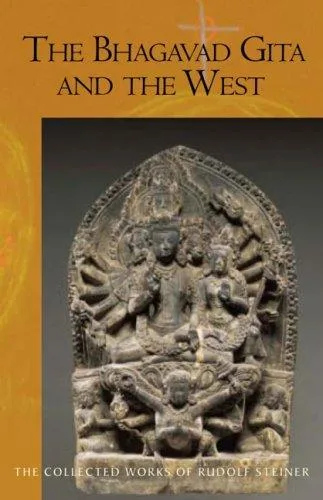
The Bhagavad Gita and the West
 80
80

The Bhagavad Gita and the West
Rudolf Steiner's engagement with the Bhagavad Gita, as presented in this collection of lectures from 1912-1913, offers a distinctive perspective on the ancient Indian scripture. His focus on Krishna as a spiritual guide for humanity, particularly in relation to Western esoteric development, is a central theme. Steiner masterfully connects the dilemmas faced by Arjuna to the challenges of modern spiritual life, framing the Gita's teachings as universally applicable. A notable strength is his ability to draw parallels between Eastern concepts and Western Christian esoteric thought, suggesting a unified spiritual source. However, the lectures, while intellectually rigorous, can be dense and require a prior familiarity with Steiner's own philosophical system (Anthroposophy) to fully grasp the nuances of his interpretations. The section discussing the 'Christ Impulse' in relation to Krishna, while central to Steiner's thesis, may be challenging for those unfamiliar with his unique Christology. Despite this, the work provides a valuable lens for understanding how a major 20th-century esoteric thinker approached one of the world's most influential spiritual texts, offering a bridge between seemingly disparate traditions.
📝 Description
80
Rudolf Steiner lectured on the Bhagavad Gita in 1912 and 1913, connecting it to Western esoteric Christianity.
This volume collects Rudolf Steiner's lectures from 1912 and 1913, focusing on his interpretation of the Bhagavad Gita and its relationship to Western esoteric Christianity. Steiner engaged with Hindu philosophy, particularly the figure of Krishna, to illuminate spiritual development accessible to Western individuals. The lectures, delivered in Cologne, Helsinki, and Basel, showcase Steiner's synthesis of Eastern and Western mystical traditions.
These talks were given in the years preceding World War I, a time of significant intellectual and spiritual questioning in Europe. Steiner, a key figure in Theosophy and the founder of Anthroposophy, aimed to articulate a spiritual science capable of countering modern materialism. His study of the Bhagavad Gita, a central Hindu scripture, was part of his effort to demonstrate the universal nature of spiritual truths across different cultures and eras, a stance distinct from contemporary Western academic study of Eastern religions.
These lectures place the Bhagavad Gita within the framework of Western esoteric traditions, particularly Anthroposophy. Steiner viewed Hindu scriptures not just as historical artifacts but as living sources of spiritual knowledge applicable to modern life. He sought to bridge the perceived divide between Eastern philosophies and Western contemplative practices, especially Christian mysticism. His work aimed to reveal an underlying unity in spiritual truths, accessible through a spiritual science he was developing.
💡 Why Read This Book?
• Gain a unique Anthroposophical interpretation of Krishna and the Bhagavad Gita, understanding them not just as Indian figures but as universal spiritual archetypes relevant to Western seekers. • Explore Steiner's specific lectures from Cologne (Dec. 1912), Helsinki (May-June 1913), and Basel (Sept. 1912) to grasp his comparative approach to Eastern and Western spiritual traditions. • Understand Steiner's concept of the 'Christ Impulse' as he relates it to the spiritual forces active in the Bhagavad Gita, offering a bridge between Hindu and Christian esoteric streams.
⭐ Reader Reviews
Honest opinions from readers who have explored this book.
❓ Frequently Asked Questions
What is the primary focus of Rudolf Steiner's lectures in 'The Bhagavad Gita and the West'?
The lectures focus on Rudolf Steiner's interpretation of the Bhagavad Gita, particularly the figure of Krishna, and how these teachings illuminate Western Christian esotericism and spiritual development.
When were these lectures originally delivered?
The lectures were delivered in 1912 and 1913, with specific dates including December 28, 1912 - January 1, 1913 (Cologne), May 28 - June 5, 1913 (Helsinki), and September 19, 1912 (Basel).
What is the connection between the Bhagavad Gita and Western esotericism in Steiner's view?
Steiner views the Bhagavad Gita as offering spiritual insights and archetypes that can be understood and integrated into the development of Western spiritual consciousness, particularly within a Christian esoteric framework.
Which volume of Rudolf Steiner's Collected Works are these lectures drawn from?
These lectures are drawn from volumes CW 142, CW 146, and CW 139 of Rudolf Steiner's Collected Works.
Who is the intended audience for this book?
The book is intended for students of Anthroposophy, comparative religion, Western esotericism, and those interested in Rudolf Steiner's unique interpretations of spiritual texts.
What is the significance of Krishna in Steiner's interpretation?
Steiner interprets Krishna not just as a historical figure but as an archetype of divine consciousness and spiritual guidance, whose teachings in the Bhagavad Gita offer a path for individual soul development applicable across cultures.
🔮 Key Themes & Symbolism
Krishna as Archetype
Steiner presents Krishna not merely as a deity from Hindu scripture but as a profound spiritual being who embodies divine wisdom and guides the soul. His role in the Bhagavad Gita is interpreted as a cosmic exemplar for individual spiritual awakening. This perspective seeks to universalize Krishna's significance beyond its Indian origins, making his teachings relevant to the spiritual evolution of humanity worldwide, especially within the Western context.
East-West Spiritual Synthesis
A central theme is Steiner's effort to bridge the perceived gap between Eastern and Western spiritual traditions. He analyzes the Bhagavad Gita's philosophical depth and its emphasis on duty (dharma) and spiritual knowledge, seeking resonances with Western esoteric Christianity. The aim is to demonstrate that underlying spiritual truths connect diverse cultures, offering a foundation for a unified global spiritual science.
Spiritual Science and Modern Life
The lectures were delivered during a period of societal upheaval and growing materialism. Steiner uses the Bhagavad Gita's narrative of Arjuna's existential crisis and Krishna's counsel as a model for confronting modern life's challenges. He frames these ancient teachings as vital resources for developing inner strength and spiritual clarity necessary for working through the complexities of the 20th century and beyond.
The Christ Impulse
Steiner connects the spiritual forces embodied by Krishna to the 'Christ Impulse,' a concept central to his own spiritual philosophy. He argues for a deeper understanding of Christ's cosmic significance that can encompass and harmonize with the spiritual insights found in Eastern traditions, suggesting a universal spiritual hierarchy and interconnectedness.
💬 Memorable Quotes
Direct passages from the work, attributed to the author.
“Krishna appears as a being who can speak to the human soul about its path of development.”
— This highlights Steiner's view of Krishna as a spiritual guide. It suggests that the Bhagavad Gita's narrative is not just a story but a pedagogical tool for understanding the soul's journey toward higher consciousness.
“Arjuna's dilemma on the battlefield mirrors the inner conflicts faced by individuals seeking spiritual understanding.”
— This interpretation frames the central narrative of the Bhagavad Gita as a timeless allegory for the human condition. It positions the text as a guide for overcoming personal crises through spiritual insight and resolve.
“Understanding Krishna's role can illuminate the path of Christ for Western esoteric practitioners.”
— This concept suggests a deliberate effort by Steiner to find parallels and connections between the spiritual significance of Krishna in Hinduism and the Christ event in Christianity, aiming for a holistic spiritual perspective.
“The lectures aimed to reveal the universal principles underlying diverse religious and philosophical expressions.”
— This interpretation underscores Steiner's broader goal of establishing a 'spiritual science' that transcends cultural and religious boundaries, demonstrating the interconnectedness of all spiritual traditions.
💡 Key Ideas
Editorial paraphrase of the work's core concepts — not direct quotes.
The spiritual truths of the East offer essential knowledge for the West's evolution.
This paraphrased concept emphasizes Steiner's belief in the complementary nature of Eastern and Western spiritual traditions. He saw value in Eastern wisdom for addressing the specific spiritual needs and challenges arising in Western civilization.
🌙 Esoteric Significance
Tradition
This work is firmly situated within the Western esoteric tradition, specifically as interpreted through the lens of Rudolf Steiner's Anthroposophy. While engaging deeply with Hindu scripture, Steiner's objective is not comparative religion in a purely academic sense, but rather to extract and recontextualize spiritual principles relevant to Western initiates. It departs from traditional Hinduism by emphasizing the Bhagavad Gita's role in fostering Western spiritual development and linking it to the esoteric understanding of Christ.
Symbolism
Key symbols include Krishna, depicted not just as a historical avatar but as an embodiment of divine wisdom and a guide for the soul's journey. The battlefield of Kurukshetra symbolizes the arena of human consciousness where inner battles between higher and lower impulses are waged. Arjuna's chariot represents the human being, with the senses, mind, and spirit needing guidance to read through the path of spiritual realization.
Modern Relevance
Contemporary Anthroposophists continue to draw on Steiner's interpretation for understanding spiritual development. His synthesis also appeals to practitioners of comparative spirituality seeking to find universal threads in diverse religious traditions. The emphasis on inner transformation and navigating modern life's challenges through spiritual insight remains relevant for individuals exploring consciousness and esoteric paths today.
👥 Who Should Read This Book
• Students of Rudolf Steiner and Anthroposophy seeking to understand his specific interpretation of Eastern scriptures and their relation to Western spiritual paths. • Researchers in comparative religion and esotericism interested in how 20th-century thinkers synthesized diverse spiritual traditions. • Individuals drawn to the Bhagavad Gita who are open to exploring its esoteric dimensions through a non-traditional, Western esoteric lens.
📜 Historical Context
The lectures collected in 'The Bhagavad Gita and the West' were delivered between 1912 and 1913, a period of intense intellectual ferment in Europe preceding the First World War. Rudolf Steiner, already a significant figure in the Theosophical Society before founding Anthroposophy, was actively engaged in synthesizing Eastern spiritual traditions with Western esoteric Christianity. This era saw a surge of interest in Eastern philosophies among European intellectuals, partly as a reaction against burgeoning materialism and industrialization. Steiner's work offered a spiritual-scientific interpretation, distinct from academic Indology or purely devotional approaches. While figures like Annie Besant and others were popularizing Vedic texts, Steiner focused on their esoteric significance for Western spiritual evolution. His approach aimed to demonstrate a universal spiritual impulse underlying both traditions, particularly linking the Krishna impulse to the Christ impulse, a controversial but central aspect of his work at the time.
📔 Journal Prompts
Arjuna's spiritual crisis before the battle: how does this manifest in contemporary life?
Krishna's role as a spiritual guide: what qualities does he embody that are essential for soul development?
The concept of 'dharma' as presented by Krishna: how can this principle inform ethical decision-making today?
Steiner's bridging of Eastern and Western spiritual streams: what are the implications for personal spiritual practice?
The battlefield as a metaphor for inner struggle: reflect on a personal challenge where spiritual insight was crucial.
🗂️ Glossary
Anthroposophy
A spiritual philosophy founded by Rudolf Steiner, seeking to understand the spiritual nature of the human being and the cosmos through a process of inner development and spiritual perception.
Krishna
In Hinduism, a major deity worshipped as the eighth avatar of Vishnu. In Steiner's interpretation, Krishna represents divine wisdom and a spiritual guide for humanity's evolution.
Bhagavad Gita
A 700-verse Sanskrit scripture that is part of the Hindu epic Mahabharata. It features a dialogue between Prince Arjuna and Lord Krishna on duty, destiny, and the path to spiritual liberation.
Christ Impulse
A central concept in Anthroposophy referring to the cosmic spiritual force associated with the incarnation, life, death, and resurrection of Jesus Christ, seen as a unique and transformative event for Earth's evolution.
Spiritual Science
Steiner's term for his epistemological and metaphysical system, which posits that the spiritual world is accessible to human cognition through specific methods of disciplined thinking and inner development.
Esotericism
Systems of belief and practice that focus on hidden knowledge, inner transformation, and direct experience of the spiritual realm, often transmitted through initiation or specialized teachings.
Dharma
A Sanskrit term with multiple meanings, often translated as duty, righteousness, cosmic law, or the intrinsic nature of things. In the Bhagavad Gita, it relates to one's righteous path and responsibilities.