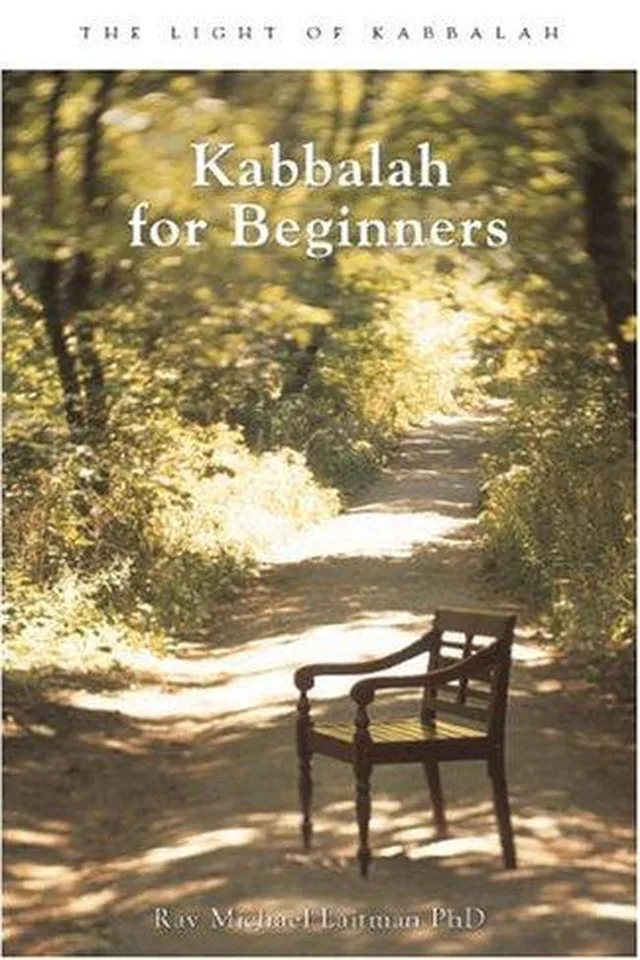
Kabbalah for beginners
 64
64

Kabbalah for beginners


Alaric Kestrel, Metaphysical Studies Reviewer: Michael Laitman's "Kabbalah for Beginners" serves as an exceptional portal into the esoteric depths of this ancient wisdom. Laitman's approach is remarkably lucid, stripping away the arcane jargon to reveal the profound philosophical underpinnings of Kabbalistic thought. He masterfully illustrates how this tradition offers a unique lens through which to understand our cosmic role and the interconnectedness of all things. The book excels in its ability to make complex concepts accessible without sacrificing their inherent mystique. It is an indispensable resource for neophytes eager to explore the spiritual architecture of reality, providing a solid foundation for further study and personal spiritual advancement.
📝 Description
64
Michael Laitman's 2006 book introduces Kabbalah's core concepts for newcomers.
Michael Laitman's "Kabbalah for Beginners" aims to make the complex system of Kabbalah accessible. The book breaks down its symbolic language and spiritual principles, presenting them as a method for self-understanding and grasping the universe's structure. Laitman argues that Kabbalah is not merely historical but a practical tool for comprehending reality and one's role within it.
This guide is intended for individuals seeking to understand the fundamental forces that shape existence. It covers key ideas within Jewish mysticism, translating them into terms that resonate with contemporary readers. The author's approach focuses on clarity, making the path to Kabbalistic insights manageable for those new to the subject.
Kabbalah is a tradition of Jewish mysticism that seeks to understand the divine nature and the creation of the universe. Its texts, such as the Zohar, are often dense and symbolic, requiring significant study. This book positions itself as an entry point into that tradition, simplifying its core tenets for those unfamiliar with Jewish mysticism or esoteric studies. It connects Kabbalistic thought to the broader human desire for meaning and comprehension of existence.
💡 Why Read This Book?
This book is essential for anyone seeking to understand their fundamental place in the universe. It offers a direct method for investigating reality and discovering hidden connections. Ideal for spiritual seekers, students of comparative mysticism, and those drawn to the profound philosophical inquiries of Jewish tradition. Read it to unlock a deeper understanding of existence and your own potential for spiritual growth.
⭐ Reader Reviews
Honest opinions from readers who have explored this book.
❓ Frequently Asked Questions
What is Kabbalah?
Kabbalah is an ancient esoteric tradition of Jewish mysticism that seeks to understand the nature of God, the universe, and humanity's role within it through symbolic interpretation and spiritual practice.
Is this book suitable for absolute beginners?
Yes, "Kabbalah for Beginners" is specifically designed to introduce the core concepts and principles of Kabbalah in an accessible and understandable manner for those with no prior knowledge.
What are the main goals of studying Kabbalah?
The primary goals involve achieving spiritual enlightenment, understanding the divine plan, and realizing one's purpose and connection to the Creator. It's about self-transformation and perceiving the underlying reality.
Does this book require a specific religious background?
While originating within Jewish tradition, the universal principles of Kabbalah explored in this book can be beneficial to seekers of any background interested in spiritual wisdom and self-understanding.
What kind of practical application can I expect from this book?
The book provides a framework for a more profound perception of life and a method for personal spiritual development. It encourages a shift in consciousness towards understanding the interconnectedness of all things.
🔮 Key Themes & Symbolism
The Ladder of Spiritual Ascent
This theme explores the Kabbalistic concept of spiritual ascent, often visualized as a ladder or series of worlds, representing the progressive stages of a soul's journey from the material realm to the divine source. It explores the inner transformation required to ascend, emphasizing the development of spiritual perception and the overcoming of egoistic desires. Understanding this ascent is crucial for grasping the Kabbalistic view of existence as a dynamic process of spiritual evolution, where each step reveals deeper layers of reality and connection.
The Unity of Creation and the Creator
At the heart of Kabbalistic thought lies the principle of absolute unity – the oneness of the Creator and all creation. This theme investigates how, despite apparent multiplicity and separation in the material world, all existence emanates from a single, unified source. It explores the concept of 'Malkhut' (Kingdom) receiving from 'Bina' (Understanding) and the continuous flow of divine energy, explaining that true perception reveals this underlying unity. Understanding this interconnectedness is key to dissolving illusion and fostering a sense of universal brotherhood and divine immanence.
The Science of Attributes and Perception
Kabbalah posits itself as a science of perception, detailing the spiritual attributes (Sefirot) through which the divine manifests and by which humans can comprehend reality. This theme unpacks the symbolic language of these attributes, explaining how they represent different facets of divine emanation and human consciousness. It highlights how studying these attributes allows one to decode the spiritual blueprint of existence and to refine one's own perception, moving from limited, ego-driven awareness to a more expansive, altruistic, and divinely aligned understanding of oneself and the cosmos.
💬 Memorable Quotes
Direct passages from the work, attributed to the author.
“Man's position in the universe is defined by his ability to perceive it.”
— This profound statement underscores the active role of consciousness in defining our reality. It suggests that true understanding comes not from passive observation, but from the development of an inner faculty to grasp the deeper, spiritual dimensions of existence.
“To know the Creator is to know oneself.”
— This aphorism points to the ultimate goal of Kabbalistic study: self-realization through understanding the divine. It suggests that the path to knowing the infinite is found within the finite self.
“Kabbalah offers a map of the soul's journey.”
— This metaphorical statement positions Kabbalah as a guide, providing a structured understanding of spiritual progression and transformation, much like a cartographer maps unknown territories for the traveler.
💡 Key Ideas
Editorial paraphrase of the work's core concepts — not direct quotes.
The universe is a reflection of our inner state.
This quote highlights the principle of correspondence between the inner and outer worlds, a central to many mystical traditions. It implies that our perception and our spiritual development are intrinsically linked to the reality we experience.
Hidden within the mundane is the eternal.
This quote invites the reader to look beyond the superficial appearances of everyday life, hinting at the presence of profound spiritual truths and divine essence woven into the fabric of the ordinary.
🌙 Esoteric Significance
Tradition
Kabbalah is a profound esoteric tradition within Judaism, deeply rooted in the interpretation of the Torah and the exploration of divine emanation. It is not merely a philosophical system but a practical method for spiritual transformation, aiming to reveal the hidden spiritual reality that underlies the physical world. Its esoteric nature stems from its symbolic language, complex spiritual architecture, and the emphasis on direct, experiential knowledge of the divine.
Symbolism
The symbolism in Kabbalah is rich and multi-layered, with the Tree of Life (Etz Chaim) being its central diagrammatic representation. This diagram illustrates the ten Sefirot (divine emanations) and the pathways connecting them, symbolizing the flow of divine energy and the structure of creation. Other key symbols include Hebrew letters, which are believed to possess creative power, and various cosmological metaphors that describe the relationship between the Creator and creation.
Modern Relevance
In the modern era, Kabbalah's relevance lies in its ability to offer a comprehensive framework for understanding existential questions and the human condition. It provides tools for self-awareness, personal growth, and the cultivation of a deeper sense of purpose and connection in an often fragmented world. Its emphasis on interconnectedness and spiritual unity speaks to contemporary desires for meaning, social harmony, and a more profound engagement with life's mysteries.
👥 Who Should Read This Book
This book is a vital resource for spiritual seekers yearning to understand the fundamental nature of reality and their place within it. Beginners to Kabbalah will find it an invaluable, accessible introduction, laying a clear foundation for further exploration. Scholars of comparative mysticism and Jewish studies will appreciate its lucid exposition of core concepts. Practitioners seeking to deepen their spiritual practice will discover practical insights into consciousness and divine connection. Ultimately, anyone with a curious mind and a desire for profound self-discovery will benefit immensely from engaging with its timeless wisdom.
📜 Historical Context
The Kabbalistic tradition, with roots stretching back to ancient Jewish esoteric practices, flourished significantly in medieval Spain and the Ottoman Empire. The Zohar, its seminal text, emerged in the 13th century, profoundly influencing subsequent Kabbalistic thought. The 16th century saw the development of Lurianic Kabbalah in Safed, which introduced complex cosmogonies and messianic interpretations. Throughout history, Kabbalah has been an internal, often secret, discipline within Judaism, studied by select scholars and mystics. Its appeal has been cyclical, experiencing resurgences of interest particularly during periods of societal upheaval or spiritual searching. Michael Laitman's work represents a modern effort to distill and disseminate these ancient teachings for a contemporary audience, adapting them for broader comprehension while retaining their core esoteric essence.
📔 Journal Prompts
Reflect on the concept of 'man's position in the universe.' How does this book's perspective challenge or affirm your current understanding?
Identify a symbol from the book that resonates deeply with you. What does it represent in your personal spiritual journey?
Consider the idea of 'hidden knowledge.' What aspects of your own life or the world around you do you suspect hold deeper, unseen meanings?
How can the principle of 'unity of creation' be applied to your daily interactions and perceptions?
Journal about your initial feelings and expectations before reading this book, and how they have evolved through its teachings.
🗂️ Glossary
Sefirot
The ten divine emanations or attributes through which the Creator reveals Himself and by which the universe is structured. They represent stages of divine manifestation and perception.
Ein Sof
Literally 'Without End,' this term refers to God in His absolute, infinite, and unknowable essence, beyond all attributes and limitations. It is the ultimate source from which all creation emanates.
Tzimtzum
The concept of divine 'contraction' or withdrawal, which created the empty space (Chalal) necessary for the existence of the created world. It signifies the Creator making room for creation.
Keter
The first Sefirah, often translated as 'Crown.' It represents the highest level of divine will and potential, the initial impulse of creation, and the ultimate aspiration of the soul.
Malkhut
The tenth and final Sefirah, often translated as 'Kingdom' or 'Sovereignty.' It represents the receptive aspect of divinity, the culmination of emanation, and the manifestation of God in the created world.
This book appears in 1 collection
🔮 Readers Also Liked
Browse all →









More by Michael Laitman
All books →





From the “Kabbalah” Collection
View all →








More Free Kabbalah & Jewish Mysticism Books
View all →