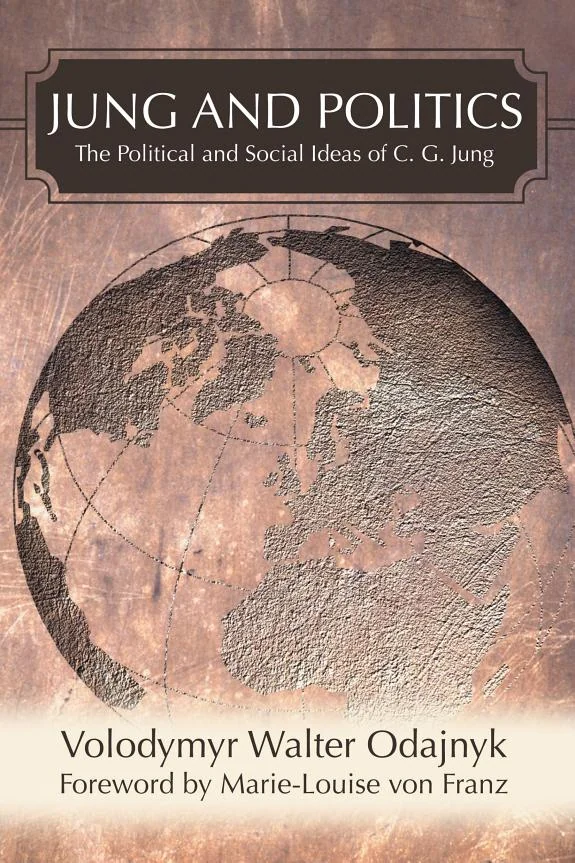
Jung and Politics
 71
71

Jung and Politics
Odajnyk's effort to distill Carl Jung's scattered political thoughts is commendable, though the result is uneven. The strength lies in its systematic compilation, bringing together disparate ideas that illuminate Jung's views on the shadow's projection onto national enemies and the dangers of collective inflation. A particularly insightful section discusses Jung's observations on the "German psychosis" during the 1930s. However, the book sometimes struggles to create a cohesive argument, occasionally feeling more like a curated bibliography than a flowing analysis. The lack of direct Jungian quotes, replaced by interpretations, while necessary given the source material, diminishes some of the author's voice. Despite these limitations, "Jung and Politics" offers a vital resource for understanding a less-explored facet of Jung's profound engagement with the human condition.
📝 Description
71
Volodymyr Odajnyk's 2007 book organizes Carl Jung's scattered political and social commentary.
This volume gathers Carl Jung's political and social commentary, which was previously dispersed throughout his extensive writings. Jung did not produce a single, systematic work on politics, so Odajnyk has consolidated his observations on how analytical psychology relates to collective life. The book provides a structured view of Jung's ideas, often found within his broader discussions of archetypes, the unconscious, and individuation.
Scholars of Jungian psychology, political theorists, and anyone interested in the connection between depth psychology and societal structures will find this compilation useful. It is especially suited for readers who want to see how Jung's concepts, like the shadow or collective unconscious, appear in political discussions and social dynamics, going beyond individual therapy. The book places Jung's ideas within the context of mid-20th century European thought. It addresses a long felt need for a clear presentation of Jung's political ideas, which were largely implicit and spread out in his works, unlike Freud's more direct comments on society. Odajnyk discusses how Jung's theories on the persona, shadow projection, collective unconscious, and archetypes shape his views on political conduct, national identity, and societal problems. It also looks at his criticisms of mass movements, the function of leaders, and the possibility of psychological regression in politics, linking individual psychic states to collective events.
This work situates Jung's political thought within the broader esoteric tradition that seeks to understand collective human behavior through psychological and symbolic lenses. Jung's focus on archetypes, the collective unconscious, and individuation draws from and contributes to a lineage of thought that looks for universal patterns in human consciousness and their manifestation in cultural and social life. By connecting these deep psychological structures to political phenomena, Odajnyk's compilation aligns with esoteric approaches that view societal events not merely as random occurrences but as expressions of underlying psychic forces and mythic patterns.
💡 Why Read This Book?
• Gain a structured understanding of Carl Jung's views on political behavior, moving beyond individual psychology to collective dynamics, as presented by Odajnyk's synthesis of Jung's work published in 2007. • Explore the application of concepts like the "shadow" and "collective unconscious" to analyze political phenomena, providing a framework for understanding societal conflicts and leadership patterns. • Understand Jung's critiques of mass movements and national psychology, offering a unique lens through which to view historical events and contemporary political discourse, as detailed in the work.
⭐ Reader Reviews
Honest opinions from readers who have explored this book.
❓ Frequently Asked Questions
Did Carl Jung write a specific book solely on politics?
No, Carl Jung did not author a systematic treatise exclusively on politics. His political and social views are dispersed throughout his extensive writings, requiring compilation and interpretation, as undertaken by Volodymyr Odajnyk in "Jung and Politics" (2007).
What are the main political concepts explored in "Jung and Politics"?
The book explores concepts such as the projection of the collective shadow onto political enemies, the psychology of mass movements, archetypal influences on national identity, and the dangers of collective inflation, drawing from Jung's broader psychological theories.
How does Jung's work relate to understanding political leaders?
Odajnyk's compilation examines Jung's perspective on how leaders can embody or exploit collective archetypes and unconscious projections, influencing public sentiment and political outcomes. This includes the potential for leaders to act as vessels for the collective shadow.
What is the "German psychosis" mentioned in relation to Jung's political thought?
This refers to Jung's analysis of the psychological state of Germany during the Nazi era, exploring how collective unconscious dynamics and archetypal forces contributed to the nationalistic fervor and aggression characteristic of the period.
Is this book suitable for someone new to Jungian psychology?
While it tackles political applications, readers unfamiliar with Jung's core concepts like archetypes and the collective unconscious might benefit from foundational reading first. The book assumes some familiarity with analytical psychology's basic tenets.
When was "Jung and Politics" by Volodymyr Odajnyk first published?
Volodymyr Odajnyk's "Jung and Politics" was first published in 2007, making it a relatively modern compilation and analysis of Carl Jung's dispersed political commentary.
🔮 Key Themes & Symbolism
Collective Shadow in Politics
The work highlights Jung's concept of the collective shadow – the repressed, dark aspects of a society or nation – and its dangerous projection onto external enemies. Odajnyk illustrates how this psychological mechanism fuels political conflict, scapegoating, and international antagonism. It’s argued that understanding this projection is crucial for de-escalating political tensions and fostering a more conscious societal attitude, moving beyond simplistic 'good versus evil' narratives prevalent in political discourse.
Archetypes and National Identity
This theme looks at how archetypal patterns, fundamental structures of the human psyche, shape collective identity and national character. Odajnyk examines Jung's ideas on how potent archetypes can be activated during times of crisis or political upheaval, influencing mass psychology and the rise of charismatic leaders. The book explores the potential for both destructive and constructive manifestations of these archetypal energies within a nation's psyche.
Critique of Mass Psychology
Odajnyk synthesizes Jung's critical stance on the dangers inherent in mass movements and collective behavior. The compilation focuses on Jung's concern that individuals in a crowd can lose their autonomy, becoming susceptible to irrational impulses and the manipulation of powerful unconscious forces. This section investigates Jung's warnings against the loss of critical thinking and the potential for psychological regression when individuals are swept up in collective fervor.
Individuation vs. Collective Inflation
A central tension explored is Jung's emphasis on individuation – the process of becoming a distinct, whole individual – versus the allure of collective inflation, where a group's inflated ego overrides individual consciousness. The book analyzes how political ideologies and nationalistic movements can foster this collective inflation, hindering personal psychological development and leading to destructive societal outcomes. Odajnyk connects this to Jung's views on ethical responsibility.
💬 Memorable Quotes
Direct passages from the work, attributed to the author.
“Jung's political views are scattered, not systematically presented.”
— This statement underscores the core challenge Odajnyk addresses: the need to compile and interpret Jung's political insights from diverse sources, as he never wrote a dedicated political treatise.
“The collective unconscious can manifest in political phenomena.”
— This interpretation highlights how shared, inherited psychic structures can influence societal behavior, political movements, and national consciousness, extending psychological analysis to the collective realm.
“Mass movements risk individual psychological regression.”
— This interpretation points to Jung's concern that the loss of individual critical thinking within a crowd can lead to irrationality and a susceptibility to dangerous collective impulses.
“Archetypes influence national character and behavior.”
— This concept captures the idea that fundamental psychic patterns shape a nation's identity and collective actions, particularly during times of political stress or transformation.
💡 Key Ideas
Editorial paraphrase of the work's core concepts — not direct quotes.
Shadow projection fuels inter-group conflict.
This paraphrased concept explains how a group's repressed negative traits are often attributed to an 'other,' leading to political antagonism and dehumanization of perceived enemies.
🌙 Esoteric Significance
Tradition
This work engages with the psychological dimensions of esoteric traditions by examining how Carl Jung's analytical psychology, which itself draws from Gnosticism, alchemy, and Hermeticism, can be applied to understanding collective phenomena. It bridges the gap between individual psychic exploration, a hallmark of esoteric practice, and the socio-political arena. The book positions Jung's ideas as a modern esoteric framework for analyzing the unconscious forces driving societal and political events, offering a psychological lens on collective spiritual and psychological maladies.
Symbolism
Key symbols explored include the "shadow," representing the repressed, unacknowledged aspects of both individuals and societies, often projected onto political 'enemies.' The "collective unconscious" serves as a symbolic reservoir of archetypes that can unconsciously shape national identity and political movements. The "persona" is examined in the context of political leaders and public figures, highlighting the often-illusory mask presented to the world versus the underlying psychic reality.
Modern Relevance
Contemporary thinkers in depth psychology, political science, and cultural studies continue to draw upon Jung's insights into collective psychology. Schools of thought focusing on archetypal psychology, critical psychology, and even certain strands of geopolitical analysis find value in Jung's frameworks for understanding societal anxieties, political polarization, and the impact of unconscious biases. Practices aiming for societal healing and conscious political engagement can utilize these compiled ideas.
👥 Who Should Read This Book
• Students of Carl Jung's analytical psychology seeking to understand the political implications of his theories beyond the individual psyche. • Political theorists and sociologists interested in applying psychological concepts, such as the collective shadow and archetypes, to analyze societal dynamics and historical events. • Individuals concerned with the psychological underpinnings of mass movements, nationalism, and political conflict, looking for a framework to understand collective behavior.
📜 Historical Context
Published in 2007, Volodymyr Odajnyk's "Jung and Politics" emerges decades after Carl Jung's death in 1961, addressing a persistent gap in Jungian scholarship. The mid-20th century, Jung's active writing period, was marked by profound political turmoil, including two World Wars and the rise of totalitarian ideologies. Jung's own engagement with these events, particularly his controversial 1930s writings on the "German psychosis," placed him in dialogue, often implicitly, with contemporaries like Hannah Arendt and Sigmund Freud, who also grappled with the psychological underpinnings of political phenomena. While Freud offered more direct psychoanalytic critiques of society, Jung's approach was often more symbolic and archetypal. Odajnyk's work seeks to consolidate these scattered insights, providing a framework for understanding Jung's unique perspective on collective psychology and political behavior in a period overshadowed by mass movements and ideological conflict.
📔 Journal Prompts
The collective shadow's projection onto political adversaries.
Archetypal influences on national identity during crises.
The individual's psychological risk within mass movements.
The tension between personal individuation and collective inflation.
Jung's critique of political rhetoric and its psychological impact.
🗂️ Glossary
Collective Unconscious
A theoretical concept introduced by Carl Jung, positing a shared reservoir of innate psychic structures and predispositions inherited by all humans, containing archetypes that influence behavior and perception.
Archetype
Universal, archaic patterns and images that derive from the collective unconscious and are the psychic counterpart of a biological instinct. They manifest in myths, symbols, and dreams.
Shadow
The unconscious or repressed aspects of the personality, both positive and negative. In a collective context, it refers to the undesirable traits a society or nation may project onto others.
Persona
The social mask or role an individual adopts to interact with the world. In politics, it can refer to the public image of leaders or parties, often concealing deeper realities.
Individuation
Carl Jung's term for the lifelong psychological process of differentiation of the self, involving the integration of conscious and unconscious elements to become a whole, unique individual.
Collective Inflation
A state where a group's collective ego becomes excessively enlarged or grandiose, often leading to hubris, intolerance, and a disregard for individual consciousness or external realities.
Projection
In psychology, the unconscious attribution of one's unacceptable thoughts, feelings, or motives to another person or group. In politics, this often fuels scapegoating and conflict.
This book appears in 1 collection
🔮 Readers Also Liked
Browse all →









From the “Collective Unconscious” Collection
View all →





More Free Occult Philosophy Books
View all →