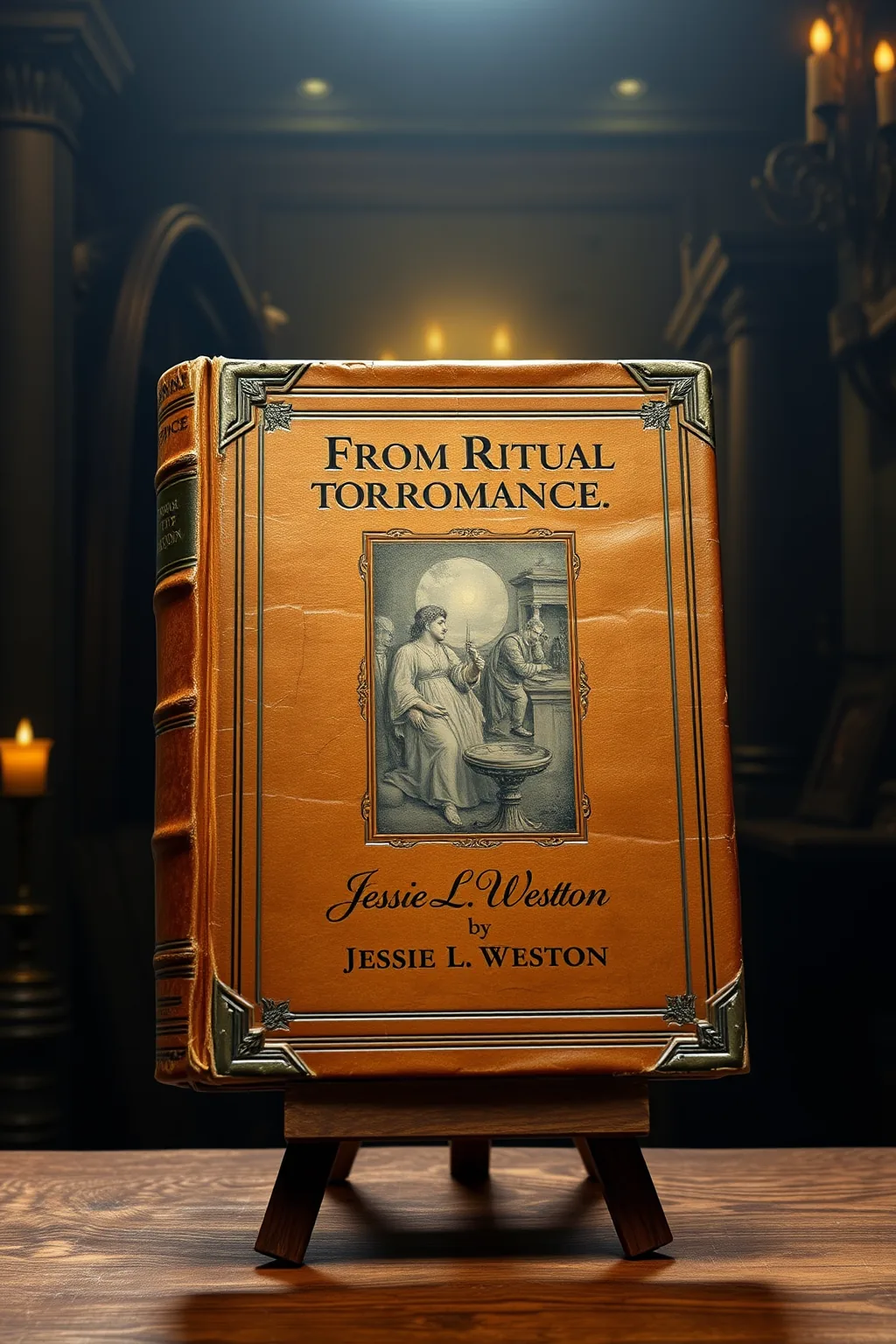
From Ritual to Romance
 62
62

From Ritual to Romance


Marcus Thorne, Esoteric Sciences Reviewer: Jessie L. Weston's "From Ritual to Romance" remains an indispensable cornerstone for anyone seeking to comprehend the esoteric underpinnings of Western civilization. Weston's meticulous scholarship brilliantly illuminates the ancient fertility cults that secretly informed the Arthurian romances, revealing the Grail quest not as a mere chivalric adventure but as a potent allegory for spiritual initiation and the restoration of cosmic balance. Her exposition of the Fisher King myth, in particular, offers profound insights into themes of sacrifice, healing, and the interconnectedness of the individual and the collective psyche. This work is essential reading for students of comparative mythology, occult history, and the enduring power of archetypal narratives.
📝 Description
62
Jessie L. Weston's 1920 book connects Arthurian romance to ancient fertility rites.
Published in 1920, Jessie L. Weston's "From Ritual to Romance" examines the Arthurian legends, positing a deep link between medieval romances and older fertility cults. Weston argues that the quest for the Holy Grail reflects an ancient spiritual journey. She deciphers the symbolism in these stories, suggesting a hidden system related to initiation and spiritual renewal. The book traces chivalric quests back to pre-Christian agricultural practices focused on divine union and the healing of the land. It aims to reveal the deeper, often overlooked, spiritual and ritualistic origins behind popular medieval tales. Weston's work suggests that the familiar narratives of knights and quests hold a forgotten layer of meaning connected to ancient mysteries.
Weston's work is situated within the early 20th-century revival of interest in Western esotericism and ancient mythologies. It places Arthurian romance within a lineage of pre-Christian mystery traditions and agrarian cults, connecting them to themes of spiritual initiation and cosmic balance. The book implicitly argues for a continuous thread of esoteric knowledge running through Western culture, visible in the symbolic language of medieval literature. It anticipates later explorations of myth and ritual's influence on Western consciousness.
💡 Why Read This Book?
Uncover the hidden spiritual lineage of the Arthurian legends and the Grail quest. Explore the deep connections between medieval romance, ancient fertility rites, and esoteric initiation. This book is vital for seekers of lost wisdom, scholars of myth and symbolism, and practitioners interested in the archetypal foundations of Western mysticism.
⭐ Reader Reviews
Honest opinions from readers who have explored this book.
❓ Frequently Asked Questions
What is the primary thesis of 'From Ritual to Romance'?
Weston's central thesis is that the Arthurian romances, particularly the Grail quest, are deeply rooted in ancient pagan fertility myths and rituals, representing a veiled tradition of spiritual initiation and the restoration of a wounded spiritual landscape.
Who was Jessie L. Weston?
Jessie L. Weston (1857-1928) was a British scholar and folklorist renowned for her groundbreaking work in comparative mythology and medieval literature, particularly her insights into the esoteric origins of the Grail legends.
What is the significance of the Fisher King?
The Fisher King is a pivotal figure representing a wounded, barren land and a spiritually incapacitated ruler. His healing is intrinsically linked to the success of the Grail quest and the spiritual awakening of the knight.
Does this book require prior knowledge of Arthurian legends?
While prior familiarity is helpful, Weston's clear and insightful prose makes the complex themes accessible. The book serves as an excellent introduction to the deeper, esoteric dimensions of these tales.
What kind of symbolism is explored in the book?
The book delves into rich symbolism related to fertility, initiation, the sacred feminine, the cycle of death and rebirth, and the quest for spiritual enlightenment, often drawn from pre-Christian European traditions.
🔮 Key Themes & Symbolism
The Grail as an Esoteric Symbol
Weston posits the Holy Grail not merely as a religious relic but as a potent symbol of divine illumination, spiritual nourishment, and the attainment of higher consciousness. Its quest mirrors the alchemical process of spiritual transformation, wherein the aspirant undergoes trials and purifications to achieve inner wholeness and reintegration with the divine. The emptiness and fulfillment associated with the Grail speak to the profound paradoxes of spiritual seeking. This theme elevates the romance from a historical narrative to a map for the soul's journey.
Ancient Fertility Rites and Their Echoes
A core part of Weston's argument is the undeniable link between the Arthurian narratives and the ancient fertility cults of Europe. She meticulously traces the symbolic language of these pre-Christian traditions – the dying and resurrected god, the sacred marriage, the wounded king, and the barren land – into the fabric of medieval romances. This connection reveals a continuity of spiritual understanding, suggesting that the chivalric ideals and the quest for the Grail are deeply embedded in the primal human need to understand and participate in the cycles of nature and divine renewal.
The Knight's Initiation and Spiritual Awakening
The journey of the Arthurian knight is reinterpreted as a profound initiatory process. Weston demonstrates how the trials, temptations, and quests faced by knights like Lancelot and Perceval are symbolic stages in their spiritual development. From the initial call to adventure to the ultimate attainment of the Grail, the knight undergoes a process of self-discovery, humbling of the ego, and the integration of the shadow aspects of the psyche. This theme underscores the book's relevance to modern seekers exploring personal growth and the path to self-realization.
💬 Memorable Quotes
Direct passages from the work, attributed to the author.
“The land is wounded, and the king is wounded, and they must be healed together.”
— This highlights the profound interconnectedness between the spiritual health of the ruler and the prosperity of the land, a central theme derived from ancient fertility myths.
“The quest for the Grail is a symbol of the soul's desire for perfection.”
— This interpretation emphasizes the Grail's role as an ultimate goal, representing the individual's inherent drive towards spiritual completeness and enlightenment.
“The mysteries of the ancient world were not forgotten, but transformed.”
— Weston suggests a continuous flow of esoteric knowledge, where ancient pagan traditions were not lost but subtly transmuted into the Christianized narratives of the Middle Ages.
“Romance is the veil through which the deeper truths are revealed.”
— This points to the literary form of romance as a deliberate method of preserving and transmitting hidden spiritual knowledge to those capable of discerning its deeper meanings.
💡 Key Ideas
Editorial paraphrase of the work's core concepts — not direct quotes.
The story of the Holy Grail is essentially the story of the quest for the knowledge of God.
This quote captures Weston's core idea that the Grail quest is not merely a physical pursuit but a profound spiritual pilgrimage aimed at achieving divine understanding and union.
🌙 Esoteric Significance
Tradition
Weston's work is deeply rooted in the study of ancient European pagan traditions, particularly fertility cults and mystery religions. She bridges the gap between these pre-Christian practices and the later development of Christian esotericism, suggesting a continuous thread of initiatory knowledge. Her analysis reveals how primal archetypes and rituals, focused on life, death, rebirth, and cosmic balance, were transmuted and recontextualized within the chivalric and Christian framework of the Arthurian romances.
Symbolism
The book masterfully deciphers a collection of symbolism. Key symbols include the Grail itself (representing divine attainment, spiritual sustenance, or the sacred feminine), the Fisher King (a wounded archetype of leadership and fertility), the barren land (reflecting spiritual or societal decay), and the quest (a metaphor for the soul's journey towards enlightenment). Weston links these symbols to ancient agricultural cycles, shamanic journeys, and the alchemical process of transformation, revealing their profound psychological and spiritual implications.
Modern Relevance
In an era often characterized by spiritual fragmentation and a search for meaning, Weston's work offers a compelling re-examination of enduring archetypes. "From Ritual to Romance" provides a framework for understanding the psychological underpinnings of quests for purpose and fulfillment. Its insights into the cyclical nature of life, death, and renewal resonate deeply with contemporary interests in ecology, personal growth, and the rediscovery of ancient wisdom traditions as pathways to holistic well-being and spiritual integration.
👥 Who Should Read This Book
This foundational text is essential for a diverse readership. **Scholars** of medieval literature, mythology, and comparative religion will find Weston's meticulous research indispensable. **Seekers** of spiritual truths and hidden knowledge will be drawn to the book's exploration of ancient mysteries and the Grail's symbolic journey. **Practitioners** of esoteric arts and those interested in archetypal psychology will discover profound connections to their own paths. Even **beginners** to Arthurian legends will find their understanding illuminated, as Weston unveils the deeper, often overlooked, esoteric dimensions that imbue these tales with timeless power and relevance.
📜 Historical Context
Jessie L. Weston penned "From Ritual to Romance" in the early 20th century, a period of intense scholarly interest in comparative mythology, folklore, and the hidden currents of Western civilization. The rise of the Theosophical Society and other esoteric movements fueled a desire to uncover ancient wisdom and find spiritual resonance in historical texts. Weston's work emerged from this fertile ground, challenging prevailing purely historical or religious interpretations of the Arthurian legends. It placed medieval romances within a broader, ancient European pagan context, arguing for a continuity of symbolism and spiritual practice that had been largely overlooked. Her scholarship was revolutionary, influencing not only literary criticism but also thinkers like C.G. Jung and T.S. Eliot, who recognized the profound psychological and archetypal dimensions of her findings.
📔 Journal Prompts
Reflect on a personal 'quest' you are currently undertaking. What are its hidden spiritual dimensions?
Consider the concept of a 'wounded land' in your own life or society. How might healing begin?
What symbols in nature or daily life resonate with themes of death and rebirth for you?
How can the idea of 'romance' serve as a veil for deeper truths in your own experiences?
Explore the archetypal journey of the knight: what trials have shaped your own spiritual development?
🗂️ Glossary
Fertility Rites
Ancient ceremonies and rituals aimed at ensuring the productivity of the land, the abundance of crops, and the continuation of life, often involving symbolic representations of divine union and cyclical renewal.
Initiation
A ceremonial process through which an individual is admitted into a new stage of life, community, or knowledge, often involving symbolic death and rebirth, and the transmission of sacred wisdom.
Archetype
A universal, primordial pattern of imagery or symbolism that is part of the collective unconscious, influencing human behavior and understanding, such as the Hero, the Mother, or the Wise Old Man.
The Grail
In Arthurian legend, a mystical object (cup, dish, or stone) central to a quest, often associated with spiritual enlightenment, divine grace, and the healing of the land.
Chivalry
The medieval knightly system of ideals and social behavior, emphasizing honor, courage, loyalty, courtesy, and the protection of the weak, which Weston reinterprets through an esoteric lens.
This book appears in 2 collections
🔮 Readers Also Liked
Browse all →









More by Jessie L. Weston
All books →

From the “Ritual Magic” Collection
View all →





More Free Magic & Ritual Books
View all →