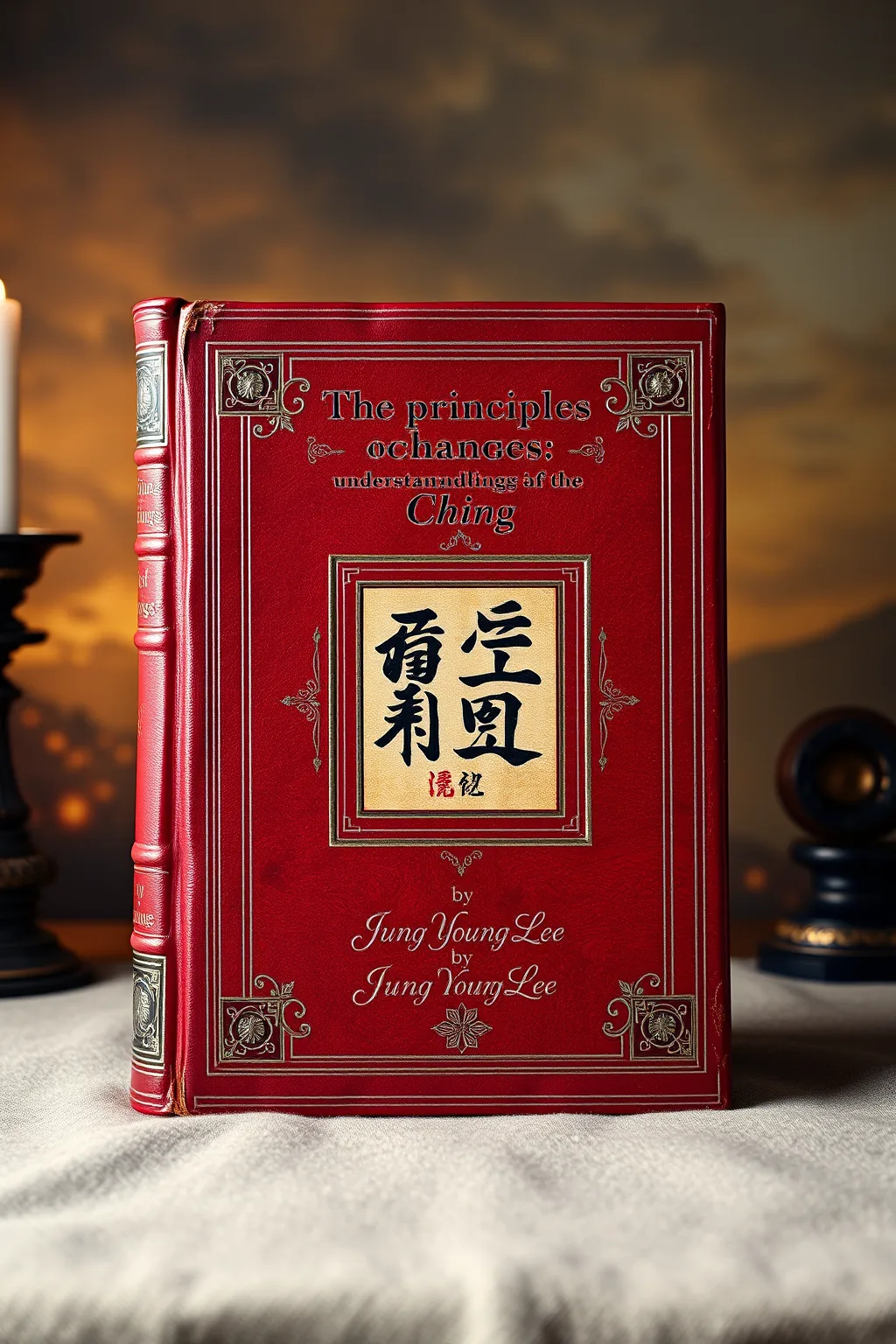
The principle of changes: understanding the I ching
 61
61

The principle of changes: understanding the I ching



Celeste Moreau (Divination & Symbolism Reviewer) — Jung Young Lee's "The Principle of Changes" stands as a beacon of clarity for those seeking to master the enigmatic I Ching. Lee masterfully demystifies the ancient text, presenting its complex symbolism and philosophical underpinnings with accessible yet profound depth. This work is an essential guide for practitioners looking to elevate their understanding beyond rote memorization, offering genuine insights into the I Ching's predictive and transformative power. Its strength lies in its ability to connect the hexagrams to universal psychological and spiritual principles, making it invaluable for serious students of esoteric arts and Eastern philosophy. An indispensable addition to any serious library on divination.
📝 Description
61
Jung Young Lee's 1981 book, 'The Principle of Changes,' interprets the I Ching's hexagrams.
Jung Young Lee's "The Principle of Changes: Understanding the I Ching" examines the ancient Chinese text not as a simple divination tool, but as a symbolic system. Lee details the seventy-two hexagrams, explaining their archetypal meanings and how they relate to human psychology and the natural world. The book emphasizes the I Ching's philosophical underpinnings, particularly the interplay of Yin and Yang, as a means to comprehend change and destiny.
This work encourages a serious engagement with the I Ching's structure and philosophy. It aims to provide a framework for understanding personal transformation and living in accordance with natural principles. Lee’s approach connects the text’s symbolism to broader existential questions.
This book situates itself within the study of the I Ching, a classic Chinese text used for divination, philosophy, and personal guidance for millennia. It is often considered part of the broader category of esoteric or hermetic traditions that seek to understand cosmic principles and their correspondence with human experience. By focusing on the symbolic meanings of the hexagrams and their connection to psychological states and natural phenomena, Lee’s work aligns with methods that interpret hidden patterns and universal laws.
💡 Why Read This Book?
Uncover the ancient secrets of the I Ching, a profound oracle that has guided sages for millennia. "The Principle of Changes" offers a deep, philosophical exploration of this symbolic language, revealing its power to illuminate personal growth and universal patterns. Ideal for seekers of wisdom, students of Eastern philosophy, and practitioners of divination who desire a truly comprehensive understanding.
⭐ Reader Reviews
Honest opinions from readers who have explored this book.
❓ Frequently Asked Questions
What is the I Ching?
The I Ching, also known as the Book of Changes, is an ancient Chinese divination text and philosophical classic. It is comprised of 64 hexagrams, each representing a fundamental situation or state of transformation, offering guidance and insight into life's complexities.
Is this book suitable for beginners?
Yes, while it delves into profound concepts, Jung Young Lee's clear explanations make "The Principle of Changes" accessible to beginners eager to understand the I Ching's core principles and symbolism.
How does the I Ching relate to divination?
The I Ching is used as a tool for divination by casting yarrow stalks or coins to generate hexagrams. These hexagrams are then interpreted using the text's commentary to provide guidance on present circumstances and future possibilities.
What are the core philosophical concepts of the I Ching?
Key philosophical concepts include the interplay of Yin and Yang, the constant flux and change inherent in the universe, the cyclical nature of time, and the importance of aligning oneself with the natural order (Tao).
What makes this book unique?
Jung Young Lee's "The Principle of Changes" distinguishes itself through its in-depth analysis of the hexagrams' symbolic language, its connection to psychological archetypes, and its philosophical richness, transcending a purely practical approach to divination.
🔮 Key Themes & Symbolism
The Dance of Yin and Yang
This book examines the fundamental duality of Yin and Yang, the cosmic forces of passive receptivity and active creativity. It illustrates how their ceaseless interplay shapes all phenomena, from the grand cycles of nature to the subtle shifts in human consciousness. Understanding this dynamic balance is crucial for interpreting the hexagrams and working through the currents of change with wisdom and foresight. The text emphasizes that true harmony arises not from the suppression of one force by the other, but from their synergistic and complementary existence, a profound lesson for both personal and universal understanding.
The Language of Symbols and Archetypes
Fundamentally, the I Ching is a profound symbolic language, a body of work woven with archetypal imagery that speaks directly to the unconscious. Lee masterfully decodes these symbols, revealing their deep psychological and spiritual resonance. Each hexagram acts as a potent archetype, reflecting universal human experiences and cosmic principles. By understanding these symbols, readers can gain clear insights into their own lives, recognizing patterns of behavior and potential pathways forward. This exploration transcends mere intellectual comprehension, inviting a visceral connection with the timeless wisdom embedded within the I Ching's visual and conceptual lexicon.
Working through the Currents of Change
The "Principle of Changes" is not about predicting a fixed future, but about understanding the perpetual flow of transformation that defines existence. The I Ching provides a framework for discerning the opportune moments for action and moments for patient observation. It teaches the art of adapting to shifting circumstances, of finding strength in fluidity, and of making choices that are in alignment with the natural unfolding of events. This book empowers readers to become active participants in their destinies, not by resisting change, but by embracing it with conscious awareness and strategic insight.
💬 Memorable Quotes
Direct passages from the work, attributed to the author.
“The wise man understands the signs of the times.”
— Highlights the I Ching's role in discerning opportune moments and understanding the underlying currents of events.
“In stillness, there is great power.”
— Refers to the value of introspection and patient observation, often represented by the Yin aspect.
“Action must be timely and aligned.”
— Emphasizes the necessity of conscious decision-making and acting in harmony with the prevailing cosmic flow.
“The hexagrams are maps of the soul's journey.”
— Suggests the I Ching's profound connection to psychological understanding and personal growth.
💡 Key Ideas
Editorial paraphrase of the work's core concepts — not direct quotes.
Change is the only constant.
A fundamental tenet of the I Ching, this quote underscores the ever-shifting nature of reality and the importance of adaptability.
🌙 Esoteric Significance
Tradition
The I Ching is deeply rooted in Taoist philosophy and ancient Chinese cosmology, embodying a profoundly esoteric worldview. It represents a system of understanding the universe through dynamic principles and symbolic correspondences, rather than rigid dogma. Its esoteric nature lies in its ability to reveal the hidden patterns and interconnectedness of all things, offering a path to spiritual insight and harmonious living by attuning oneself to the natural order.
Symbolism
The primary symbolism of the I Ching resides in its 64 hexagrams, composed of six lines, each representing either Yin (broken line) or Yang (solid line). These hexagrams are intricate diagrams depicting archetypal situations and the dynamic interplay of cosmic forces. Beyond the hexagrams, the trigrams (three-line combinations) and the individual lines themselves carry rich symbolic meanings, offering a complex lexicon for understanding the subtle shifts and transformations occurring in the universe and within the human psyche.
Modern Relevance
In the modern era, the I Ching's relevance has expanded beyond its traditional role as an oracle. Its principles of change, adaptation, and interconnectedness resonate deeply with contemporary challenges in fields ranging from psychology and systems thinking to environmentalism and personal development. The I Ching offers a timeless perspective on navigating uncertainty, understanding complex systems, and fostering personal growth by aligning with the natural rhythms of life, providing a profound and enduring source of wisdom.
👥 Who Should Read This Book
This comprehensive exploration of the I Ching is important for a diverse audience. **Beginners** eager to grasp the fundamental principles and symbolic language will find clarity and accessible guidance. **Scholars** of Eastern philosophy and comparative religion will appreciate the depth of analysis and historical context. **Seekers** of esoteric knowledge and spiritual wisdom will discover a powerful tool for self-reflection and understanding the universe's subtle workings. **Practitioners** of divination and contemplative arts will find it an essential resource for deepening their practice and gaining clear insights into the art of change.
📜 Historical Context
The I Ching, or Book of Changes, boasts a lineage stretching back over three millennia, making it one of the oldest continuously used texts in the world. Its origins are shrouded in legend, often attributed to the sage-king Fu Hsi and later refined by King Wen and the Duke of Zhou. During the Han Dynasty, it was elevated to one of the Five Classics of Confucianism, solidifying its place as a central to Chinese thought, philosophy, and governance. For centuries, it served not only as a profound philosophical treatise on the nature of reality and change but also as a vital oracle for emperors, scholars, and commoners alike, offering guidance through times of peace and upheaval. Its influence permeated Chinese culture, impacting art, literature, medicine, and military strategy, and its esoteric interpretations have continued to captivate thinkers globally.
📔 Journal Prompts
Reflect on a recent situation where understanding the interplay of Yin and Yang could have provided a different perspective.
How does the concept of continuous change manifest in your personal life?
Identify a hexagram that speaks to your current life circumstances and explore its symbolic meaning.
Consider the 'timeliness' of an upcoming decision you need to make.
Journal about a time you resisted change and the outcome. What could you have learned from the I Ching's principles?
🗂️ Glossary
Hexagram
A figure composed of six stacked horizontal lines, where each line is either Yang (solid) or Yin (broken). There are 64 unique hexagrams in the I Ching, each representing a fundamental situation or archetype.
Yin
The passive, receptive, dark, and feminine principle in Taoist philosophy and the I Ching. Represented by a broken line (--) in hexagrams.
Yang
The active, creative, light, and masculine principle in Taoist philosophy and the I Ching. Represented by a solid line (—) in hexagrams.
Trigram
A figure composed of three stacked horizontal lines, forming the building blocks of hexagrams. There are eight basic trigrams, each with specific symbolic associations.
Tao
The fundamental principle of the universe in Taoist philosophy; the Way. It represents the natural order, the source of all things, and the path of harmonious living.
This book appears in 3 collections
🔮 Readers Also Liked
Browse all →








More by Jung Young Lee
All books →
From the “Tarot” Collection
View all →









More Free Divination & Tarot Books
View all →