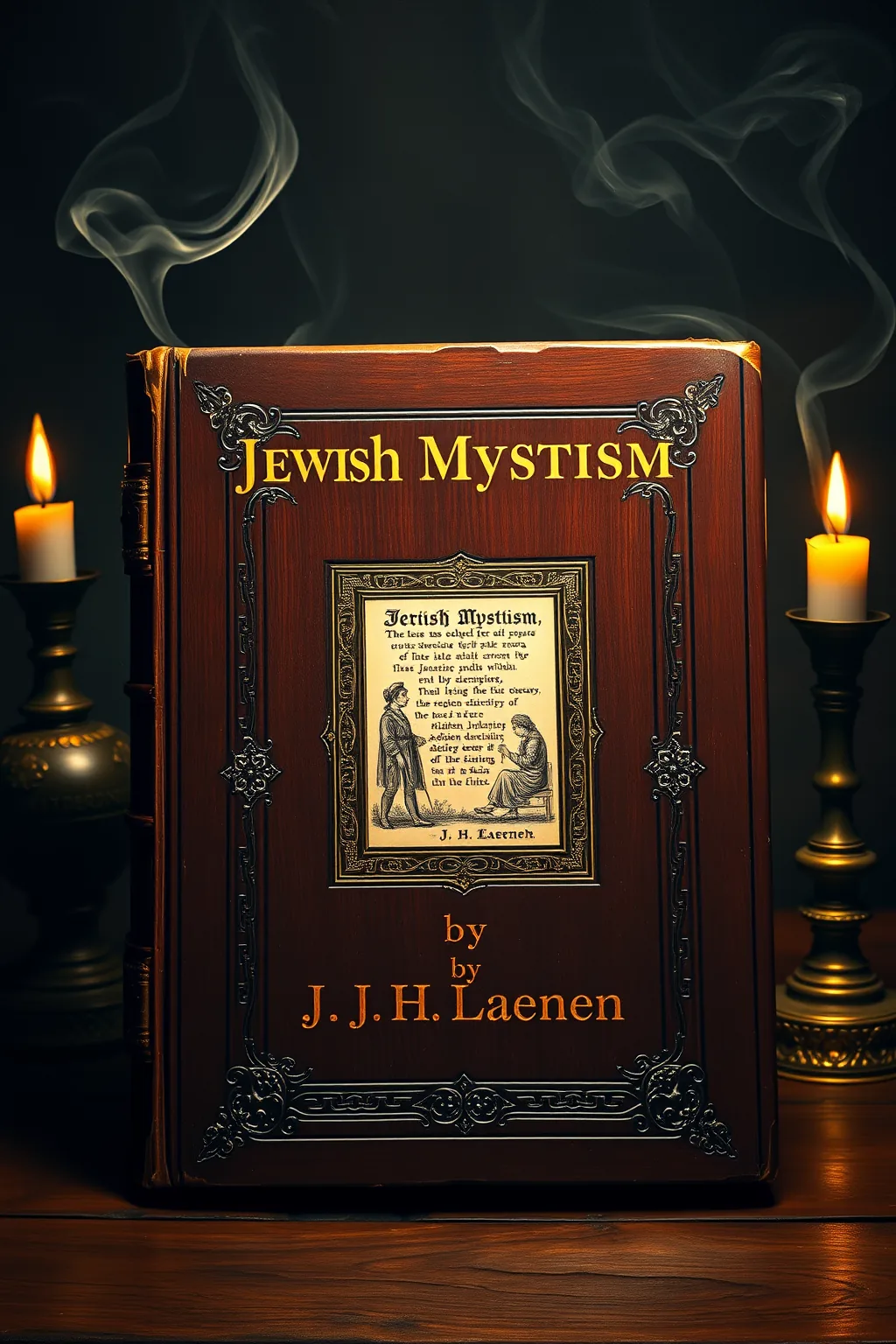
Jewish Mysticism
 61
61

Jewish Mysticism



Aurelia Blackwood (Occult Philosophy Critic) — J. H. Laenen's "Jewish Mysticism" stands as a beacon of scholarly illumination in the often-obscured realms of Kabbalah. This volume masterfully deciphers the profound symbolism and esoteric doctrines that form the bedrock of Jewish mystical thought. Laenen's meticulous research provides an authoritative yet accessible gateway for both the seasoned occultist and the curious scholar. He navigates complex theological concepts with clarity, revealing the transformative potential inherent in these ancient wisdom traditions. For anyone yearning to understand the hidden currents of spiritual insight within Judaism, this book offers an indispensable and deeply rewarding intellectual and spiritual odyssey. Its exploration of divine emanations and cosmic interconnectedness is particularly compelling.
📝 Description
61
J. H. Laenen's 'Jewish Mysticism' examines Kabbalistic thought, divine revelation, and spiritual ascent within Judaism.
J. H. Laenen's "Jewish Mysticism" analyzes the esoteric traditions within Judaism, focusing on Kabbalistic thought. The book explains the symbolic language, numerology, and ecstatic practices central to this lineage. Laenen investigates how these elements aim to connect the earthly and the celestial, the finite and the infinite. The work covers the philosophical ideas that underpin these mystical pursuits.
This study guides readers through ancient texts and traditions. It seeks to clarify the symbolic expressions and spiritual techniques that characterize Jewish mysticism. The book aims to illuminate the cosmic vision that has shaped generations of practitioners and thinkers. It is a detailed study of a tradition's spiritual inquiry.
This book situates itself within the study of Jewish mysticism, a tradition that seeks direct experience of the divine. It looks at the Kabbalah, a body of esoteric teachings developed in medieval Europe. The focus is on understanding the symbolic language, meditative practices, and cosmological frameworks used to approach God. Laenen's work addresses the historical and conceptual development of these mystical currents within Judaism.
💡 Why Read This Book?
Uncover the profound spiritual architecture of Kabbalah and Jewish mysticism. This book offers a scholarly yet accessible journey into hidden meanings, divine symbolism, and the history of esoteric thought within Judaism. Ideal for seekers of ancient wisdom, students of comparative religion, and anyone intrigued by the mystical dimensions of faith. It provides essential context for understanding esoteric traditions and the human quest for transcendence.
⭐ Reader Reviews
Honest opinions from readers who have explored this book.
❓ Frequently Asked Questions
What is Kabbalah?
Kabbalah is the esoteric tradition of Jewish mysticism, seeking to understand the divine nature and the relationship between God and creation through symbolic interpretation of scripture and mystical contemplation. It explores concepts like the Sefirot and divine emanations.
Is this book suitable for beginners?
Yes, while scholarly, Laenen's approach aims for clarity. Beginners will find it an excellent introduction to the foundational concepts and historical development of Jewish mysticism, providing a solid academic grounding.
What are the key concepts discussed?
The book delves into the Tree of Life (Sefirot), Gematria (numerology), the nature of God, creation, the soul's journey, and various mystical practices aimed at achieving divine union or understanding.
How does this book relate to other mystical traditions?
It provides a deep dive into one of the most influential Western esoteric traditions, offering insights that can be compared and contrasted with other mystical paths, highlighting universal themes of spiritual seeking.
What is the historical significance of Jewish mysticism?
Jewish mysticism has profoundly shaped Jewish philosophy, liturgy, and practice for centuries, offering a rich interpretative framework and a vibrant spiritual dimension that continues to resonate today.
🔮 Key Themes & Symbolism
The Tree of Life (Sefirot)
The central metaphor of Kabbalah, the Tree of Life, is explored as a divine map of creation and a pathway for spiritual ascent. Laenen elucidates the ten Sefirot as emanations of the divine, each representing a distinct attribute or stage of manifestation. Understanding these interconnected spheres is crucial for grasping the Kabbalistic cosmology, revealing the intricate relationship between the Infinite Creator and the created world, and serving as a key to unlocking hidden divine knowledge and achieving spiritual enlightenment.
Symbolic Language and Gematria
Jewish mysticism is deeply rooted in a rich symbolic language, where letters, words, and numbers hold profound esoteric meanings. Laenen highlights the significance of Gematria, the practice of assigning numerical values to Hebrew letters to reveal hidden connections and deeper interpretations of sacred texts. This symbolic approach is not merely academic; it is a living tradition intended to facilitate direct mystical experience and to unveil the divine order embedded within the fabric of existence, guiding the practitioner towards higher states of consciousness.
The Divine Name and Mystical Union
Central to Jewish mystical practice is the contemplation of the Divine Name and the pursuit of mystical union with God. Laenen examines the various approaches within Kabbalah to experiencing the immanence and transcendence of the Divine. This involves not only intellectual understanding but also devotional practices, meditation, and ecstatic prayer, all aimed at dissolving the perceived separation between the human soul and its Divine source, leading to profound spiritual insight and a transformative connection with the Infinite.
💬 Memorable Quotes
Direct passages from the work, attributed to the author.
“Every letter is a vessel of divine light.”
— This highlights the Kabbalistic belief that the Hebrew alphabet is not merely a system of communication but a sacred conduit through which divine energy and wisdom flow into the world.
“The soul's journey is a return to its source.”
— This speaks to the core esoteric concept of spiritual repatriation, where the soul, having descended into materiality, strives to ascend back to its divine origin through purification and gnosis.
“Silence is the language of the Infinite.”
— This suggests that the ultimate nature of the Divine is beyond conceptualization or verbal expression, best apprehended through stillness and contemplative awareness.
“The microcosm reflects the macrocosm.”
— A fundamental esoteric principle indicating that the individual human being contains within them a complete reflection of the entire universe and its divine order.
💡 Key Ideas
Editorial paraphrase of the work's core concepts — not direct quotes.
The hidden is but a veil for the revealed.
This quote suggests that what appears hidden in the physical or mundane world actually conceals a deeper, more profound spiritual reality waiting to be discovered through mystical insight.
🌙 Esoteric Significance
Tradition
This book is a reference for understanding the Kabbalistic tradition, one of the most influential and enduring esoteric streams within Western spirituality. It looks at the core doctrines, practices, and philosophical frameworks that have guided Jewish mystics for centuries, offering a profound exploration of divine emanations, the nature of reality, and the path to spiritual illumination. Its significance lies in its ability to explain complex concepts and reveal the universal quest for divine connection.
Symbolism
The esoteric significance of Jewish mysticism, as presented by Laenen, is deeply embedded in its rich symbolic language. The Tree of Life, the Hebrew alphabet, gematria, and the divine names are not mere decorative elements but potent keys to unlocking higher consciousness and understanding the cosmic order. These symbols act as a bridge between the material and the spiritual, allowing practitioners to perceive the divine immanence and transcendence in all aspects of existence, facilitating a deeper, experiential connection with the sacred.
Modern Relevance
In an age often characterized by disconnection and a search for meaning, Jewish mysticism offers useful insights into the nature of consciousness, the interconnectedness of all things, and the human capacity for spiritual growth. Laenen's work makes these ancient teachings accessible, revealing their relevance to contemporary questions about existence, purpose, and the divine. The exploration of symbolic language and contemplative practices provides tools for personal transformation and a deeper understanding of the spiritual dimensions of life, resonating with modern seekers of wisdom.
👥 Who Should Read This Book
This key work is essential for scholars of comparative religion, Jewish studies, and esoteric traditions. It is highly recommended for practitioners of Kabbalah seeking a deeper, scholarly understanding of their tradition's foundations. Aspiring mystics and spiritual seekers interested in the profound philosophical and theological dimensions of Jewish thought will find it clear. Even those new to the subject will benefit from Laenen's clear exposition, which serves as an excellent gateway into the complex and beautiful world of Jewish mysticism and its esoteric wisdom.
📜 Historical Context
The study of Jewish mysticism, particularly Kabbalah, gained significant academic traction in the late 19th and early 20th centuries, a period marked by a burgeoning interest in comparative religion, esoteric traditions, and the philosophical underpinnings of various faiths. Scholars began to move beyond purely theological interpretations to explore the historical, cultural, and mystical dimensions of Jewish thought. This era saw a critical re-evaluation of ancient texts and a recognition of Kabbalah not just as a fringe element, but as a vital and complex spiritual and philosophical system that had profoundly influenced Jewish culture and thought for centuries. Laenen's work emerges from this intellectual climate, contributing to a more nuanced and comprehensive understanding of this ancient and mystical tradition.
📔 Journal Prompts
Reflect on the concept of divine emanations (Sefirot) and how they might manifest in your own life.
Explore the idea of letters as vessels of divine light. What 'hidden messages' might ordinary words hold for you?
Consider the 'microcosm reflecting the macrocosm.' How does your individual experience mirror larger universal patterns?
Meditate on the significance of silence as the 'language of the Infinite.' What insights arise when you quiet the internal dialogue?
How does the pursuit of 'mystical union' or deep connection resonate with your personal spiritual aspirations?
🗂️ Glossary
Kabbalah
The esoteric, mystical tradition within Judaism that seeks to understand the divine nature and the relationship between God and creation through symbolic interpretation and contemplative practices.
Sefirot
The ten divine emanations or attributes of God, often represented as a diagram known as the Tree of Life, central to Kabbalistic cosmology.
Gematria
A method of interpreting Hebrew scripture by assigning numerical values to letters and words, seeking hidden meanings and connections based on these calculations.
Ein Sof
The Kabbalistic term for the 'Infinite' or 'Without End,' referring to God in His absolute, unknowable, and transcendent aspect before any divine manifestation.
Tikkun Olam
A Hebrew phrase meaning 'repairing the world.' In Kabbalistic thought, it refers to humanity's role in restoring cosmic harmony and spiritual wholeness through righteous actions and spiritual striving.
This book appears in 1 collection
🔮 Readers Also Liked
Browse all →









From the “Kabbalah” Collection
View all →





More Free Kabbalah & Jewish Mysticism Books
View all →





![[Mitsṿat ahavat Yiśraʼel]](/img/thumb/mitsvat-ahavat-yisraʼel-menahem-mendel-schneersohn-604606.webp)