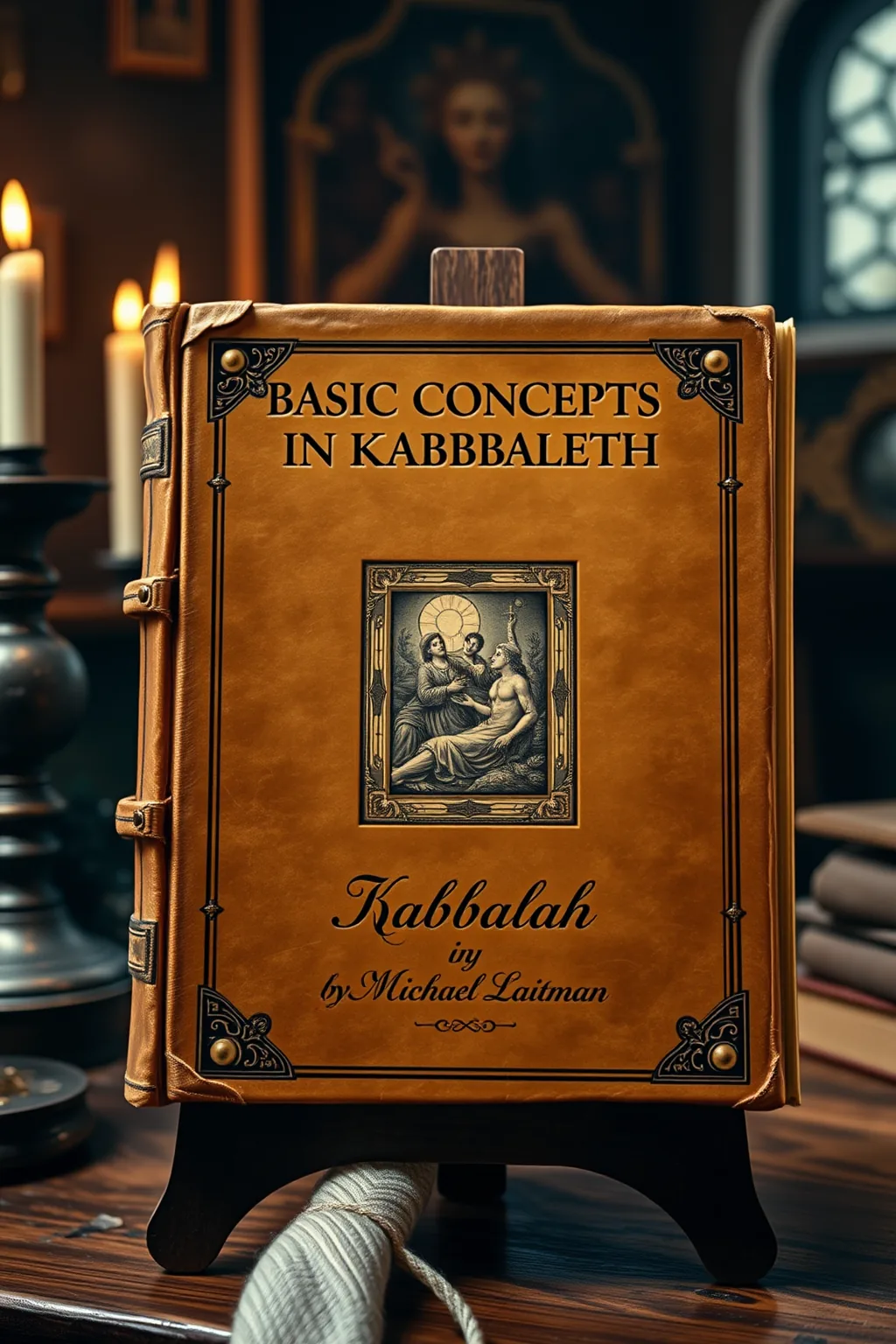
Basic Concepts in Kabbalah
 61
61

Basic Concepts in Kabbalah


Celeste Moreau (Divination & Symbolism Reviewer) — Michael Laitman's 'Basic Concepts in Kabbalah' serves as an indispensable guide for those seeking to penetrate the profound depths of Jewish esoteric thought. Laitman's lucid explanations unravel complex Kabbalistic principles, making them accessible without sacrificing their inherent mystical power. He skillfully navigates the Tree of Life, the Sefirot, and the divine names, revealing their symbolic resonance and practical application for spiritual growth. This book is a beacon for serious students and curious souls alike, offering not just knowledge but a pathway to inner transformation. It is particularly valuable for its ability to connect ancient wisdom with contemporary existential questions.
📝 Description
61
Michael Laitman's 2006 book, 'Basic Concepts in Kabbalah,' explains core Kabbalistic ideas.
This book introduces fundamental Kabbalistic principles as taught by Michael Laitman. It aims to make the wisdom of Jewish mysticism accessible to contemporary readers. The text examines spiritual ascent, the concept of divine emanations (sefirot), and the interconnectedness of all things. Laitman interprets ancient Kabbalistic sources, explaining their symbolic language and underlying esoteric ideas.
The writing encourages readers to set aside prior assumptions and develop a clearer grasp of existence. It offers a structured way to understand the universe as a unified entity driven by purposeful, interconnected forces. The book serves as an introduction for those interested in esoteric thought and the deeper aspects of creation.
Kabbalah, originating in medieval Jewish mysticism, presents a symbolic interpretation of the Torah and the nature of God and creation. Its teachings often involve complex cosmological models, divine emanations, and methods for spiritual development. This tradition, while deeply rooted in Jewish scripture and practice, has also influenced broader esoteric and occult thought. Laitman's work engages with these traditional frameworks, seeking to articulate them for a modern audience.
💡 Why Read This Book?
Unlock the ancient secrets of spiritual reality and the hidden order of the universe. 'Basic Concepts in Kabbalah' offers a clear, accessible entry point into the profound wisdom of Jewish mysticism, perfect for seekers yearning for deeper meaning and practitioners seeking to refine their understanding of spiritual mechanics. Explore the foundational principles that govern creation and discover your place within the divine tapestry.
⭐ Reader Reviews
Honest opinions from readers who have explored this book.
❓ Frequently Asked Questions
What is the primary goal of studying Kabbalah?
The primary goal is to comprehend the true nature of reality, the Creator, and humanity's role in the grand design, ultimately leading to spiritual attainment and unity with the Divine.
Is this book suitable for beginners with no prior knowledge?
Yes, 'Basic Concepts in Kabbalah' is specifically designed as an introductory text, meticulously explaining core concepts in a clear and progressive manner for those new to the subject.
What is the Tree of Life in Kabbalah?
The Tree of Life is a central symbolic diagram representing the emanations of the Divine and the spiritual structure of the universe, outlining the path of creation and spiritual ascent.
Are there practical applications of Kabbalistic study?
Absolutely. Kabbalistic principles offer profound insights into personal transformation, understanding relationships, and perceiving the underlying spiritual forces at play in daily life.
How does Kabbalah relate to other spiritual traditions?
While rooted in Jewish tradition, Kabbalah shares universal mystical themes with other esoteric paths, focusing on the divine essence, spiritual evolution, and the interconnectedness of all beings.
🔮 Key Themes & Symbolism
The Sefirot and Divine Emanations
This core concept explores the ten Sefirot, divine attributes or emanations through which the Infinite Light manifests and creates the universe. Laitman elucidates their symbolic representation on the Tree of Life, detailing how each Sefirah embodies a unique aspect of divine will and energy, from the most transcendent to the most immanent. Understanding these emanations is crucial for grasping the Kabbalistic cosmology and the process by which creation unfolds, offering a map of spiritual reality and the pathways for human connection to the divine source.
The Tree of Life as a Cosmic Map
The Tree of Life is presented not merely as a diagram but as a dynamic blueprint of existence. Laitman guides readers through its intricate structure, revealing how the interconnected paths and spheres represent the flow of spiritual energy, the stages of creation, and the journey of the soul. This sacred geometry serves as a profound tool for meditation, self-discovery, and understanding the underlying order of the cosmos. It is the central mandala of Kabbalistic thought, offering a visual language for the ineffable.
The Nature of the Creator and Creation
At the heart of Kabbalah lies the profound exploration of the Creator, often described as the Infinite Light (Ein Sof), and the intricate process of creation. Laitman looks at the concept of Tzimtzum (contraction), the divine act that made space for creation, and the subsequent emanations that formed the spiritual and physical worlds. This theme addresses the fundamental questions of existence, purpose, and the relationship between the transcendent divine and the manifest reality, inviting a contemplation of the universe as a purposeful, loving manifestation.
💬 Memorable Quotes
Direct passages from the work, attributed to the author.
“The Creator desires to bestow delight upon His creations.”
— This fundamental Kabbalistic tenet highlights the inherent benevolence of the Divine, suggesting that the entire universe exists to fulfill this desire for giving and receiving joy.
“The purpose of life is to attain the Creator's quality.”
— This points to the ultimate goal of spiritual development in Kabbalah: to align one's own nature with the selfless, loving attributes of the Divine through conscious effort and spiritual practice.
“The spiritual world is the cause and the material world is the effect.”
— This highlights the Kabbalistic understanding of causality, where all tangible phenomena are seen as the direct consequence of underlying spiritual forces and intentions.
“Man is a bridge between the spiritual and the material.”
— This emphasizes the unique role of humanity in Kabbalah, possessing the capacity to connect with and integrate both spiritual and material realms, thereby facilitating the revelation of the Divine in creation.
💡 Key Ideas
Editorial paraphrase of the work's core concepts — not direct quotes.
Everything that exists is a manifestation of the Infinite Light.
This quote emphasizes the monistic nature of Kabbalah, asserting that all reality, from the most subtle spiritual realms to the material world, is a direct expression of a single, unified divine source.
🌙 Esoteric Significance
Tradition
This work is firmly rooted in the Kabbalistic tradition, a mystical and esoteric interpretation of Judaism that seeks to understand the nature of God, creation, and humanity's relationship with the divine. It draws heavily on the Zohar, the foundational text of Kabbalah, and subsequent developments such as Lurianic Kabbalah, presenting its insights as a path to spiritual enlightenment and self-realization within a Jewish framework.
Symbolism
The book meticulously deciphers the strong symbolism inherent in Kabbalah, with the Tree of Life serving as its central symbolic structure. It explores the profound meanings behind the Sefirot (divine emanations), Hebrew letters, numerical Gematria, and various scriptural allegories. These symbols are not mere decorations but represent dynamic forces and spiritual principles that govern the universe, acting as keys to unlocking deeper levels of consciousness and understanding.
Modern Relevance
In an era often characterized by materialism and spiritual searching, 'Basic Concepts in Kabbalah' offers a timeless framework for understanding the interconnectedness of all things and the underlying purpose of existence. It provides tools for personal transformation, ethical development, and a deeper appreciation of the spiritual dimension of life, making ancient mystical wisdom profoundly relevant to contemporary challenges and aspirations.
👥 Who Should Read This Book
This book is an invaluable resource for a diverse audience. **Beginners** seeking an accessible entry into the complex world of Kabbalah will find Laitman's clear explanations a gentle yet profound introduction. **Spiritual seekers** of all backgrounds drawn to esoteric wisdom and the mysteries of creation will discover a body of insight. **Students of comparative religion and mysticism** will find it an essential text for understanding a central tradition. **Practitioners** of spiritual disciplines looking to deepen their theoretical understanding and connection to the divine will benefit from its foundational teachings.
📜 Historical Context
Kabbalah, meaning 'reception' or 'tradition,' emerged from the esoteric currents of Judaism in the medieval period, flourishing particularly in 13th-century Spain with the Zohar, its foundational text. It developed as a response to both philosophical rationalism and mystical yearning, seeking to understand the divine nature and the hidden meanings within the Torah. The Kabbalistic tradition has undergone various phases, from the speculative and theological to the more practical and ecstatic forms like Lurianic Kabbalah. Michael Laitman's work draws upon this rich historical lineage, particularly the Hasidic and Kabbalistic schools, aiming to present its ancient wisdom in a relevant and accessible manner for contemporary seekers, bridging the gap between historical esoteric knowledge and modern spiritual inquiry.
📔 Journal Prompts
Reflect on your personal perception of the 'Infinite Light' and how it might manifest in your daily life.
Consider the concept of the Tree of Life as a map for your own spiritual journey. Where do you see yourself on its paths?
How can the principle of 'bestowing delight' be applied to your interactions with others?
What does the idea of 'spiritual cause and material effect' mean to you, and how might it influence your perspective?
Explore a personal challenge through the lens of Kabbalistic symbolism. What hidden spiritual lesson might it hold?
🗂️ Glossary
Ein Sof
The Kabbalistic term for the Infinite, Unknowable Divine Essence that exists beyond all conceptualization and manifestation, the primordial state of God.
Sefirot
The ten divine emanations or attributes through which the Infinite Light (Ein Sof) manifests and creates the universe, often depicted on the Tree of Life.
Tzimtzum
Literally 'contraction' or 'reduction,' this is the Kabbalistic concept of God's self-withdrawal or contraction to make space for creation, initiating the process of emanation.
Keter
The first Sefirah on the Tree of Life, representing the Divine Will, the Crown, the highest and most transcendent aspect of the emanation, closest to Ein Sof.
Malchut
The tenth and final Sefirah, representing the Kingdom, the physical world, the receptacle for divine energy, and the manifestation of the Divine in the lowest realm.
This book appears in 1 collection
🔮 Readers Also Liked
Browse all →







More by Michael Laitman
All books →





From the “Kabbalah” Collection
View all →







More Free Kabbalah & Jewish Mysticism Books
View all →