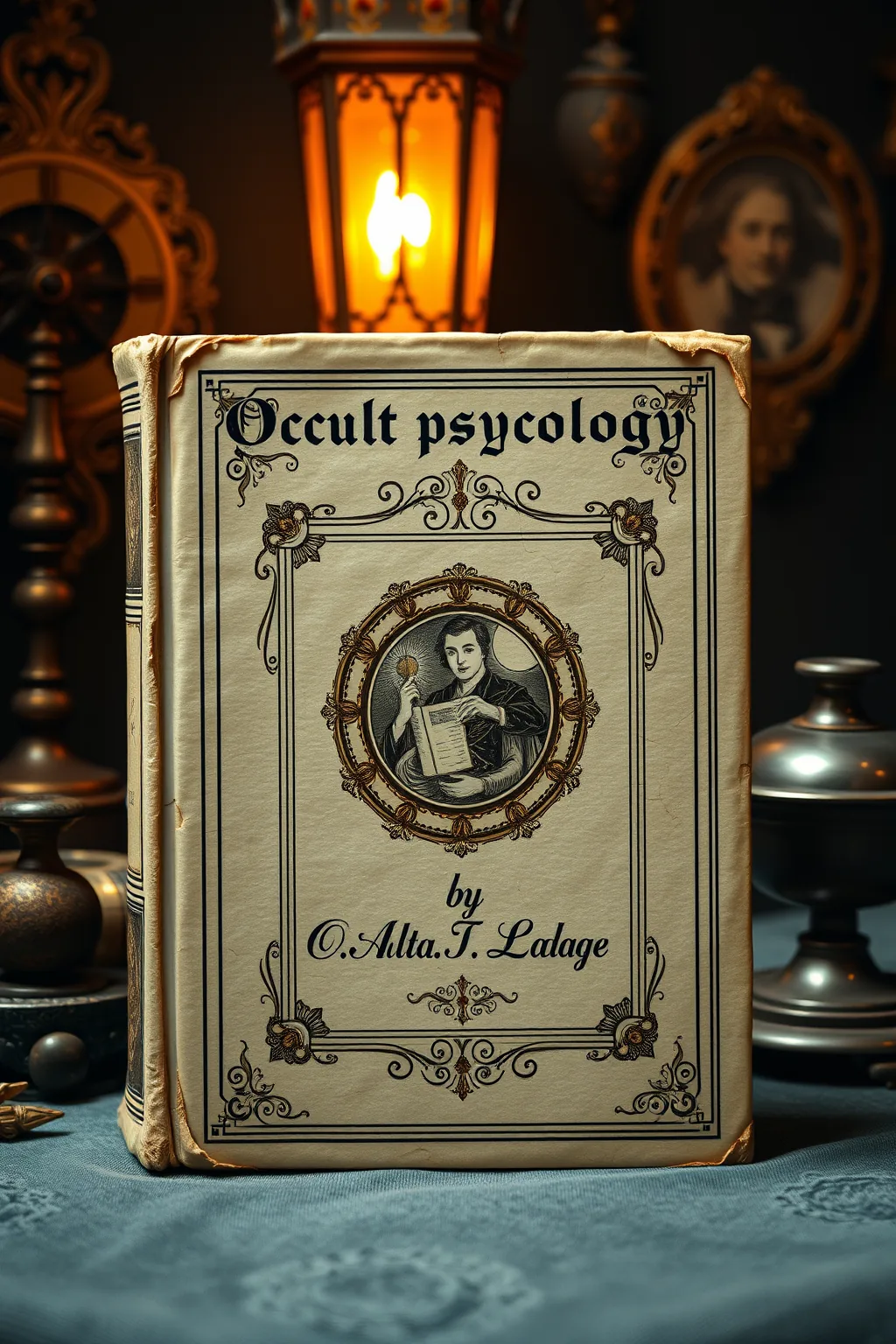
Occult psychology
 61
61

Occult psychology



Ophelia Vance, Mystical Literature Reviewer: Alta J. LaDage's 'Occult Psychology' is a revelation, a luminous synthesis of Kabbalistic lore and Jungian psychoanalysis. LaDage navigates the intricate symbolism of the Tree of Life with unparalleled clarity, illuminating its profound resonance with the unconscious mind. This work offers esoteric insights into archetypal patterns and the soul's journey, making complex Qabalistic concepts accessible without sacrificing their mystical depth. It's an essential read for anyone seeking to integrate spiritual wisdom with psychological understanding, particularly those drawn to the rich tapestry of Jewish mysticism. A truly transformative text.
📝 Description
61
Alta J. LaDage's 'Occult Psychology' (1977) connects Kabbalah's Tree of Life to Jungian archetypes.
Published in 1977, Alta J. LaDage's 'Occult Psychology' seeks to map the human psyche using the Qabalah, specifically its Tree of Life. LaDage draws parallels between the ten sephiroth and stages of psychological and spiritual development. The book aims to show how this ancient Jewish mystical system offers a framework for understanding consciousness and the self. It presents the Tree of Life not just as a theological diagram, but as a symbolic map for inner exploration.
The work examines the symbolic language of the Qabalah and relates it to Jungian psychology's concepts of archetypes and the unconscious. LaDage's intention is to provide a structured approach for individuals interested in both esoteric traditions and psychological insight. The book is written for those who wish to engage with these ideas through introspection and intellectual study, aiming for a deeper understanding of existence.
This book belongs to the Western Esoteric Tradition, specifically the branch that integrates Kabbalah with modern psychological thought. It follows a lineage of thinkers who sought to find correspondences between mystical systems and the inner workings of the mind. The Qabalah, a complex system of Jewish mysticism, has historically been a source for esoteric explorations in Europe. LaDage's contribution is to explicitly link its structure, particularly the Tree of Life, with the theoretical framework established by Carl Jung.
💡 Why Read This Book?
Unravel the profound connections between ancient Kabbalistic principles and modern psychological theories. 'Occult Psychology' offers a unique roadmap for understanding the depths of the human psyche through the lens of esoteric wisdom. Ideal for seekers of hidden knowledge, scholars of mysticism, and practitioners of spiritual disciplines who wish to integrate their inner and outer worlds.
⭐ Reader Reviews
Honest opinions from readers who have explored this book.
❓ Frequently Asked Questions
What is the primary aim of 'Occult Psychology'?
The book aims to bridge the gap between Kabbalistic symbolism and Jungian psychology, offering a unique framework for understanding the human psyche and its spiritual dimensions through esoteric knowledge.
Is prior knowledge of Kabbalah or Jungian psychology required?
While beneficial, extensive prior knowledge is not strictly necessary. LaDage provides clear explanations, making the work accessible to dedicated newcomers eager to learn.
How does this book differ from standard psychological texts?
Unlike standard texts, 'Occult Psychology' delves into the symbolic and metaphysical aspects of the psyche, drawing upon ancient mystical traditions to explore consciousness and spiritual development.
Who is the intended audience for this book?
The book is ideal for those interested in esoteric philosophy, Jewish mysticism, Jungian psychology, and individuals on a path of spiritual and personal growth seeking deeper self-understanding.
What is the significance of the Tree of Life in this context?
The Tree of Life serves as a central metaphor and map, illustrating the structure of the cosmos, the divine emanations, and the stages of psychological and spiritual evolution within the human soul.
🔮 Key Themes & Symbolism
The Kabbalistic Framework of the Psyche
This theme explores how the intricate structure of the Kabbalistic Tree of Life serves as a profound metaphor for the architecture of the human psyche. LaDage illuminates how the ten Sephiroth represent not only divine emanations but also distinct stages and facets of consciousness, from the primal unconscious to the integrated self. The pathways connecting these spheres become symbolic representations of psychological processes, spiritual ascent, and the transformative journey of individuation. Understanding this framework allows for a deeper comprehension of archetypal forces and the hidden dynamics that shape our inner world.
Archetypal Resonance and the Unconscious
The book intricately ties Jungian concepts of archetypes and the collective unconscious with the symbolic language of Kabbalah. LaDage demonstrates how the ancient figures and narratives embedded within Jewish mystical tradition offer powerful expressions of universal human experiences and psychological patterns. The Sephiroth, for instance, can be seen as corresponding to fundamental archetypes, providing a wide range for exploring the contents of the unconscious mind. This exploration reveals how esoteric symbolism can unlock clear insights into our deepest motivations, fears, and aspirations, fostering a more integrated and conscious existence.
The Alchemical Transformation of Consciousness
Central to 'Occult Psychology' is the concept of spiritual alchemy, viewed through the lens of both Kabbalah and Jungian psychology. LaDage presents the journey of psychological and spiritual development as an alchemical process of refinement and transformation. The ascent through the Sephiroth mirrors the alchemical stages of dissolution, purification, and reintegration, leading towards a more unified and illuminated consciousness. This theme emphasizes the potential for profound personal metamorphosis, where by understanding and integrating the hidden aspects of the self, one can achieve a higher state of being and spiritual awareness.
💬 Memorable Quotes
Direct passages from the work, attributed to the author.
“The unconscious speaks in the language of symbols.”
— This highlights the book's focus on deciphering the symbolic expressions of the psyche, drawing parallels between dream imagery, myth, and Kabbalistic iconography.
“The path upward is the path inward.”
— This adage underscores the book's emphasis on introspection and the idea that true spiritual progress is achieved through a deep exploration of one's inner landscape.
💡 Key Ideas
Editorial paraphrase of the work's core concepts — not direct quotes.
The Tree of Life is a map of the soul's journey.
This quote captures the core thesis, presenting the Kabbalistic Tree as a symbolic guide to understanding the structure and progression of human consciousness and spiritual development.
Within the shadow lies the seed of light.
Reflecting Jungian concepts of the shadow, this quote suggests that confronting and integrating our darker aspects is essential for spiritual growth and illumination.
To know oneself is to know the divine.
This quote emphasizes the reciprocal relationship between self-knowledge and spiritual realization, a central tenet in many esoteric traditions, including Kabbalah.
🌙 Esoteric Significance
Tradition
This work is deeply rooted in the esoteric tradition of Kabbalah, specifically drawing upon its cosmological diagrams, symbolic language, and mystical interpretations of scripture and divine emanations. It also engages with the broader Hermetic and alchemical traditions, which share common ground with Kabbalistic thought in their emphasis on symbolic transformation and hidden correspondences.
Symbolism
The primary symbolism revolves around the Kabbalistic Tree of Life, with its ten Sephiroth and twenty-two paths, serving as a comprehensive map of the cosmos, the divine, and the human psyche. Other key symbols include the Hebrew alphabet, divine names, and archetypal figures that represent various stages of consciousness and spiritual evolution, all interpreted through a psychological lens.
Modern Relevance
In an age often characterized by psychological fragmentation and a search for meaning, 'Occult Psychology' offers a powerful, integrated model for self-understanding. Its synthesis of ancient wisdom and modern psychology provides a robust framework for exploring consciousness, archetypes, and spiritual growth, resonating with contemporary seekers of holistic well-being and profound self-awareness.
👥 Who Should Read This Book
This book is a rich source for those starting a path of profound self-discovery. Beginners to esoteric studies will find a clear yet deep introduction to Kabbalistic concepts interwoven with accessible psychological principles. Scholars of comparative religion and psychology will appreciate its unique synthesis and rigorous exploration. Seekers yearning for a more mystical understanding of their inner world will find their questions illuminated. Practitioners of spiritual disciplines will discover potent metaphors and frameworks for deepening their practice and integrating their experiences.
📜 Historical Context
Written during a period of burgeoning interest in esoteric traditions and their potential integration with emerging psychological sciences, 'Occult Psychology' emerges as a significant contribution to the literature of the early 20th century. The era was marked by a departure from purely materialistic viewpoints, with thinkers like Carl Jung exploring the depths of the human psyche through archetypes and the collective unconscious. Simultaneously, there was a resurgence of interest in ancient mystical systems, including the Kabbalah, which offered symbolic frameworks for understanding existence and consciousness. Alta J. LaDage's work stands as a proof of this intellectual ferment, daring to bridge these seemingly disparate realms and offering a compelling argument for their inherent interconnectedness. It reflects a desire to find meaning beyond the empirical, seeking wisdom in the symbolic and the transcendent.
📔 Journal Prompts
Reflect on a personal challenge and identify which Sephiroth on the Tree of Life might represent the energies at play.
Consider a recurring dream or symbol and explore its potential Kabbalistic or Jungian interpretations.
How does the concept of the 'shadow self' resonate with your understanding of spiritual growth?
If the Tree of Life is a map of the soul, what stage of the journey do you feel you are currently navigating?
Explore the idea of 'divine emanations' in your own life. Where do you perceive them manifesting?
🗂️ Glossary
Sephiroth
The ten divine emanations or attributes of God in Kabbalah, forming the structure of the Tree of Life and representing stages of creation and consciousness.
Tree of Life (Etz Chaim)
A central diagram in Kabbalah, depicting the relationship between God and the created universe through ten interconnected spheres (Sephiroth) and twenty-two paths.
Archetype
In Jungian psychology, a universal, inherited pattern of thought or imagery derived from the experience of the human race, present in the collective unconscious.
Unconscious
In Jungian psychology, the part of the mind that contains repressed memories, desires, and instincts, and that exerts influence on conscious behavior.
Gematria
A Kabbalistic method of interpreting scripture by calculating the numerical value of Hebrew letters and words to find hidden meanings or connections.
This book appears in 1 collection
🔮 Readers Also Liked
Browse all →








From the “Kabbalah” Collection
View all →







More Free Kabbalah & Jewish Mysticism Books
View all →