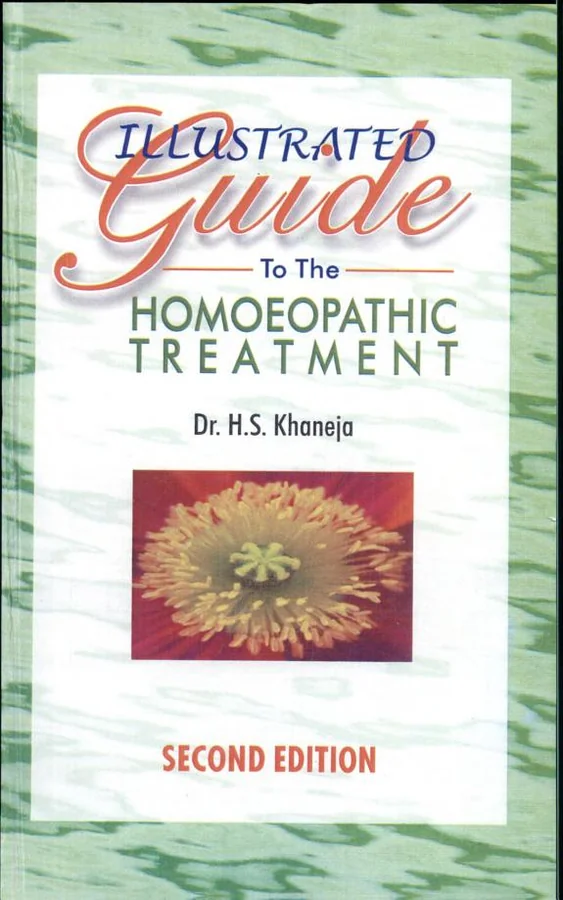
Illustrated Guide to Homoeopathic Treatment
 79
79

Illustrated Guide to Homoeopathic Treatment
H.S. Khaneja's *Illustrated Guide to Homoeopathic Treatment* offers a commendably direct approach to a field often characterized by dense, labyrinthine texts. Its strength lies in its clear, symptom-disease organizational structure, making it an accessible tool for practitioners focused on rapid case correlation. I found the section on fever presentations particularly well-executed, offering a concise comparison of remedies based on specific febrile symptoms. However, the guide’s utility is somewhat constrained by its brevity; it presupposes a familiarity with homoeopathic materia medica, acting more as a cross-referencing tool than a comprehensive learning resource. While it champions individualization, it could benefit from deeper exploration of the mental and emotional symptom nuances that are critical to selecting a true simillimum. Nonetheless, for practitioners seeking a quick, reliable handbook to augment their existing knowledge, this guide provides a valuable, if limited, utility.
📝 Description
79
Published in June 2004, H.S. Khaneja's Illustrated Guide to Homoeopathic Treatment aids practitioners in case analysis.
This guide serves as a practical reference for homoeopathic practitioners. It is organized by disease and symptom presentation, allowing practitioners to compare a patient's symptoms against potential homoeopathic remedies. The book aims to streamline diagnosis and prescription by providing a structured method for case analysis.
It is suitable for homoeopaths of all experience levels. Beginners will find it a clear, organized resource for learning case analysis. Seasoned professionals can use it to refine their case-taking and analysis, ensuring thoroughness in remedy selection. The guide supports those committed to individualizing patient care in healing.
Khaneja's work builds on the principles established by Samuel Hahnemann in the late 18th century. Homoeopathy emerged as a medical philosophy during a time of scientific change, proposing alternatives to contemporary practices like bloodletting. This book focuses on detailed symptom comparison, engaging with the ongoing homoeopathic discussion about balancing symptom totality with miasmatic diagnosis.
💡 Why Read This Book?
• You will learn a systematic method for comparing a patient's specific symptom totality with potential remedies, directly referencing the organizational structure by diseases and symptoms outlined in the book. This offers a concrete pathway to enhancing diagnostic precision in homoeopathic practice. • Gain practical skill in individualizing cases by understanding how to precisely match unique patient presentations to specific remedies, as demonstrated by the comparative symptom-remedy format detailed in H.S. Khaneja's guide. • Appreciate the historical development of homoeopathic case analysis by understanding how this handbook builds upon the foundational principles of individualization established by early homoeopaths, situating it within the broader evolution of this medical art.
⭐ Reader Reviews
Honest opinions from readers who have explored this book.
❓ Frequently Asked Questions
What is the primary benefit of using H.S. Khaneja's 'Illustrated Guide to Homoeopathic Treatment' for case analysis?
The primary benefit is its structured organization by diseases and symptoms, which facilitates a quick and reliable comparison between a patient's unique symptom totality and potential homoeopathic remedies, aiding in accurate individualization.
When was the 'Illustrated Guide to Homoeopathic Treatment' first published?
The book was first published in June 2004, making it a relatively modern handbook for practitioners of homoeopathy.
Who is the intended audience for this homoeopathic guide?
It is intended for practitioners of homoeopathy, including students and experienced professionals, who need a handbook to assist in the task of individualizing cases and selecting appropriate remedies.
How does this guide help in remedy selection?
The guide helps by allowing practitioners to compare the totality of a patient's symptoms with various remedies, organized systematically by disease and symptom presentation, thereby supporting precise remedy matching.
Is this book a comprehensive materia medica, or a guide for case taking?
It functions primarily as a guide for case taking and analysis, designed to assist practitioners in the task of individualizing cases by providing a structured way to compare symptoms and remedies.
What is the core principle of homoeopathy emphasized by this guide?
The core principle emphasized is individualization, meaning the careful consideration of each patient's unique set of physical, mental, and emotional symptoms to select the most similar remedy.
🔮 Key Themes & Symbolism
Symptom Totality & Individualization
The central theme is the homoeopathic principle of individualization, where the practitioner must consider the complete picture of a patient's unique symptoms—physical, mental, and emotional—rather than just a disease label. Khaneja's guide facilitates this by organizing information to allow for direct comparison of these specific symptoms against known remedy profiles, ensuring that the chosen remedy is the 'simillimum' that most closely matches the patient's entire presentation.
Disease and Symptom-Based Repertorization
This guide provides a structured method for repertorization, a key homoeopathic practice. It is organized specifically by diseases and their associated symptoms. This allows practitioners to systematically cross-reference a patient's presented ailments with a curated list of remedies known to affect those specific symptoms. The approach aims to simplify the complex task of remedy selection by offering a clear, comparative framework.
Practical Handbook for Practitioners
The Illustrated Guide is conceived as a quick and reliable handbook, aiming to be a practical tool for daily use by homoeopathic practitioners. Its design prioritizes efficiency and ease of access to information, enabling practitioners to swiftly consult and compare data during patient consultations. This focus on practicality underscores its role as a supportive resource for clinical application rather than a theoretical treatise.
The Art of Case Taking
Underpinning the guide's utility is the art of case taking – the meticulous process of eliciting and recording a patient's symptoms. The book implicitly guides the practitioner by providing a framework for analyzing the gathered information. By organizing remedies according to symptom presentations, it encourages a thorough examination of each detail presented by the patient, reinforcing the homoeopathic axiom that the remedy should match the disease as it appears in the individual.
💬 Memorable Quotes
Direct passages from the work, attributed to the author.
“Organized by diseases and symptoms, the case taker can compare the totality of symptoms with remedies.”
— This statement captures the book's core functionality: a structured system for matching a patient's complete symptom picture to appropriate homoeopathic remedies, thereby streamlining the diagnostic process.
“A quick and reliable handbook to assist the practitioner of Homoeopathy with the task of individualizing cases.”
— This highlights the guide's practical purpose as a dependable resource designed to simplify the complex homoeopathic objective of treating the individual, not just the disease.
“It aids in individualizing cases.”
— A concise interpretation of the book's primary goal: to support practitioners in tailoring their treatment to the unique characteristics of each patient, a fundamental tenet of homoeopathy.
“The organization by disease and symptom allows for comparison.”
— This emphasizes the structured approach of the guide, which breaks down complex information into digestible categories of disease and symptom for easier reference and remedy correlation.
💡 Key Ideas
Editorial paraphrase of the work's core concepts — not direct quotes.
The work facilitates the comparison of symptom totality with remedies.
This paraphrased concept emphasizes the book's role as a comparative tool, enabling practitioners to juxtapose a patient's unique symptoms against the known effects of various homoeopathic substances.
🌙 Esoteric Significance
Tradition
Homoeopathy, while often presented as a medical system, possesses strong esoteric underpinnings rooted in vitalism and the concept of a vital force, aligning it with broader traditions that explore subtle energies and the interconnectedness of mind, body, and spirit. Its principle of 'like cures like' (similia similibus curentur) can be seen as a manifestation of sympathetic magic or resonance, a concept found in Hermetic and Alchemical traditions. Khaneja's guide, by focusing on the precise matching of energetic patterns (symptoms) to energetic substances (remedies), adheres to this esoteric framework of energetic correspondence.
Symbolism
The core symbolism in homoeopathy, and by extension in Khaneja's guide, lies in the remedy itself as a symbol for the patient's state. Each remedy, with its specific symptom profile, becomes a symbolic representation of a particular illness manifestation or energetic imbalance. The act of 'individualizing' a case involves discerning the unique symbolic language of the patient's suffering and finding the corresponding symbolic language of a potentized substance. The potency and dilution process itself can be viewed through an alchemical lens, symbolizing the extraction and refinement of a substance's essential, energetic essence.
Modern Relevance
Contemporary practitioners of holistic medicine, energy healing modalities, and even some integrative physicians draw upon the principles articulated and systematized in works like Khaneja's guide. The focus on individualized treatment and the exploration of subtle energetic influences continues to inform practices such as naturopathy, vibrational medicine, and certain forms of psychotherapy that integrate mind-body-spirit approaches. Thinkers and practitioners in these fields often reference the foundational concepts of homoeopathy as a precursor or parallel system to their own work in understanding and treating the whole person.
👥 Who Should Read This Book
• Beginning students of homoeopathy seeking a clear, organized introduction to case analysis and remedy correlation based on symptom presentation. • Experienced homoeopathic practitioners looking for a quick reference handbook to enhance their efficiency in matching remedies to complex patient cases. • Alternative medicine practitioners interested in understanding the foundational principles and practical application of homoeopathic individualization as a model for holistic treatment.
📜 Historical Context
H.S. Khaneja's *Illustrated Guide to Homoeopathic Treatment*, published in 2004, emerges within a long lineage of homoeopathic literature dedicated to systematizing the practice established by Samuel Hahnemann in the early 19th century. Homoeopathy itself arose during a period of intense medical exploration, offering a stark alternative to invasive treatments like bloodletting and purging prevalent in the era of Hahnemann's contemporaries such as Benjamin Rush. While Khaneja's work is contemporary, its methodology of symptom-based repertorization reflects the efforts of early 20th-century homoeopaths like James Tyler Kent, whose repertories became standard references. The enduring appeal of homoeopathy, despite ongoing scientific skepticism and debates with conventional medicine, is evident in the continued publication of such guides. Khaneja's contribution engages with the persistent challenge within homoeopathy: balancing the detailed symptom picture with broader miasmatic or constitutional understanding, a discourse that has seen various interpretations throughout its history.
📔 Journal Prompts
The symptom totality as a map for remedy selection.
How the organization by disease and symptom illuminates the path to the simillimum.
The practitioner's role in discerning the unique symbolic language of a patient's suffering.
Comparing the efficiency of symptom-based repertorization versus other diagnostic methods.
The concept of individualization in healing and its practical application.
🗂️ Glossary
Homoeopathy
A system of alternative medicine based on the principle 'like cures like' (similia similibus curentur), using highly diluted substances that are believed to stimulate the body's self-healing mechanisms.
Individualizing Cases
The homoeopathic process of treating a patient based on their unique set of symptoms (physical, mental, emotional) rather than a general disease classification.
Totality of Symptoms
The complete collection of a patient's characteristic symptoms, including peculiar, rare, and striking manifestations, which are used to select the most similar remedy.
Repertorization
The process of analyzing a patient's symptoms and using a repertory (an index of symptoms and their corresponding remedies) to find the most indicated homoeopathic remedy.
Simillimum
The homoeopathic remedy that is most similar to the totality of the patient's symptoms, considered the ideal choice for treatment.
Materia Medica
A comprehensive reference work detailing the symptoms, effects, and therapeutic uses of homoeopathic remedies.
Potency
In homoeopathy, the degree of dilution and succussion (vigorous shaking) applied to a substance, believed to increase its energetic strength or curative power.
This book appears in 1 collection
🔮 Readers Also Liked
Browse all →









From the “Homeopathy” Collection
View all →








More Free Occult Philosophy Books
View all →