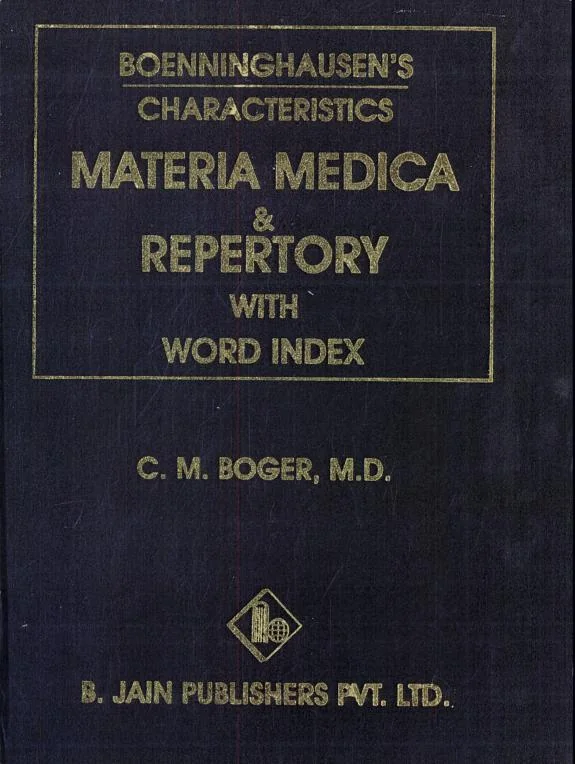
Boenninghausen's Characteristics Materia Medica & Repertory with Word Index
 77
77

Boenninghausen's Characteristics Materia Medica & Repertory with Word Index
The consolidation presented by C. M. Boger, drawing from Boenninghausen's extensive 19th-century work, offers a significant resource for the dedicated homeopath. Its primary strength lies in the sheer depth and organization of the repertory sections, bringing together disparate works into a cohesive whole. The inclusion of the 'Sides of the Body' section, for instance, provides a highly specific lens for differential diagnosis that remains clinically relevant. However, the volume's density can be a significant hurdle. Boger’s editorial hand, while comprehensive, does not always simplify Boenninghausen’s intricate system for the uninitiated. A particular passage detailing the rubrics for fever, while exhaustive, requires considerable prior knowledge of homeopathic terminology to fully parse. It is an indispensable tool for advanced study, but not an introductory text. The verdict: a formidable reference for the serious practitioner, demanding diligence but rewarding with precision.
📝 Description
77
Boenninghausen's Characteristics Materia Medica & Repertory, published in 2002, consolidates the work of a homeopathic pioneer.
This 2002 volume, edited by C. M. Boger, collects and indexes the significant repertory writings of Clemens Maria von Boenninghausen. It brings together several of Boenninghausen's key contributions to homeopathic materia medica and repertory into a single, organized reference. The book provides a structured look at homeopathic symptomology as Boenninghausen cataloged it. Boenninghausen, an associate of Samuel Hahnemann, developed his meticulous approach to symptom description and categorization in the 19th century. His work reflects a period of growing interest in vitalistic medicine and the detailed classification of natural observations. This compilation is especially useful for those seeking to understand Boenninghausen's specific diagnostic and therapeutic methods. The text is dense and best suited for students and practitioners who already have a foundation in classical homeopathy. It is not designed for absolute beginners but offers substantial value for those aiming to deepen their knowledge of Boenninghausen's system. The volume focuses on systematic repertorization, a method that organizes symptoms to help in selecting the correct remedy. It includes Boenninghausen's contributions from works like the 'Pocket Book,' the 'Psoric and Antipsoric Repertories,' and specific sections on 'Intermittent Fever' and 'Sides of the Body.' This structured format enables practitioners to pinpoint potential remedies by carefully matching them to a precise symptom picture, emphasizing characteristic and peculiar symptoms.
Clemens Maria von Boenninghausen (1785-1864) was a significant figure in the development of classical homeopathy, a system often considered within esoteric or vitalistic traditions. His meticulous cataloging of symptoms and remedies, influenced by Samuel Hahnemann, sought to capture the specific 'essence' of disease and its corresponding medicinal counterpart. This approach aligns with esoteric practices that emphasize understanding underlying patterns and correspondences rather than purely material explanations. Boenninghausen's focus on characteristic symptoms and his development of repertory tools reflect a desire to systematize this understanding, making it applicable for therapeutic purposes.
💡 Why Read This Book?
• Gain access to Boenninghausen's systematic approach to symptomology, particularly the 'Sides of the Body' section, offering a unique method for pinpointing remedies based on laterality unavailable in more general repertories. • Understand the historical development of homeopathic repertories by engaging with the consolidated works of a key figure alongside Hahnemann, appreciating the intellectual landscape of 19th-century vitalistic medicine. • Enhance diagnostic precision through the 'Psoric and Antipsoric Repertories,' learning to identify deeper miasmatic influences that Boenninghausen meticulously cataloged, offering a pathway beyond superficial symptom matching.
⭐ Reader Reviews
Honest opinions from readers who have explored this book.
❓ Frequently Asked Questions
What is the primary difference between Boenninghausen's original works and this consolidated edition?
This 2002 edition by C. M. Boger amalgamates several of Boenninghausen's key repertory texts, including the 'Pocket Book' and 'Psoric and Antipsoric Repertories,' into a single volume for easier reference, unlike their original separate publications.
Who was Clemens Maria von Boenninghausen and what was his contribution to homeopathy?
Boenninghausen (1785-1864) was a close associate of Samuel Hahnemann and a significant figure in early homeopathy, known for his meticulous cataloging of symptoms and his development of influential repertories.
Is Boenninghausen's Characteristics Materia Medica & Repertory suitable for beginners in homeopathy?
No, this text is dense and assumes a foundational understanding of homeopathic principles and terminology. It is best suited for intermediate to advanced practitioners seeking detailed repertory information.
What specific types of repertories are included in this compilation?
The book includes sections from Boenninghausen's 'Pocket Book,' his 'Psoric and Antipsoric Repertories,' and specific repertories for 'Intermittent Fever' and 'Sides of the Body'.
What is the significance of the 'Sides of the Body' section in this repertory?
This section is crucial for differentiating remedies by meticulously detailing symptoms that manifest on the left or right side of the body, offering a precise diagnostic tool.
When was C. M. Boger's edition of Boenninghausen's work first published?
C. M. Boger's compilation and editing of Boenninghausen's Characteristics Materia Medica & Repertory was first published in August 2002.
🔮 Key Themes & Symbolism
Systematic Symptom Cataloging
The core of this work lies in Boenninghausen's meticulous approach to organizing disease symptoms. Unlike broad overviews, it presents a structured, cross-referenced catalog designed to guide practitioners toward specific remedies based on detailed symptom presentations. This method emphasizes characteristic and peculiar symptoms, reflecting a key tenet of classical homeopathy developed in the 19th century, distinguishing it from more generalized medical texts of the era.
Miasmatic Theory in Practice
The inclusion of the 'Psoric and Antipsoric Repertories' highlights Boenninghausen's engagement with the concept of miasmata, particularly psora, as described by Hahnemann. These sections attempt to map remedies to underlying chronic constitutional conditions, suggesting that effective treatment requires addressing not just acute complaints but the deeper, often hereditary, patterns of disease. This provides a framework for understanding chronic illness within a vitalistic paradigm.
Laterality and Localization
The dedicated 'Sides of the Body' section is a evidence of Boenninghausen's focus on precise localization of symptoms. In homeopathy, where the body is viewed holistically, the exact side (left or right) on which a symptom appears can be a critical differentiator between remedies. This highly specific approach allows for a finer degree of diagnostic refinement, moving beyond general symptom descriptions to pinpoint nuances.
Consolidation of Foundational Texts
This volume serves as a crucial aggregator of Boenninghausen's seminal repertory works, originally published at different times. By bringing together the 'Pocket Book,' fever repertories, and others under one cover, C. M. Boger provides a unified reference point. This consolidation makes accessible a significant portion of Boenninghausen's contribution to the development of homeopathic materia medica and repertory science.
💬 Memorable Quotes
Direct passages from the work, attributed to the author.
“The Repertory Section Contains The Pocket Book, The Psoric And Antipsoric Repertories, The Repertory Part Of Intermittent Fever, And The Sides Of The Body.”
— This statement directly outlines the scope of the repertory compilation, emphasizing the breadth of Boenninghausen's original works that have been unified. It highlights the practical, reference-oriented nature of the volume for practitioners.
“A Condensation Of All Boenninghausen S Work.”
— This blurb suggests the comprehensive nature of the edited volume, aiming to present the essential contributions of Boenninghausen in a more accessible, unified format than their original, potentially scattered, publications.
“The Pocket Book”
— Referencing one of Boenninghausen's early and influential works, this term signifies a foundational element within the compilation, representing a concise yet thorough repertory designed for practical application by physicians.
“Psoric and Antipsoric Repertories”
— These specific sections point to Boenninghausen's application of Hahnemann's miasmatic theory, mapping remedies to chronic constitutional states rooted in psora, a concept central to understanding long-term illness in classical homeopathy.
“Sides of the Body”
— This rubric indicates a focus on precise symptom localization, a key differentiating factor in homeopathic prescribing. It allows practitioners to differentiate between similar remedies based on whether symptoms manifest on the left or right side.
🌙 Esoteric Significance
Tradition
This work firmly belongs within the tradition of classical homeopathy, a branch of vitalistic medicine that developed from Hermetic and alchemical principles concerning the essence of substances and their effect on the vital force. While not overtly mystical in its language, homeopathy's premise that 'like cures like' and its reliance on infinitesimally diluted substances (potentization) place it in dialogue with esoteric concepts of energetic correspondences and subtle bodies.
Symbolism
The 'Sides of the Body' section can be interpreted symbolically, representing the duality inherent in manifestation – the polarities of left and right, yin and yang, often seen in Hermetic and Gnostic thought. The concept of 'Psora' itself, as a deep-seated miasm, functions as a symbolic representation of primal energetic disruptions or inherited patterns within the vital force, akin to ancestral burdens or karmic imprints.
Modern Relevance
Contemporary classical homeopaths continue to rely on Boenninghausen's meticulous cataloging, particularly his repertories. Practitioners seeking to refine their prescribing by focusing on characteristic symptoms and miasmatic understanding find his work indispensable. The structured approach also influences modern research into symptom analysis and remedy differentiation within the homeopathic field.
👥 Who Should Read This Book
["• Dedicated classical homeopaths seeking to deepen their understanding of symptom analysis and remedy differentiation through Boenninghausen's precise methods.", "• Students of homeopathic history interested in the evolution of repertory work and the contributions of Hahnemann's early associates, particularly Boenninghausen's role.", '• Practitioners who value a systematic, structured approach to case-taking and wish to incorporate detailed rubrics concerning symptom localization and miasmatic influence.']
📜 Historical Context
Clemens Maria von Boenninghausen's work, as presented in this 2002 compilation, emerged from the fertile ground of 19th-century homeopathy, a period marked by intense development and systematization following Samuel Hahnemann's initial discoveries. Boenninghausen, a close collaborator and contemporary of Hahnemann, was instrumental in refining the repertory method, moving beyond initial symptom lists to more structured symptom analysis. This era saw vigorous debate and experimentation within the burgeoning field of vitalistic medicine. While Boenninghausen focused on detailed symptom cataloging, figures like Constantine Hering were simultaneously establishing the American Journal of Homoeopathy, providing a platform for disseminating such works and engaging with theoretical advancements. The meticulous nature of Boenninghausen's repertories stood as a counterpoint to more philosophical or theoretical homoeopathic writings, emphasizing empirical observation and detailed classification.
📔 Journal Prompts
The Psoric and Antipsoric Repertories: How do these sections illuminate chronic disease patterns beyond acute symptom presentation?
Boenninghausen's 'Sides of the Body' section: Reflect on how laterality influences your understanding of a patient's symptom picture.
Consider the 'Pocket Book' as a foundational tool: What is the significance of concise, yet comprehensive, repertory structures in practice?
Analyze the concept of 'characteristic symptoms' as emphasized by Boenninghausen. How do they differ from general symptoms?
Evaluate the impact of consolidating multiple repertory works. What are the advantages for a practitioner using this 2002 edition?
🗂️ Glossary
Repertory
A homeopathic index or catalog of symptoms, arranged systematically to assist practitioners in finding the most appropriate remedy for a patient's condition.
Materia Medica
A comprehensive description of the drugs or substances used in homeopathy, detailing their effects on the healthy human body and their therapeutic applications.
Psora
In homeopathic theory, a fundamental chronic miasm or underlying disease state, often considered the root of many chronic illnesses, first extensively described by Hahnemann and further developed by Boenninghausen.
Antipsoric
Relating to remedies believed to act upon or counteract the psoric miasm, forming a category of treatments for chronic conditions in classical homeopathy.
Pocket Book
Refers to one of Boenninghausen's key works, 'The Pocket-Book of Homeopathic Medicine,' which provided a concise repertory for practical use.
Rubric
A specific symptom or heading within a homeopathic repertory, under which remedies known to produce that symptom are listed.
Vital Force
The animating principle of life in homeopathic philosophy, believed to be the source of health and susceptible to disturbances that lead to disease.
This book appears in 1 collection
🔮 Readers Also Liked
Browse all →









From the “Homeopathy” Collection
View all →








More Free Occult Philosophy Books
View all →



![Secret Societies of the Middle Ages [by T. Keightley]](/img/thumb/secret-societies-of-the-middle-ages-by-t-keightley-thomas-keightley-272139.webp)