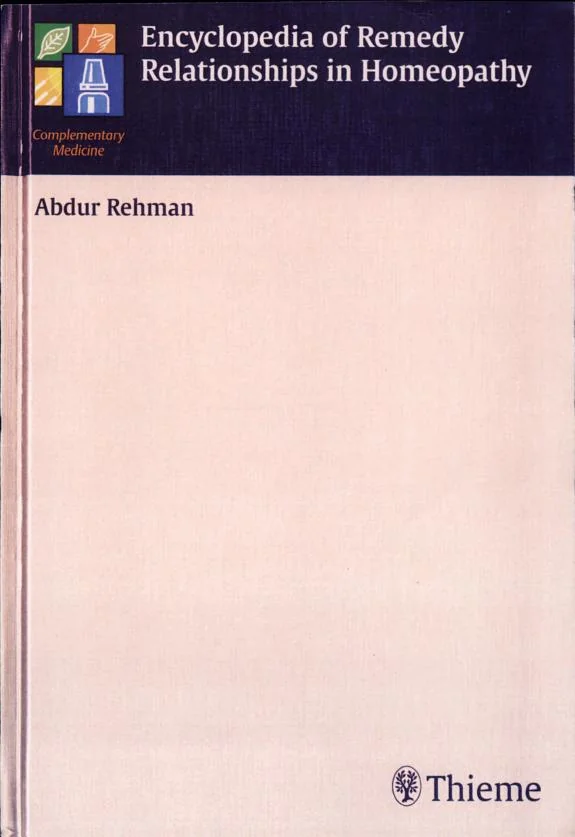
Encyclopedia of Remedy Relationships in Homeopathy
 83
83

Encyclopedia of Remedy Relationships in Homeopathy
Abdur Rehman's Encyclopedia of Remedy Relationships in Homeopathy tackles a critical, often overlooked, aspect of homeopathic practice: the dynamic interplay between remedies. Its strength lies in its systematic cataloging of these relationships—complementary, successive, inimical, and collateral—offering a much-needed reference for complex cases. The inclusion of details on duration of action and food interactions adds a practical layer that is invaluable for practitioners. However, the sheer volume of information, while comprehensive, can feel overwhelming without a strong prior grounding in homeopathic Materia Medica. A concrete example, the detailed listing of inimical remedies for *Arsenicum album*, demonstrates the book's depth but also hints at its encyclopedic rather than narrative approach. It is an indispensable tool for the serious homeopath, albeit one demanding dedicated study.
📝 Description
83
Abdur Rehman's Encyclopedia of Remedy Relationships in Homeopathy, published in 2003, systematically catalogs homeopathic substance interactions.
This reference work details how homeopathic substances affect one another within a therapeutic course. It moves beyond single-remedy approaches to address complex chronic conditions where sequential or complementary remedies are often necessary. The volume systematically lists relationships such as complementary, successive, inimical (antagonistic), and collateral remedies.
This book is for experienced homeopathic practitioners, students in advanced study, and researchers interested in the precise application of homeopathic principles. It will benefit those who face cases resistant to initial treatments or who wish to improve their understanding of remedy sequencing. Individuals focused on the historical development of homeopathic Materia Medica and the theoretical basis of remedy interactions will find significant value.
The encyclopedia emerged in the early 21st century, a time of growing interest in classical homeopathy and deeper exploration of its foundational texts. It addresses the practical challenge of managing complex cases that often require a sophisticated grasp of remedy relationships, a topic less thoroughly covered in earlier works. It builds on the work of pioneers like Hahnemann and Kent by offering a more detailed view of therapeutic progression.
Within the homeopathic tradition, understanding the relationships between remedies is crucial for effective treatment, particularly in chronic illness. This encyclopedia situates itself within the lineage of Materia Medica, a body of knowledge detailing the effects of substances on the human body. By focusing on how remedies interact—whether they follow well, are used in planned succession, or act antagonistically—the book provides practitioners with tools to manage complex cases. This granular approach to therapeutic progression reflects an ongoing effort within homeopathy to refine its practical application and theoretical underpinnings, drawing from both historical texts and contemporary clinical experience.
💡 Why Read This Book?
• Gain a structured understanding of how to select sequential remedies in chronic case management, a critical skill highlighted by the book's detailed exploration of 'successive remedies' and their indications. • Learn to avoid potential therapeutic conflicts by identifying 'inimical remedies' and antidotes, a crucial aspect for optimizing patient outcomes as outlined in the remedy interaction sections. • Enhance case analysis by referencing data on duration of action and foods to avoid for specific remedies, a practical benefit derived directly from the detailed entries for each substance.
⭐ Reader Reviews
Honest opinions from readers who have explored this book.
❓ Frequently Asked Questions
What is the primary purpose of the Encyclopedia of Remedy Relationships in Homeopathy?
The primary purpose is to provide homeopathic practitioners with a comprehensive reference for understanding how different remedies interact. It details complementary, successive, inimical remedies, and antidotes, crucial for managing complex and chronic cases.
Who is Abdur Rehman and when was this book first published?
Abdur Rehman is the author of this specialized homeopathic text. The Encyclopedia of Remedy Relationships in Homeopathy was first published in 2003, offering a contemporary compilation of remedy interaction data.
What kind of relationships between homeopathic remedies are covered?
The book covers several key relationships: complementary remedies (those that follow well), successive remedies (used in planned sequence), inimical remedies (those that may counteract previous remedies), and collateral remedies (those similar in action).
Does the book provide information beyond just remedy pairings?
Yes, it includes supplementary data such as the duration of action for remedies, specific foods to avoid during treatment, and references to miasms, enhancing its utility for detailed case management.
Is this book suitable for beginners in homeopathy?
While valuable, its comprehensive nature and focus on complex interactions make it more suitable for advanced students and experienced practitioners rather than absolute beginners.
How does this book help in treating chronic diseases?
For chronic diseases, where single remedies are often insufficient, the book's focus on complementary and successive remedy sequences helps practitioners develop more effective long-term treatment strategies.
🔮 Key Themes & Symbolism
Remedy Sequencing Strategies
The central theme is the strategic application of remedies in sequence, particularly vital in chronic conditions that do not respond to initial treatments. The work meticulously categorizes 'successive remedies', outlining the rationale for their use and the expected therapeutic progression. This moves beyond the 'single remedy' paradigm to acknowledge the dynamic nature of healing, where one substance may prepare the ground for another or address residual pathological layers, as detailed in the sections on complementary and successive prescriptions.
Antagonism and Counteraction
A critical aspect explored is the concept of 'inimical remedies' – substances that can negate or interfere with the action of a previously administered remedy. The encyclopedia provides extensive lists of these antagonistic pairs, alongside 'antidotes' that can mitigate such negative interactions. Understanding these dynamics is paramount for avoiding therapeutic setbacks and ensuring the efficacy of the homeopathic treatment, a core concern for practitioners dealing with complex case histories.
Holistic Case Management
Beyond simple remedy-to-remedy correlations, the book integrates broader case management factors. It includes data on the 'duration of action' for various remedies, helping practitioners time subsequent prescriptions appropriately. Furthermore, considerations for 'foods to avoid' and references to miasms (the underlying chronic constitutional disease patterns in homeopathy) are provided. This holistic approach equips practitioners with a more nuanced toolkit for comprehensive patient care.
Materia Medica Refinement
The encyclopedia serves as an advanced refinement of homeopathic Materia Medica. It doesn't just list symptoms but details the *relationships* between substances, offering a deeper, more dynamic understanding of their therapeutic application. By cataloging 'collateral remedies' and providing context on interactions, it encourages a more sophisticated prescribing approach, moving beyond rote memorization to an analytical understanding of remedy dynamics.
💬 Memorable Quotes
Direct passages from the work, attributed to the author.
“Often in chronic diseases, a complementary remedy or a series of remedies in sequence is frequently needed.”
— This highlights the core premise of the book: that optimal homeopathic care, especially for long-standing ailments, requires a dynamic approach involving multiple remedies used in a planned succession, not just a single prescription.
“The first comprehensive handbook on homeopathic remedy relationships.”
— This statement positions the work as a pioneering effort, filling a gap in existing literature by systematically organizing and presenting data on how different homeopathic medicines interact with each other.
“Provides lists of complementary, successive, and inimical remedies, antidotes, and collaterals.”
— This outlines the structural foundation of the book, detailing the specific categories of remedy interactions that practitioners can reference for case management and therapeutic planning.
“Data on interactions, duration of actions, foods to avoid, references to miasms.”
— This points to the comprehensive nature of the information provided, extending beyond simple remedy pairings to include practical considerations that influence treatment efficacy and patient adherence.
“Particularly in chronic diseases that have already been treated.”
— This identifies a key clinical scenario where the book's content is most applicable: complex, long-term health issues where previous treatments may have altered the patient's state, necessitating careful consideration of subsequent remedy choices.
🌙 Esoteric Significance
Tradition
While homeopathy itself is often categorized within Vitalist or Energetic medicine traditions rather than strictly Hermetic or Kabbalistic, its focus on subtle substances and energetic interactions aligns with broader esoteric principles of correspondence and energetic influence. This work fits within the tradition of applied esoteric pharmacology, seeking to understand and manipulate unseen forces (remedy energies) for healing, echoing alchemical pursuits of understanding material and energetic transformations.
Symbolism
The core symbolism lies in the concept of 'relationships' itself – the interconnectedness of substances, mirroring the esoteric belief in a web of sympathetic and antipathetic connections within the cosmos and its microcosm, the human body. The 'inimical' relationship symbolizes opposing forces or blockages, while 'complementary' and 'successive' relationships represent harmonious flow and developmental progression, akin to alchemical stages or astrological influences.
Modern Relevance
Contemporary practitioners of classical homeopathy continue to rely on such detailed reference works for complex case management. The principles of understanding remedy interactions are also relevant to those exploring integrated medicine or energetic healing modalities that acknowledge the subtle effects of substances and their dynamic interplay within a living system.
👥 Who Should Read This Book
['• Advanced Homeopathic Practitioners: Those managing chronic or complex cases who need to understand remedy sequencing, antidotes, and potential interactions to optimize treatment outcomes.', '• Homeopathic Students: Individuals undertaking rigorous study of the Materia Medica who wish to grasp the nuances of remedy relationships beyond individual drug pictures.', '• Researchers in Homeopathy: Scholars and practitioners interested in the historical development and systematic cataloging of homeopathic knowledge concerning remedy dynamics.']
📜 Historical Context
Abdur Rehman's Encyclopedia of Remedy Relationships in Homeopathy, first published in 2003, emerged at a time when classical homeopathy was experiencing a resurgence, with practitioners seeking to deepen their understanding beyond foundational texts. The early 21st century saw a growing academic interest in the history and practice of alternative medicine, including homeopathy, prompting a demand for more specialized references. While Samuel Hahnemann laid the groundwork in the late 18th and early 19th centuries, and figures like James Tyler Kent further developed the Materia Medica in the early 20th century, there remained a need for comprehensive compilations on specific aspects of practice. Rehman's work addresses the practical challenge of managing complex cases where remedy interactions are crucial, a nuance often less emphasized in earlier, broader Materia Medica works. This book provided a much-needed systematic resource, building upon the established principles of homeopathic prescribing and offering a detailed guide to reading through the intricate web of remedy relationships.
📔 Journal Prompts
The cataloging of 'inimical remedies' and their potential effects.
The strategic application of 'successive remedies' in chronic conditions.
The integration of 'duration of action' data into prescribing decisions.
The role of 'complementary remedies' in facilitating deeper healing.
The significance of 'foods to avoid' in relation to specific remedy actions.
🗂️ Glossary
Complementary Remedies
Homeopathic substances that follow well after another remedy, often enhancing or completing its action. They are typically similar in their overall effect but may address different aspects of the case.
Successive Remedies
Remedies prescribed in a planned sequence, often used in chronic diseases where a series of medicines is needed to address evolving symptoms or deeper pathological layers over time.
Inimical Remedies
Homeopathic substances that may counteract, nullify, or interfere with the action of a previously administered remedy, leading to an aggravation or cessation of therapeutic effects.
Antidotes
Remedies used to counteract the adverse effects of another remedy or a harmful substance, whether homeopathic or allopathic, restoring the patient's balance.
Collateral Remedies
Remedies that share similar therapeutic actions or indications, often considered as alternatives or supplementary options when the primary remedy is not fully effective or available.
Miasms
In homeopathic theory, the underlying chronic constitutional disease predispositions (e.g., Psora, Sycosis, Syphilis) that influence a person's susceptibility to illness and guide long-term therapeutic strategy.
Duration of Action
The estimated length of time a homeopathic remedy is expected to act in the system before its effects diminish or a subsequent remedy may be required.
This book appears in 1 collection
🔮 Readers Also Liked
Browse all →








From the “Homeopathy” Collection
View all →






More Free Occult Philosophy Books
View all →