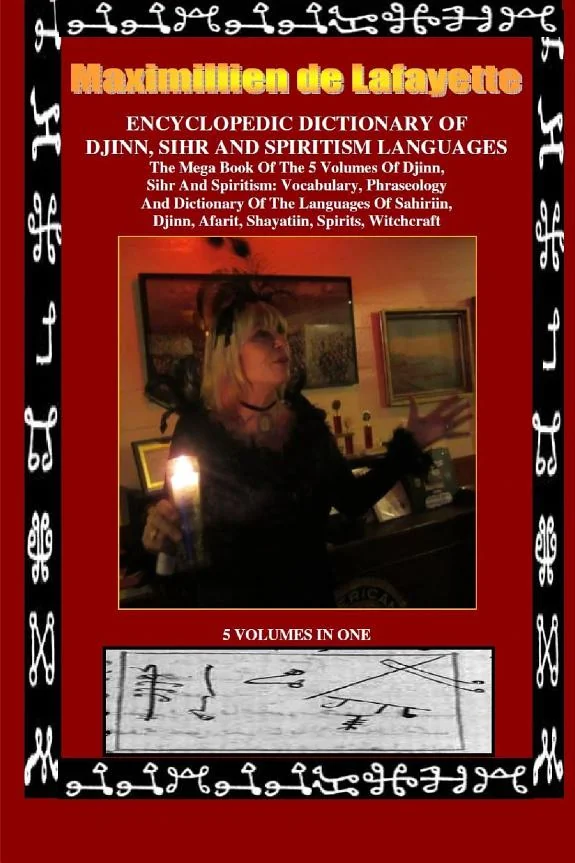
ENCYCLOPEDIC DICTIONARY OF DJINN, SIHR AND SPIRITISM LANGUAGES
 82
82

ENCYCLOPEDIC DICTIONARY OF DJINN, SIHR AND SPIRITISM LANGUAGES
Maximillien De Lafayette's 'Encyclopedic Dictionary of Djinn, Sihr and Spiritism Languages' attempts to bridge a significant gap in practical occult literature. The sheer ambition to codify the linguistic frameworks of Djinn, various classes of spirits, and the specialized language of Sihr is commendable. The book's strength lies in its detailed compilation of terms, offering a reference point for practitioners who have felt the sting of miscommunication or the frustration of untranslated invocations. However, its limitation is the inherent difficulty in verifying the accuracy and universality of such specialized, often orally transmitted or tradition-bound, lexicons. A passage detailing the specific incantations used to bind an 'Afarit' offers a concrete example of the practical, albeit potentially hazardous, knowledge contained within. The work is an ambitious, if occasionally opaque, resource for serious occult students. It provides a unique linguistic key for those dedicated to unlocking deeper engagement with the unseen.
📝 Description
82
Published in 2014, this dictionary defines terms for Djinn, Sihr, and spiritism languages.
This encyclopedic dictionary details the languages and terminologies used in Djinn lore, Sihr (magic), and various Spiritist traditions. It aims to clarify the specialized vocabulary that often creates barriers to direct communication or effective practice within these domains. The work meticulously covers specific words, phrases, and terminology employed by both human practitioners and the entities themselves.
The intended audience includes occultists, ceremonial magicians, spiritists, and academic researchers studying comparative religion or folklore. It is especially useful for individuals who wish to move from theoretical knowledge to practical application. Such engagement requires a precise understanding of nomenclature to interact with Djinn, Afarit, Shayatiin, and other spiritual intelligences, alongside comprehending the language of Sihr.
Published in 2014, this work addresses a gap in contemporary occult literature concerning the linguistic specifics of non-human intelligences and magical systems. It distinguishes itself from broader philosophical occult texts by focusing on the specialized vocabularies often rooted in Arabic and Middle Eastern traditions. The book operates on the premise that mastering these distinct languages is crucial for authentic spiritual or magical engagement, introducing terms for sorcerers, various classes of Djinn, and 'Noble Souls'.
💡 Why Read This Book?
• Gain access to the specialized terminology of Djinn and Sahiriin, crucial for understanding and performing rituals outlined in texts predating the 2014 publication. • Decipher specific phrases used in Sihr, enabling a deeper comprehension of magical texts and practices that might otherwise remain obscure due to linguistic barriers. • Learn the distinct 'languages' of various spiritual entities, including Afarit and Shayatiin, facilitating more precise communication and interaction as detailed in the dictionary's sections.
⭐ Reader Reviews
Honest opinions from readers who have explored this book.
❓ Frequently Asked Questions
What is the primary purpose of the Encyclopedic Dictionary of Djinn, Sihr and Spiritism Languages?
The book's primary purpose is to provide a comprehensive lexicon of the languages and terminologies used to communicate with Djinn, spirits, and in Sihr (magic). It aims to equip readers with the necessary vocabulary to engage effectively with these entities and practices.
Who is Maximillien De Lafayette, the author?
Maximillien De Lafayette is an author known for his extensive works on paranormal phenomena, occultism, and esoteric sciences. His writings often explore subjects like UFOs, paranormal communication, and ancient mysteries, with this dictionary focusing on the linguistic aspects of spiritism and Djinn lore.
What specific types of entities does the book cover?
The dictionary covers a range of entities including Djinn, Afarit, Shayatiin (demonic entities), and 'Arwaah Tahira' (Noble Souls). It also addresses the specialized language used by Sahiriin, or sorcerers, within magical contexts.
Is prior knowledge of magic or spiritism required to use this book?
While prior knowledge is beneficial, the book is designed to be a foundational resource. It aims to teach the essential terminology and phraseology needed for those new to these subjects or seeking to deepen their understanding of specific esoteric languages.
When was this book first published?
The 'Encyclopedic Dictionary of Djinn, Sihr and Spiritism Languages' by Maximillien De Lafayette was first published on October 13, 2014.
Can this book help me summon spirits?
The book explicitly states that familiarity with the terminology and vocabulary of these languages is a prerequisite for summoning and communicating with spirits and Djinn. Therefore, it provides the linguistic tools necessary for such practices.
🔮 Key Themes & Symbolism
Linguistic Keys to the Unseen
The core tenet of this work is that the unseen realms, populated by Djinn, spirits, and magical forces, possess distinct linguistic structures. Effective interaction, whether for invocation, evocation, or understanding, hinges on mastering this specialized vocabulary and phraseology. The book argues that ignorance of these 'languages' creates an insurmountable barrier to genuine communion and practical application of Sihr. It posits that understanding terms like 'Afarit' or specific incantatory phrases is not merely academic but a practical necessity for any serious practitioner engaging with these forces.
The Language of Sihr
Sihr, often translated as magic or sorcery, is presented as having its own unique lexicon. This dictionary aims to decode the specific terminology and syntax employed in magical operations, particularly those involving the invocation or manipulation of spiritual entities. By providing a vocabulary for Sahiriin (sorcerers), the work seeks to explain the linguistic components of spellcraft and ritual, allowing for a more precise understanding of ancient and contemporary magical texts and practices that utilize these specialized linguistic forms.
Hierarchies of Spiritual Communication
The book delineates specific vocabularies for different classes of spiritual beings, suggesting a structured approach to the spirit world. It distinguishes between the languages of Djinn, Afarit (a type of Djinn often associated with fire), Shayatiin (demonic entities), and 'Arwaah Tahira' (Noble Souls). This categorization implies that communication must be tailored to the specific nature and rank of the entity being addressed, with different terms and phrases carrying distinct implications and operational effects within esoteric traditions.
Practical Application vs. Theory
This dictionary is framed not as a theoretical treatise but as a practical tool for practitioners. The original blurb emphasizes that without familiarity with the terminology, summoning and communication are impossible. This highlights the book's focus on actionable knowledge, providing the essential linguistic building blocks for those actively engaged in or aspiring to engage with the occult and spiritist practices, moving beyond mere intellectual curiosity.
💬 Memorable Quotes
Direct passages from the work, attributed to the author.
“There is no way in the world would you be able to summon and communicate with spirits, Djinns, Afarit, demons and even Noble Souls (Arwaah Tahira) if you are not familiar with the terminology, vocabulary and phraseology of their languages and the Sihr language.”
— This statement underscores the book's central thesis: language is the primary gateway to the spirit world. It asserts that practical engagement with Djinn and spirits is impossible without a command of their specific linguistic codes, positioning the dictionary as an indispensable tool for practitioners.
“This book will teach you all of the above, and provide you w”
— This excerpt from the original blurb directly promises the reader the acquisition of essential linguistic knowledge. It positions the dictionary as a didactic instrument, capable of imparting the specific vocabulary and phraseology necessary for esoteric communication and practice.
“Vocabulary, Phraseology And Dictionary Of The Languages Of Sahiriin, Djinn, Afarit, Shayatiin, Spirits, Witchcraft”
— This descriptive phrase outlines the comprehensive scope of the dictionary's content. It explicitly lists the key subjects covered, indicating a focus on the specialized languages of various occult entities and practices, serving as a direct summary of the book's utility.
“Noble Souls (Arwaah Tahira) have their own distinct terminology.”
— This interpretation points to the book's recognition of a hierarchy and diversity within the spirit world, indicating that even benevolent spiritual entities possess unique linguistic conventions. It suggests the dictionary provides the means to differentiate and address these various spiritual classes appropriately.
💡 Key Ideas
Editorial paraphrase of the work's core concepts — not direct quotes.
Understanding the Sihr language is crucial for interacting with Djinn.
This paraphrased concept highlights the interconnectedness of magical language (Sihr) and communication with Djinn. It suggests that mastery of one linguistic domain directly facilitates interaction within the other, emphasizing the dictionary's role in bridging these esoteric fields.
🌙 Esoteric Significance
Tradition
This work draws heavily from Islamic folklore and occult traditions concerning the Djinn, as well as broader practices within spiritism and ceremonial magic. It attempts to synthesize linguistic elements that are often dispersed across various cultural mythologies and esoteric lineages, particularly those that acknowledge a class of beings distinct from human and angelic realms. It functions as a bridge, codifying terms that might otherwise be learned through direct, often perilous, initiation or oral transmission within specific traditions.
Symbolism
While primarily linguistic, the book implicitly engages with the symbolism inherent in names and incantations. Terms like 'Afarit' or 'Shayatiin' carry symbolic weight, representing specific archetypes of power, rebellion, or elemental force within the Djinn hierarchy. The 'languages' themselves can be seen as symbolic systems, where specific phonetic arrangements or word choices are believed to carry inherent power or resonance, acting as keys to unlock specific spiritual potentials or states of consciousness.
Modern Relevance
In contemporary esoteric circles, particularly those focused on practical magic, demonology, and spirit communication, De Lafayette's dictionary holds relevance. Practitioners seeking to engage with entities described in various grimoires or folkloric traditions often encounter untranslated or obscure terminology. This work offers a potential resource for decoding these linguistic puzzles, aiding modern occultists in refining their invocations and understanding of spiritual hierarchies, bridging historical practices with contemporary experimentation.
👥 Who Should Read This Book
• Aspiring ceremonial magicians and occultists seeking to understand the specific linguistic requirements for invoking Djinn and other entities. • Students of comparative religion and folklore interested in the specific terminology associated with Djinn and spiritism across different cultures. • Practitioners of spiritism who aim to refine their communication protocols by learning distinct vocabularies for various spiritual classes, including 'Arwaah Tahira'.
📜 Historical Context
Published in October 2014, Maximillien De Lafayette's 'Encyclopedic Dictionary of Djinn, Sihr and Spiritism Languages' emerged during a period of intense digital proliferation of esoteric content. While many works focused on the philosophy or history of magic, De Lafayette targeted a more granular, practical aspect: the linguistic keys required for direct engagement with supernatural entities. This approach contrasts with broader occult encyclopedias that might list Djinn or spirits but rarely explore their specific lexicons. The work taps into long-standing traditions of grimoire study and spirit communication, particularly those influenced by Arabic and Islamic folklore concerning Djinn. Its publication date means it exists in dialogue, albeit indirectly, with contemporary online communities dedicated to practical occultism and spiritism, many of whom grapple with the translation and interpretation of ancient texts, a challenge De Lafayette's dictionary seeks to address.
📔 Journal Prompts
The distinction between the languages of Djinn and Sahiriin.
The role of specific phraseology in communicating with Afarit.
How the terminology for 'Arwaah Tahira' differs from Shayatiin.
The practical implications of mastering Sihr language.
Personal reflections on the necessity of specialized vocabulary for spiritual work.
🗂️ Glossary
Djinn
Supernatural creatures in pre-Islamic Arabian and later Islamic mythology and religion. They are said to inhabit a world parallel to that of humans and possess free will, capable of being good or evil.
Sihr
An Arabic term often translated as magic, sorcery, or witchcraft. In Islamic contexts, it can refer to various practices, often viewed with suspicion or condemnation, involving supernatural manipulation or knowledge.
Spiritism
A doctrine of faith and philosophy originating in the mid-19th century with Allan Kardec, which posits the existence of spirits and their ability to communicate with humans, often through mediums.
Afarit
A class of powerful Djinn, often described as malevolent or particularly strong, sometimes associated with fire or the underworld in Islamic folklore and mythology.
Shayatiin
The Arabic plural for 'Shaytan' (Satan). In a broader sense, it refers to demons or evil spirits in Islamic tradition, often seen as rebellious entities opposing divine will.
Arwaah Tahira
An Arabic phrase meaning 'Pure Souls' or 'Noble Souls'. It typically refers to highly evolved spiritual entities, saints, or benevolent spirits within Islamic mysticism and esoteric traditions.
Sahiriin
The Arabic plural for 'Sahir', meaning sorcerer or magician. This term denotes individuals who practice Sihr, often implying a knowledge of specialized magical languages and rituals.
This book appears in 1 collection
🔮 Readers Also Liked
Browse all →









From the “Djinn” Collection
View all →





More Free Occult Philosophy Books
View all →