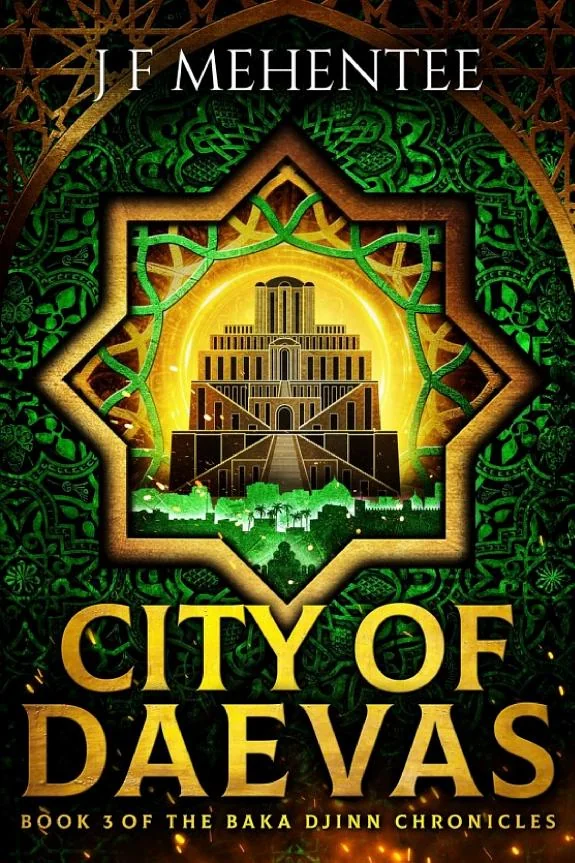
City of Daevas
 78
78

City of Daevas
J.F. Mehentee's City of Daevas presents a compelling scenario: Roshan, a warrior forced into a defensive posture against the formidable High Magus Sassan. The author effectively builds tension by contrasting Roshan's internal struggle to restrain her offensive nature with the escalating external threat to Baka. The plight of Behrouz and Zana, desperate to rescue Yesfir, adds a crucial subplot that broadens the narrative's emotional scope. One limitation is the pacing in the middle section, where the focus on Zana's quest for the Cross Scar manticores, while vital for plot progression, slightly slows the momentum of the main conflict. A particularly strong moment is Zana's decision to seek out the manticores, illustrating a character's initiative even when facing direct orders. The book offers an engaging, if sometimes complex, exploration of duty and sacrifice in a world populated by djinn and daevas.
📝 Description
78
In J F Mehentee's 2019 novel, City of Daevas, a leader must defend Baka against an invading High Magus.
City of Daevas follows Roshan as she prepares the city of Baka for war against High Magus Sassan. Roshan must control her own aggressive impulses while organizing the city's djinn and daevas for defense. The novel details the strategic and personal difficulties her characters face.
This story is for fans of epic fantasy who enjoy detailed world-building and character focused conflict. Readers drawn to mythological beings like djinn and daevas, and themes of leadership, sacrifice, and the moral questions of war, will find City of Daevas interesting. It also appeals to those who want to examine the dynamics between different groups and the personal cost of fulfilling one's duty.
Published in 2019, City of Daevas draws on Persian and Arabian folklore, particularly the concept of 'Daevas' as a distinct race rather than solely malevolent spirits. The narrative incorporates 'Djinn' from Arabian mythology, placing them within a contemporary fantasy framework. The story uses these beings to examine themes of strategic conflict and the burden of command, blending ancient lore with modern fictional interpretations.
💡 Why Read This Book?
• Gain insight into the strategic challenges of defending a city against a powerful adversary, as depicted in the preparations for war in Baka. • Experience the internal conflict of a warrior, Roshan, who must set aside personal vendettas for the greater good of her people. • Explore the unique dynamics between different magical beings, such as djinn and daevas, as they unite against external threats.
⭐ Reader Reviews
Honest opinions from readers who have explored this book.
❓ Frequently Asked Questions
What is the significance of the Daevas in City of Daevas?
In City of Daevas, Daevas are presented as a distinct race or faction, integral to the defense of Baka. Their role challenges traditional interpretations of these beings, integrating them into a complex magical and political landscape.
Who is High Magus Sassan?
High Magus Sassan is the antagonist in City of Daevas, leading an army that threatens the city of Baka. His appearance signals the onset of a major conflict that drives the novel's plot.
What is the role of djinn in the story?
Djinn are characters within City of Daevas who, alongside the daevas, are being readied by Roshan to defend Baka. Their presence adds a layer of mythological depth to the narrative's conflict.
When was City of Daevas first published?
City of Daevas was first published on August 26, 2019, placing it within the contemporary fantasy literature scene.
What are the Cross Scar manticores?
The Cross Scar manticores are a specific group or species sought out by Zana for assistance in City of Daevas. Their involvement is a plot point related to acquiring aid for the city's defense.
What is the central conflict in the book?
The central conflict in City of Daevas revolves around the impending invasion of Baka by High Magus Sassan's army and the efforts of characters like Roshan to prepare the city for war.
🔮 Key Themes & Symbolism
Defense vs. Offense
The narrative strongly contrasts the immediate urge for aggressive retaliation against High Magus Sassan with the strategic necessity of defensive preparation for Baka. Roshan's internal struggle exemplifies this, as she must forgo a direct assault to bolster the city's defenses, highlighting the difficult choices leaders face when their people are threatened. This theme is central to the escalating conflict and the characters' moral development.
Mythological Beings in Conflict
City of Daevas integrates figures from mythology, specifically djinn and daevas, into a contemporary fantasy war narrative. These beings are not merely background elements but active participants in the defense of Baka. Their inclusion allows for an exploration of how ancient lore can be recontextualized, presenting them as distinct factions with their own roles and capabilities within the story's magical framework.
Loyalty and Sacrifice
The characters in City of Daevas are consistently tested by their loyalties and the demands of sacrifice. Roshan's personal desire for vengeance is subordinated to her duty to protect Baka. Similarly, Behrouz and Zana's loyalty to Yesfir drives their desperate rescue efforts. The narrative emphasizes the personal costs of war and the difficult choices made in service to a greater cause or beloved individuals.
Strategic Warfare
The impending attack on Baka necessitates careful strategic planning. The story details the efforts to ready the city for war, involving both its inhabitants and magical allies like the djinn and daevas. This focus on preparation, the coordination of forces, and the anticipation of enemy movements provides a grounded perspective on the mechanics of fantasy warfare.
💬 Memorable Quotes
Direct passages from the work, attributed to the author.
“Roshan must put aside her desire to take the fight to the high magus.”
— This highlights the core internal conflict for the protagonist, Roshan. It frames the central tension between her personal inclination for direct combat and the strategic imperative for defensive readiness in Baka.
“Behrouz and Zana are desperate to rescue Yesfir.”
— This underscores the personal stakes and subplots driving the narrative. The desperation of Behrouz and Zana introduces an emotional urgency and a quest that runs parallel to the main conflict.
“Zana goes in search of the Cross Scar manticores for help.”
— This action demonstrates Zana's proactive approach to resolving the crisis, even when facing orders to remain in Baka. It signifies her initiative and the lengths she will go to secure aid.
“Guardsmen and golems begin their attack on Baka.”
— This marks a critical turning point, indicating the commencement of hostilities. The mention of both 'guardsmen' and 'golems' suggests a multi-faceted enemy force and the use of magical constructs in warfare.
“High Magus Sassan and his army appear outside a sand-filled and crumbling Baka.”
— This sets the immediate scene and the primary threat. The description of Baka as 'sand-filled and crumbling' establishes a sense of decay and vulnerability, heightening the tension before the conflict begins.
🌙 Esoteric Significance
Tradition
While not strictly adhering to a singular esoteric lineage, City of Daevas draws heavily on pre-Islamic Persian mythology and Arabian folklore, particularly concerning djinn and daevas. These figures have historical associations within certain occult traditions, often viewed as elemental or spiritual beings. The work can be seen as engaging with a form of 'folkloric magic' that intersects with broader esoteric interests in non-Western spiritual cosmologies.
Symbolism
The 'Daevas' themselves serve as a potent symbol, reinterpreting beings traditionally seen as malevolent in Zoroastrianism into a distinct, potentially neutral or even allied, faction. The 'city of Baka' can symbolize a fragile bastion of order or civilization threatened by external chaos, embodied by High Magus Sassan's army. The 'Cross Scar manticores' likely symbolize a specific, perhaps wild or dangerous, power source or allied force that requires careful negotiation.
Modern Relevance
Contemporary practitioners and readers interested in animism, elemental magic, and the reinterpretation of global mythologies find resonance in works like City of Daevas. It contributes to a modern esoteric discourse that seeks to broaden the scope beyond traditional Western Hermeticism or Kabbalah, incorporating diverse cultural myth-systems into magical and spiritual exploration.
👥 Who Should Read This Book
• Readers interested in mythic fantasy: Those who appreciate narratives that integrate beings like djinn and daevas into a compelling plot will find the world-building and character dynamics particularly engaging. • Students of comparative mythology: Individuals exploring how ancient mythological figures are reinterpreted in modern literature will find value in the novel's unique portrayal of these beings. • Fans of character-driven conflict: Readers who enjoy stories focusing on internal struggles, leadership challenges, and the moral complexities of warfare will connect with Roshan's journey.
📜 Historical Context
Published in 2019, J.F. Mehentee's City of Daevas arrived during a period of robust growth and diversification within the fantasy genre. Contemporary fantasy authors frequently engaged with established mythological frameworks, reinterpreting figures from global folklore for new narratives. While no specific contemporary author is directly cited as engaging with this work, the novel's approach to incorporating djinn and daevas aligns with a broader trend of drawing upon Middle Eastern and Persianate mythologies, seen in works by authors like S.A. Chakraborty. The early 21st century saw increased interest in these traditions, moving beyond predominantly Western European-inspired fantasy. The book's emergence reflects a market receptive to complex world-building rooted in less commonly explored mythologies, offering an alternative to the prevailing tropes.
📔 Journal Prompts
Roshan's suppression of her desire for direct confrontation with High Magus Sassan.
The defensive preparations within the city of Baka against invasion.
Zana's decision to seek aid from the Cross Scar manticores.
The contrasting motivations of Behrouz, Zana, and Roshan.
The strategic implications of including djinn and daevas in Baka's defense.
🗂️ Glossary
Daevas
In the context of City of Daevas, Daevas are presented as a distinct race or faction, integral to the narrative's magical and political landscape, challenging traditional interpretations.
Djinn
Mythological beings, often associated with Arabian folklore, who play a role in the defense of the city of Baka in the novel, contributing to its magical capabilities.
High Magus Sassan
The primary antagonist leading an invading army, whose appearance outside Baka initiates the central conflict of the story.
Baka
The city central to the plot, described as sand-filled and crumbling, which the characters must defend against an impending attack.
Cross Scar manticores
A specific group or entity that Zana seeks out for assistance, representing a potential source of aid or power in the face of overwhelming odds.
Golems
Magical constructs or artificial beings mentioned as part of the attacking forces, indicating a blend of military might and arcane power.
Manticores
Mythical creatures, often depicted as having a lion's body, human head, and scorpion's tail, sought by Zana for help in the narrative.
This book appears in 1 collection
🔮 Readers Also Liked
Browse all →









From the “Djinn” Collection
View all →









More Free Occult Philosophy Books
View all →