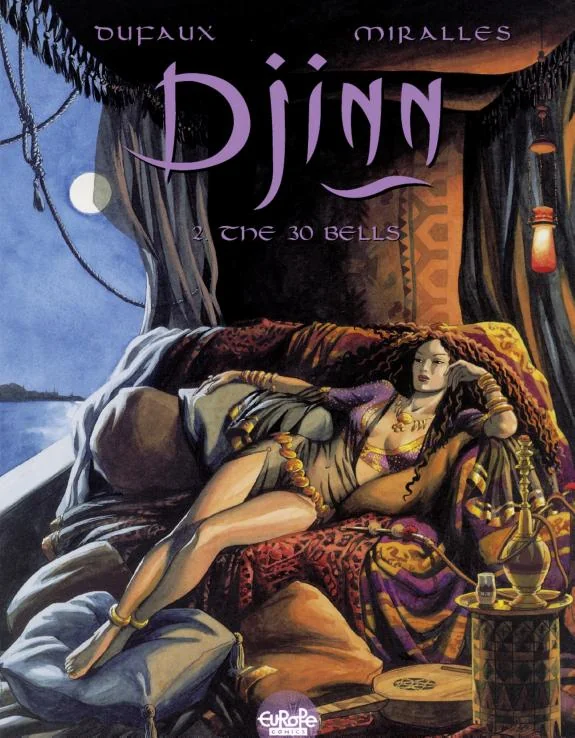
Djinn - Volume 2 - The 30 Bells
 84
84

Djinn - Volume 2 - The 30 Bells
Jean Dufaux's "Djinn - Volume 2 - The 30 Bells" presents a dual narrative that is both ambitious and, at times, uneven. The strength lies in its atmospheric conjuring of two distinct harem settings: the opulent, almost palpable sensuality of 20th-century Istanbul, and the stark, spectral austerity of a desert sanctuary. Dufaux excels at creating environments that feel lived-in, steeped in unspoken rules and ancient power dynamics. The character of Jade, a nexus of influence, is particularly well-rendered, her presence felt even when she is off-page. However, the narrative's progression, particularly concerning the "30 Bells" as a symbolic gateway, feels somewhat abstract and less concrete than the settings themselves. The connection between the two storylines, while intended to be thematic, occasionally strains for parity, making the overall coherence of the quest for "the heart of the harem" less impactful than it could be. The work ultimately succeeds in its evocative portrayal of feminine power and ritual, even if the mechanics of its central metaphor remain somewhat elusive. It's a curious exploration of hidden worlds, more successful in its mood than its explicit mechanics.
📝 Description
84
Jean Dufaux's Djinn - Volume 2 - The 30 Bells was published in 2015, continuing its look at the harem.
This 2015 volume, Djinn - Volume 2 - The 30 Bells, unfolds across two distinct timelines within the concept of the harem. One narrative centers on the Black Sultan's harem in 20th-century Istanbul, a place controlled by the figure of Jade. This setting is portrayed as a site of significant power and allure.
The second narrative shifts to a more withdrawn, ethereal harem, existing as a remnant of a past era and situated in the Turkish desert. Both storylines, despite their temporal and situational differences, share a common thread: the quest for entry and understanding within this exclusive female community.
The book delves into the dynamics of initiation and the complex relationships that form within these enclosed, ritualistic spaces. It contrasts the tangible power structures of the Istanbul harem with the more spectral atmosphere of its desert counterpart.
The narrative draws on archetypes associated with Middle Eastern harems, treating them not as literal historical accounts but as symbolic settings. Published in 2015, the work engages with ongoing academic and popular interest in Orientalist studies and the reevaluation of gender roles. Dufaux's approach deconstructs traditional depictions of the harem, moving beyond mere exoticism to examine its potential as a site for ritual and psychological exploration, aligning with contemporary literature's tendency to revisit and reframe ancient mystique.
💡 Why Read This Book?
• Gain insight into ritualistic initiation by studying the "30 Bells" framework, understanding its symbolic progression and the trials faced by the initiates in their quest for "the heart of the harem." • Explore the complex power dynamics within secluded feminine spaces, contrasting the 20th-century Istanbul harem with the ancient desert sanctuary, as depicted by Jean Dufaux. • Analyze the multifaceted role of Jade, a central figure of authority, and her influence over the characters' choices and journeys within the harem's confines.
⭐ Reader Reviews
Honest opinions from readers who have explored this book.
❓ Frequently Asked Questions
What is the significance of "The 30 Bells" in Jean Dufaux's Djinn - Volume 2?
The "30 Bells" refers to a series of stages or rites of passage that characters must undergo to be fully initiated into the harem. It symbolizes a structured journey towards attaining a deeper understanding or position within this exclusive feminine domain.
How does "Djinn - Volume 2 - The 30 Bells" connect to the first volume?
This volume continues the narrative threads and thematic explorations established in the first volume of the Djinn series. It deepens the reader's immersion into the world of the harem and the characters' interconnected destinies.
What historical period does the Istanbul harem setting in Volume 2 reference?
The Istanbul harem is set in the 20th century, offering a more contemporary, albeit still mystically charged, interpretation of harem life compared to the ancient desert sanctuary depicted in the same volume.
Who is Jade in "Djinn - Volume 2 - The 30 Bells"?
Jade is a dominant and captivating figure within the 20th-century Istanbul harem. She serves as a central point of influence and mystery, driving much of the plot and the motivations of other characters.
Does the book require prior knowledge of the first Djinn volume?
While not strictly mandatory, prior knowledge of "Djinn - Volume 1" would enhance the reader's understanding of the established characters and the overarching narrative arc. Volume 2 builds directly upon its predecessor.
What are the main themes explored in "The 30 Bells"?
The primary themes include initiation, the acquisition of power within hidden societies, feminine mystique, the contrast between historical eras, and the pursuit of esoteric knowledge or control.
🔮 Key Themes & Symbolism
Harem as Ritual Space
The harem is presented not merely as a place of confinement but as a complex, ritualistic space where initiation rites, symbolized by the "30 Bells," are central. This transforms the traditional understanding of the harem into a crucible for spiritual and psychological transformation. The contrast between the opulent Istanbul setting and the stark desert sanctuary highlights the enduring, adaptable nature of this feminine power structure across different eras and environments.
The Pursuit of Power
Central to the narrative is the quest for power, both overt and subtle, within the harem's hierarchy. Characters are driven by varying motivations to attain influence, control, or a deeper understanding of the harem's secrets. The figure of Jade embodies a potent, enigmatic form of authority, suggesting that true power lies not just in position but in mystique and the ability to orchestrate events from behind the scenes.
Feminine Mystique and Agency
Dufaux explores the concept of feminine mystique as a source of power and allure. The women within the harem, despite their varied circumstances, are depicted as agents navigating a system that is both restrictive and empowering. Their choices, their adherence to or subversion of ritual, and their interactions reveal a complex interplay of submission and assertion, challenging simplistic notions of victimhood.
Duality of Time and Place
The juxtaposition of two distinct harem settings—one in 20th-century Istanbul and another as an ancient desert echo—serves to underscore the timeless yet evolving nature of these esoteric structures. This duality allows for an examination of how tradition persists and transforms, demonstrating that the core elements of power, initiation, and feminine influence can manifest differently across historical contexts.
💬 Memorable Quotes
Direct passages from the work, attributed to the author.
“Two women, in two different times, and for two very different reasons, choose to be initiated into the harem.”
— This foundational statement sets up the dual narrative structure of the volume, immediately establishing the central theme of voluntary entry into a hidden, ritualistic feminine space for distinct personal objectives.
“The other is the only remaining one of its kind, an echo of a bygone era, hidden away in the middle of the Turkish desert, far from prying eyes.”
— This highlights the stark contrast between the two harems, positioning one as a living, albeit contemporary, entity and the other as a spectral remnant of history, emphasizing themes of preservation and decay in esoteric traditions.
“Both women must carry out certain rites of passage before they can truly attain the heart of the harem.”
— This phrase captures the core narrative drive: the journey of initiation. It implies that access to the deepest secrets or the highest status within the harem requires a structured, challenging process of trials and transformation.
“Both women are doing it for Jade.”
— This interpretation suggests a unifying force or a central manipulator. The actions of the protagonists are ultimately linked to or influenced by the enigmatic figure of Jade, indicating her key role in the harem's power dynamics.
“Plots and...”
— This fragment suggests an unfolding narrative filled with intrigue and strategic maneuvering. It implies that the characters' journeys are not merely passive experiences but are actively shaped by machinations and hidden agendas within the harem.
🌙 Esoteric Significance
Tradition
This work can be loosely situated within modern esoteric fiction that draws upon archetypal imagery of ancient power structures, particularly those associated with feminine mystique and hidden knowledge. While not explicitly tied to a single lineage like Hermeticism or Gnosticism, it echoes themes found in certain interpretations of matriarchal cults or mystery traditions where initiation rites are paramount for accessing deeper truths and power.
Symbolism
The "30 Bells" serve as a primary symbol, representing a structured path of initiation, possibly mirroring stages of spiritual ascent or purification found in various esoteric systems. The contrast between the opulent, modern Istanbul harem and the spectral, ancient desert sanctuary symbolizes the enduring nature of feminine power and its manifestation across time, from the tangible to the ethereal.
Modern Relevance
Contemporary practitioners and scholars of esoteric studies interested in feminine spirituality, ritualistic practices, and the symbolic representation of power structures find value in Dufaux's work. It contributes to modern discussions about reclaiming and reinterpreting historical archetypes of feminine authority and hidden knowledge, offering a fictional lens through which to explore these complex themes.
👥 Who Should Read This Book
• Students of comparative religion and mythology seeking fictional explorations of initiation rites and sacred feminine spaces. • Readers of esoteric literature interested in narratives that deconstruct traditional power dynamics and explore hidden social structures. • Fans of Jean Dufaux's previous works and those drawn to atmospheric, character-driven stories with a strong sense of mystery and ritual.
📜 Historical Context
Published in 2015, Jean Dufaux's "Djinn - Volume 2 - The 30 Bells" enters a literary landscape where interest in re-examining Orientalist tropes and exploring hidden feminine power structures had been growing for decades. While not a direct historical text, it engages with archetypes of Middle Eastern harems that have been subject to extensive study and fictionalization since the 19th century. Dufaux's approach, however, moves beyond typical exoticism, presenting the harem as a site of ritualistic initiation and agency, a perspective that aligns with later critical re-evaluations of gender and power in historical contexts. The work's publication date places it within a period where contemporary authors like Elif Shafak were also exploring Turkish history and culture with nuanced perspectives, though Shafak's focus is typically more grounded in socio-historical realism. Dufaux's fictional exploration can be seen as a parallel, albeit more esoteric, engagement with the enduring mystique of these closed societies.
📔 Journal Prompts
The dual nature of the Istanbul harem and the desert sanctuary: Reflect on how setting influences the experience of initiation.
Jade's influence: Consider the power dynamics at play when a central figure orchestrates the journeys of others.
The meaning of the "30 Bells": Interpret the symbolic progression and the challenges presented by these rites of passage.
Voluntary initiation: Analyze the motivations for choosing to enter a space of strict rules and hidden knowledge.
The concept of "the heart of the harem": What does this ultimate goal represent within the narrative's esoteric framework?
🗂️ Glossary
Harem
Historically, the private living quarters of a Muslim family, typically reserved for women. In this context, it represents a secluded, ritualistic space of feminine power and initiation.
The 30 Bells
A symbolic system of rites of passage or stages of initiation within the harem, representing a structured journey towards attaining a deeper level of understanding or status.
Initiation
The process of being formally admitted into an organization, society, or secret knowledge, often involving trials, rituals, and symbolic transformation.
Black Sultan
A figure of authority within the Istanbul harem setting, implying a powerful ruler whose domain is characterized by mystery and control.
Rites of Passage
Ceremonies or events marking an important stage in someone's life, such as birth, puberty, marriage, or death. Here, specifically tied to entry and advancement within the harem.
Heart of the Harem
The ultimate goal or innermost sanctum of the harem, representing the deepest level of knowledge, power, or belonging that initiates strive to attain.
Echo of a bygone era
Refers to the desert sanctuary harem, signifying something that remains from the past but is diminished or spectral, representing a fading tradition or memory.
This book appears in 1 collection
🔮 Readers Also Liked
Browse all →









From the “Djinn” Collection
View all →








More Free Occult Philosophy Books
View all →