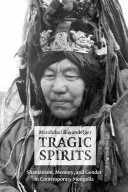
Tragic Spirits
 76
76

Tragic Spirits
Manduhai Buyandelger’s *Tragic Spirits* offers a compelling look at Mongolian shamanism’s revival amidst post-socialist upheaval. The ethnographic detail is meticulous, particularly in its depiction of how economic shock therapy in the 1990s spurred a re-engagement with ancestral spiritual frameworks. Buyandelger avoids romanticizing the past, instead grounding the resurgence in the lived realities of her interlocutors. A notable strength is the clear explanation of how traditional practices like spirit possession and healing rituals became vital coping mechanisms. However, the dense ethnographic accounts, while informative, occasionally make the narrative flow challenging for readers less familiar with the specific cultural context. The book's exploration of the interplay between state policy and spiritual revival, especially concerning the impact of the liberalization of trade, is particularly sharp. *Tragic Spirits* is a vital contribution to understanding contemporary shamanism.
📝 Description
76
Manduhai Buyandelger's 2016 "Tragic Spirits" studies Mongolian shamanism's revival.
This book offers an ethnographic account of shamanism's resurgence among Mongolian nomads. It focuses on the period after socialism's collapse, a time marked by significant political and economic shifts. Buyandelger details how traditional shamanic practices adapted in the face of globalization and economic liberalization.
The study is written for anthropologists, sociologists, and students of comparative religion. It examines the effects of sweeping socio-political changes on indigenous spiritual traditions. The author provides a readable account of these complex dynamics. The text investigates the cultural and spiritual resilience demonstrated by Mongolian communities.
As a study of contemporary shamanism, 'Tragic Spirits' connects to ongoing academic and esoteric interest in animistic traditions. It documents how spirit possession and ritual practices persist and change within a specific cultural context. The book examines the lived experience of shamans and their communities, situating their work within a lineage of indigenous spiritual authority that predates colonial or state socialist impositions.
💡 Why Read This Book?
• Understand the direct impact of Mongolia's post-socialist economic shock therapy (1990s) on traditional spiritual practices, offering a concrete case study of belief systems adapting to rapid change. • Gain insight into the specific shamanic practices, such as spirit possession and healing rituals, that have seen a resurgence as coping mechanisms. • Appreciate the nuanced relationship between political ideology and indigenous spirituality, as detailed in the ethnographic accounts of nomadic communities.
⭐ Reader Reviews
Honest opinions from readers who have explored this book.
❓ Frequently Asked Questions
What is the primary focus of Tragic Spirits?
Tragic Spirits is an ethnographic study detailing the resurgence of shamanism among nomadic Mongolians in the wake of the collapse of socialism and subsequent economic changes.
When was Tragic Spirits first published?
The book was first published on November 1, 2013.
What awards has Tragic Spirits received?
Tragic Spirits won the Francis Hsu Book Prize from the Society for East Asian Anthropology and was shortlisted for the ICAS (International Convention of Asia Scholars) Book Prize.
What historical period does the book cover?
The book covers the period following the end of socialism in Mongolia in the late twentieth century, focusing on the effects of "economic shock therapy" and liberalization.
Who is the author of Tragic Spirits?
The author is Manduhai Buyandelger.
What makes the ethnographic study 'highly readable'?
The "highly readable" nature refers to the book's accessible prose and clear presentation of complex ethnographic data, making it engaging for a broad academic audience.
🔮 Key Themes & Symbolism
Shamanism in Transition
The work meticulously documents the revival of shamanic practices among nomadic Mongolians following the collapse of socialism in the late 20th century. It highlights how these ancient traditions adapted and re-emerged as crucial frameworks for understanding and coping with the radical political and economic shifts, including the "economic shock therapy" that liberalized trade and privatized assets.
Spirituality and Socio-Economic Change
Buyandelger's ethnography connects the resurgence of shamanism directly to the profound societal disruptions experienced by Mongolians. It illustrates how spiritual beliefs and practices, particularly spirit possession and healing rituals, provided continuity and meaning in a period of uncertainty and hardship, acting as a vital social and psychological resource.
Ethnographic Rigor
Praised for its "highly readable ethnographic study" quality, the book presents in-depth fieldwork among Mongolian communities. It offers a nuanced perspective, moving beyond simplistic notions of tradition versus modernity, to show the dynamic interplay between lived experience, cultural heritage, and the forces of globalization and political reform.
Resilience and Adaptation
The core of *Tragic Spirits* lies in its portrayal of the resilience of Mongolian culture. The resurgence of shamanism is presented not as a static return to the past, but as an active adaptation, demonstrating how spiritual systems can provide pathways for navigating immense societal challenges and maintaining identity.
💬 Memorable Quotes
Direct passages from the work, attributed to the author.
“The collapse of socialism at the end of the twentieth century brought devastating changes to Mongolia.”
— This sets the stage for the book's central argument, emphasizing the drastic societal impact that necessitated new forms of spiritual and cultural adaptation.
“Economic shock therapy—an immediate liberalization of trade and privatization.”
— This phrase pinpoints the specific policy shifts that Buyandelger examines as catalysts for the resurgence of shamanism, linking economic reform to spiritual practice.
“Winner, Francis Hsu Book Prize from the Society for East Asian Anthropology”
— This indicates the book's significant academic recognition and its contribution to the field of East Asian anthropology and the study of cultural change.
“Shortlisted, ICAS (International Convention of Asia Scholars) Book Prize”
— Further underscoring its scholarly merit, this shortlisting points to the book's impact and relevance within international Asian studies scholarship.
💡 Key Ideas
Editorial paraphrase of the work's core concepts — not direct quotes.
A "highly readable ethnographic study" of the resurgence of shamanism among nomadic Mongolians.
This quote highlights the book's accessibility and its core subject: the dynamic revival of shamanic traditions in Mongolia during a period of significant societal upheaval.
🌙 Esoteric Significance
Tradition
While not strictly adhering to a single Western esoteric lineage like Hermeticism or Theosophy, *Tragic Spirits* is vital for understanding living shamanic traditions, which represent a direct, unbroken line of indigenous spiritual practice. Its significance lies in documenting a tradition that predates and often exists outside formalized esoteric systems, offering a vital comparative perspective on altered states of consciousness and healing.
Symbolism
The book explores symbols tied to the natural world and animistic beliefs integral to Mongolian shamanism. Concepts like spirit helpers (often animal or ancestral figures), the importance of sacred landscapes, and the symbolic language of dreams and divination are central. These elements represent a form of embodied spirituality where the material and spiritual realms are deeply interwoven, distinct from more codified symbolic systems.
Modern Relevance
Contemporary thinkers interested in animism, indigenous psychologies, and the sociology of religion draw on Buyandelger's work. It informs discussions on how traditional spiritual practices provide resilience in the face of globalization and modernization, influencing fields like ecopsychology and studies of trauma recovery in non-Western contexts.
👥 Who Should Read This Book
• Anthropologists and sociologists studying cultural change and religious syncretism, who will find detailed ethnographic data on post-socialist Mongolia. • Students of comparative religion interested in indigenous spiritual practices, particularly shamanism, and its adaptation to modern socio-economic pressures. • Readers concerned with the impact of political and economic policy on cultural identity and traditional belief systems, seeking concrete examples.
📜 Historical Context
Published in 2013, *Tragic Spirits* emerged from a period of intense scholarly interest in the post-Soviet transformation of Central Asia. The late 20th and early 21st centuries witnessed the collapse of socialist regimes, leading to widespread "economic shock therapy" and political liberalization across the region. In Mongolia, this meant a dramatic shift away from state control towards market economies, profoundly impacting nomadic communities. This era saw a resurgence of previously suppressed indigenous spiritual practices, including shamanism, as people sought continuity and meaning. Buyandelger's work engaged with anthropological scholarship on religion, social change, and globalization, offering a counterpoint to purely secular or economic explanations for societal shifts. Its reception was marked by its win of the Francis Hsu Book Prize, signaling its importance within East Asian anthropology and its engagement with scholars like Jack Weatherford, who also wrote extensively on Mongolian history and culture.
📔 Journal Prompts
The impact of "economic shock therapy" on shamanic practices.
Adaptations of spirit possession rituals post-1990s.
The role of shamanism as a coping mechanism in Mongolia.
Symbols of resilience in nomadic spiritual traditions.
Continuity and change in Mongolian shamanic lineages.
🗂️ Glossary
Shamanism
A range of indigenous spiritual practices characterized by the belief that a practitioner (shaman) can communicate with the spirit world, often through altered states of consciousness, to heal, divine, or influence events.
Economic Shock Therapy
A term referring to the rapid liberalization of markets, privatization of state-owned assets, and reduction of trade barriers implemented in many post-socialist countries, including Mongolia in the 1990s.
Spirit Possession
A phenomenon in shamanism where a practitioner is believed to be temporarily inhabited by a spirit, allowing for communication or action from that spirit's perspective.
Nomadic Communities
Groups of people, often pastoralists, who move from place to place, typically following seasonal migration routes for livestock grazing, as historically common in Mongolia.
Liberalization of Trade
The process of reducing government restrictions on trade between countries, such as tariffs, quotas, and subsidies, often as part of market-oriented reforms.
Resurgence
A revival or renewed popularity or force of something, in this context, referring to the increased practice and visibility of shamanism after a period of suppression or decline.
Ethnographic Study
A qualitative research method involving the systematic study of people and cultures, typically through direct observation and immersion in the community being studied.



![Yogic perception, meditation and altered states of consciouness [sic]](/img/thumb/yogic-perception-meditation-and-altered-states-of-consciouness-sic-eli-franco-166481.webp)