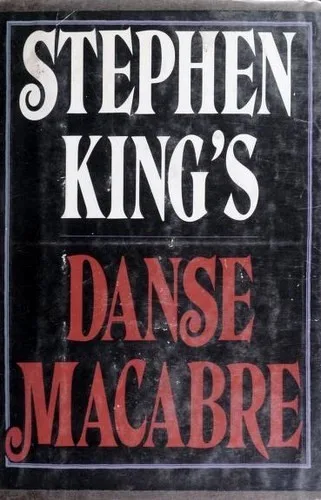
Danse Macabre
 75
75

Danse Macabre



Lorelei Sage, Contemplative Literature Editor: Stephen King's 'Danse Macabre' transcends its genre to offer a profound, almost alchemical, dissection of horror's enduring appeal. King, a masterful weaver of dread himself, turns his keen intellect to the very threads that bind us to the terrifying. He unearths the symbolic resonance within classic tales, revealing how they function as modern-day myths, speaking to our primal fears of mortality, the unknown, and the darkness within. This work is an essential grimoire for understanding the cultural and psychological underpinnings of horror, offering esoteric insights into the power of narrative. Its strength lies in its ability to connect the visceral thrill of a scare to deeper metaphysical questions, making it invaluable for scholars and seekers alike.
📝 Description
75
Stephen King's 1981 book examines horror's function beyond mere entertainment.
Published in 1981, Stephen King's 'Danse Macabre' examines the horror genre not just as fiction, but as a fundamental expression of human anxieties. King looks at how horror stories draw from folklore, mythology, and shared psychological patterns. He argues that the supernatural elements in these narratives often reflect real-world fears and the darker sides of human behavior.
The book analyzes the symbolic language of dread and how ghostly tales or haunted settings connect to primal archetypes. King suggests that popular horror works tap into ancient patterns and universal human experiences. It is a study of the hidden forces at play in fear and the role of storytelling in facing the unknown.
While not a grimoire, 'Danse Macabre' touches on esoteric traditions by analyzing how horror fiction accesses collective archetypes and subconscious fears. It frames horror narratives as a modern manifestation of ancient ritual, where confronting spectral or monstrous figures allows audiences to engage with primal anxieties and the unknown. The book implicitly links popular horror to deeper currents of human consciousness, suggesting a symbolic language that resonates across cultures and time, akin to how esoteric systems interpret symbols for spiritual or psychological insight.
💡 Why Read This Book?
Uncover the hidden symbolic language of fear and confront the archetypal forces that shape our anxieties. 'Danse Macabre' offers a profound, almost initiatory, understanding of horror's role in human consciousness. Ideal for seekers of esoteric knowledge, scholars of the uncanny, and practitioners who understand the power of narrative to influence the psyche. It's a journey into the heart of dread, illuminated by intellectual rigor and profound insight.
⭐ Reader Reviews
Honest opinions from readers who have explored this book.
❓ Frequently Asked Questions
Is 'Danse Macabre' a horror novel?
No, 'Danse Macabre' is a non-fiction work by Stephen King that analyzes the genre of horror literature and film, exploring its history, themes, and cultural impact.
What esoteric traditions does King explore?
While not explicitly framed within a single tradition, King's analysis touches upon Jungian archetypes, mythological patterns, and the collective unconscious, all of which have significant parallels in various esoteric and occult studies.
Who is the intended audience for this book?
The book is intended for fans of horror literature and film, but also for anyone interested in cultural analysis, psychology, and the deeper meanings behind our shared fears and fascinations.
Does the book offer practical advice for writers?
Yes, King, as a prolific author, offers insights and observations that can be incredibly valuable for aspiring writers, particularly those working within the horror genre.
Can this book be considered a form of divination?
While not a traditional divination tool, 'Danse Macabre' can be seen as a form of cultural divination, revealing hidden patterns and collective anxieties within society through the lens of horror narratives.
🔮 Key Themes & Symbolism
The Archetypal Shadow
King looks at how horror narratives act as conduits for exploring the collective shadow, the repressed aspects of the human psyche. He examines how figures like vampires, ghosts, and monsters embody primal fears and societal anxieties that often remain unspoken. This theme appeals to Jungian psychology and occult philosophies that seek to integrate these darker forces, suggesting that confronting them through narrative is a necessary step towards self-understanding and spiritual wholeness. The 'Danse Macabre' itself becomes a symbolic representation of humanity's dance with death and the unknown, a perpetual negotiation with the unseen.
The Language of Fear and Symbolism
This work illuminates horror as a potent, albeit often unsettling, form of symbolic language. King dissects how specific motifs—haunted houses, cursed objects, encroaching darkness—function as powerful totems that tap into universal human experiences of loss, isolation, and mortality. He demonstrates how the genre employs symbolism to communicate profound truths about the human condition, acting as a ritualistic exploration of existential dread. For the esoteric reader, this offers a framework for understanding how popular culture can serve as a modern-day oracle, revealing hidden knowledge through its allegorical structures and potent imagery.
The Metaphysics of the Macabre
Beyond mere fright, King probes the deeper metaphysical implications of horror. He posits that the genre often grapples with fundamental questions of existence, consciousness, and the nature of reality itself. The spectral encounters and supernatural phenomena described are not just plot devices but manifestations of the uncanny, the liminal spaces where the veil between worlds appears thin. This exploration invites readers to consider the philosophical underpinnings of fear and the ways in which stories of the impossible can illuminate the very fabric of our perceived reality, urging a contemplation of what lies beyond the mundane veil.
💬 Memorable Quotes
Direct passages from the work, attributed to the author.
“Terror is the engine of the horror story.”
— This highlights the fundamental role of fear as the driving force and primary mechanism through which horror narratives achieve their impact and resonance.
“The real horror is often in the mundane.”
— This suggests that the most profound and disturbing aspects of horror can be found not in overt supernatural events, but in the unsettling truths and darkness lurking within everyday life and human nature.
“Horror is a way to confront our deepest fears.”
— This positions horror as a cathartic and psychological tool, allowing individuals and society to process and grapple with existential anxieties and primal dread in a controlled environment.
“The monster is often a reflection of ourselves.”
— This emphasizes the symbolic nature of horror villains, suggesting they embody aspects of humanity's own darker impulses, societal flaws, or repressed desires, serving as a mirror to our own inner landscape.
“Stories are how we make sense of the world.”
— This underscores the fundamental human need for narrative, positing that storytelling, including horror, is a primary means by which we interpret our experiences, understand our place, and work through the complexities of existence.
🌙 Esoteric Significance
Tradition
While not strictly adhering to a single esoteric tradition, 'Danse Macabre' deeply appeals to Jungian psychology, particularly the exploration of archetypes and the collective unconscious. It also aligns with hermetic principles concerning the power of symbols and the mirroring of the macrocosm within the microcosm, suggesting that societal fears often reflect deeper spiritual or existential truths. The very act of analyzing horror can be seen as a form of occult investigation into the hidden forces that shape human experience and consciousness.
Symbolism
The book looks at the wide range of symbols inherent in horror, from the haunted house as a representation of the psyche's inner turmoil and repressed memories, to the vampire as an emblem of primal desires and mortality's inescapable grip. King highlights how these symbols function as potent totems, tapping into ancient fears and universal human experiences. He reveals how the 'Danse Macabre' itself, a medieval artistic motif depicting death leading people in a procession, serves as a powerful metaphor for the inescapable dance between life and death, the conscious and the unconscious, that horror so effectively explores.
Modern Relevance
In an era saturated with digital stimuli and increasingly complex societal anxieties, 'Danse Macabre' offers a vital framework for understanding our enduring fascination with the dark. Its analysis of fear as a symbolic language remains profoundly relevant, helping us to deconstruct the narratives that shape our perception of threat and the unknown. For contemporary seekers, it provides tools to recognize the archetypal patterns at play in modern media, fostering a more discerning and conscious engagement with the 'occult' currents that permeate our culture and inform our collective psyche.
👥 Who Should Read This Book
This indispensable work is a rich source for a diverse audience. For the **beginner** to esoteric studies, 'Danse Macabre' offers an accessible entry point into understanding the symbolic power of narrative and the psychological underpinnings of fear. **Scholars** of literature, film, and cultural studies will find it a foundational text, providing rich analytical frameworks and historical context. **Seekers** drawn to the mysteries of human consciousness and the darker aspects of existence will discover useful insights into the archetypal forces at play. **Practitioners** of various spiritual or psychological disciplines can utilize its exploration of fear and symbolism to deepen their understanding of the human psyche and its relationship to the unseen.
📜 Historical Context
Published in 1981, 'Danse Macabre' emerged during a period of significant cultural introspection and evolving artistic expression. The late 1970s and early 1980s saw a resurgence of interest in the supernatural and the occult, fueled by popular culture phenomena like the rise of the blockbuster horror film, new age spirituality, and a growing fascination with ancient mysteries. King’s work arrived as a comprehensive, yet accessible, exploration of this cultural moment, dissecting the threads of fear that had long been woven into literature and cinema. It provided a critical lens through which to understand the enduring power of horror, connecting its modern manifestations to older traditions of storytelling and psychological exploration, thus solidifying its place as a seminal text in horror criticism.
📔 Journal Prompts
Reflect on a moment of profound terror in your life. What archetypal symbols or primal fears do you now recognize at play?
How do the 'monsters' you encounter in literature or film serve as metaphors for societal anxieties or your own personal shadows?
Consider a 'haunted house' narrative. What aspects of the house's symbolism resonate with your own inner landscape or personal history?
In what ways does Stephen King's analysis of horror reveal a form of modern-day divination, predicting or clear collective fears?
How can understanding the 'Danse Macabre' of life and death through narrative help you navigate your own existential questions and mortality?
🗂️ Glossary
Archetype
In Jungian psychology, a universal, inherited pattern of thought or imagery derived from the experience of the species, which forms part of the collective unconscious.
Collective Unconscious
A theoretical reservoir of the experiences of mankind, containing archetypes and instincts, shared by all humans.
Symbolism
The use of symbols to represent ideas and qualities, by giving them symbolic meanings that are different from their literal sense.
The Uncanny
A feeling of unease or discomfort evoked by something that is strangely familiar yet alien, often associated with the repressed or the return of the repressed.
Metaphysics
The branch of philosophy that deals with the first principles of things, including abstract concepts such as being, knowing, substance, cause, identity, time, and space.
This book appears in 3 collections
🔮 Readers Also Liked
Browse all →







More by Stephen King
All books →


From the “Tarot” Collection
View all →







More Free Divination & Tarot Books
View all →