Personality, divination, and the tarot
 64
64

Personality, divination, and the tarot



Silas Hawthorne (Hermetic Studies Editor) — Carl Sargent's 'Personality, Divination, and the Tarot' stands as a monumental contribution to esoteric literature. Sargent's erudition shines as he intricately weaves together psychological theory with the rich symbolism of the Tarot. He masterfully demonstrates how the cards are not mere fortune-telling tools, but potent mirrors reflecting the deepest facets of our personality and the archetypal forces that shape our lives. This book offers unparalleled depth for those seeking to understand the psychological underpinnings of divination and the occult. Its strength lies in its ability to demystify complex concepts, making them accessible yet retaining their profound esoteric power. Essential reading for serious students of Tarot and the hidden self.
📝 Description
64
Carl Sargent's 1990 book connects tarot symbolism to personality theory.
In 'Personality, Divination, and the Tarot,' Carl Sargent examines the relationship between tarot imagery and individual psychology. Published in 1990, the book proposes that the archetypal figures and narratives within the tarot deck can serve as a framework for understanding human personality traits and patterns. Sargent details how specific cards and their associated symbolism might reflect different psychological states or tendencies.
The work aims to provide readers with a method for using the tarot not just for divination, but as a tool for self reflection and personal growth. It discusses the underlying symbolism and structure of the tarot, linking these elements to psychological concepts. The goal is to help individuals gain insight into their own characters and potential paths for development through the contemplative use of the cards.
This book sits within the tradition of psychological astrology and esoteric psychology that gained prominence in the late 20th century. Following figures like Carl Jung, who explored archetypes and their manifestation in symbols like the tarot, Sargent applies a similar lens. It continues a line of inquiry that seeks to map the human psyche using symbolic systems, moving beyond purely predictive divination towards a more introspective and therapeutic application of esoteric tools. The work engages with the idea that ancient symbolic languages hold keys to understanding fundamental human psychology.
💡 Why Read This Book?
Delve into the profound connection between your inner world and the ancient wisdom of the Tarot. This book offers a unique exploration of how archetypal energies manifest in personality, providing tools for self-understanding and personal growth. Ideal for spiritual seekers, psychology enthusiasts, and Tarot practitioners eager to deepen their practice beyond simple prediction, revealing the Tarot as a potent map of the soul.
⭐ Reader Reviews
Honest opinions from readers who have explored this book.
❓ Frequently Asked Questions
How does the Tarot relate to personality?
The Tarot acts as a symbolic language, with each card representing archetypal energies and psychological patterns. Sargent illustrates how these archetypes manifest in our personalities, offering insights into our motivations, strengths, and challenges through divinatory readings.
Is this book for beginners or advanced Tarot users?
The book is accessible to both beginners seeking a deeper understanding and advanced practitioners looking to integrate psychological perspectives into their readings. Its layered approach caters to a wide range of experience levels.
What psychological theories are explored?
Sargent draws upon various psychological frameworks, including Jungian archetypes, to explain the profound resonance between Tarot imagery and the human psyche, offering a rich theoretical foundation.
Can this book be used for self-divination?
Absolutely. The book provides the conceptual framework and interpretive keys to utilize the Tarot for self-reflection, personal insight, and understanding one's own personality dynamics in a divinatory context.
What is the esoteric significance of this work?
It reveals the Tarot not just as a tool for fortune-telling, but as a sacred system of esoteric knowledge, a map of consciousness, and a powerful instrument for spiritual development and self-realization.
🔮 Key Themes & Symbolism
The Tarot as a Mirror of the Psyche
This theme explores the profound thesis that the Tarot's archetypal imagery serves as a direct reflection of the human personality. Sargent meticulously details how the Major and Minor Arcana embody universal psychological patterns, complexes, and developmental stages. Readers will discover how the cards can illuminate their inner world, revealing hidden motivations, unconscious drives, and the subtle interplay of forces that shape their character and destiny. It's an invitation to see the Tarot not as an external oracle, but as an internal map of the soul's journey.
Archetypal Energies and Personal Manifestation
Look at the concept of archetypal energies, the primal forces of the collective unconscious that the Tarot so vividly represents. Sargent explains how these universal patterns, such as The Magician, The High Priestess, or The Fool, are not just abstract concepts but active influences within our individual lives. Understanding these energies allows for a deeper comprehension of personal strengths, weaknesses, and the underlying currents driving our actions and decisions. This theme empowers readers to consciously engage with these archetypes for personal growth and transformation.
Divination as Psychological Insight
This crucial theme redefines divination, moving beyond simple prediction to frame it as a sophisticated tool for psychological insight and self-awareness. Sargent demonstrates how Tarot readings, when approached with an understanding of personality and archetypes, can offer profound clarity on present circumstances, potential future trajectories, and the underlying psychological dynamics at play. It emphasizes the Tarot's role in facilitating introspection, problem-solving, and the conscious integration of shadow aspects of the self, leading to greater self-understanding and informed choices.
💬 Memorable Quotes
Direct passages from the work, attributed to the author.
“Within each card lies an echo of our own deepest potentials.”
— Highlights how the archetypal energies of the Tarot are intrinsically linked to the latent capacities and hidden strengths within every individual, waiting to be awakened.
“To read the cards is to read oneself, in a language of symbols.”
— This underscores the introspective nature of Tarot divination as presented in the book, framing it as a profound act of self-exploration through symbolic interpretation.
“The shadow cards reveal the hidden architects of our behavior.”
— Points to the book's exploration of the darker or more challenging aspects of the Tarot and personality, suggesting they hold keys to understanding unconscious influences.
“Wisdom is not found in the future, but in the present unfolding of the self.”
— Encourages a focus on the immediate insights gained from Tarot readings for personal development, rather than solely seeking prophetic predictions.
💡 Key Ideas
Editorial paraphrase of the work's core concepts — not direct quotes.
The Tarot is not a book of fate, but a map of the soul's journey.
This quote emphasizes the book's core philosophy: the Tarot's power lies in its ability to guide self-discovery and understand personal growth, not in dictating predetermined outcomes.
🌙 Esoteric Significance
Tradition
This work is deeply rooted in the Western Esoteric Tradition, particularly drawing upon Hermeticism and Neoplatonism, which emphasize the interconnectedness of the cosmos and the human soul through symbolic representation. It also aligns with Jungian psychology's exploration of archetypes and the collective unconscious, bridging the gap between ancient wisdom and modern psychological thought. The Tarot is presented as a key component of this tradition, a sacred text for understanding the divine spark within humanity.
Symbolism
The core symbolism revolves around the Tarot archetypes, each representing fundamental human experiences, stages of consciousness, and universal forces. Sargent elucidates how the Rider-Waite-Smith imagery, in particular, serves as a rich visual lexicon for the human psyche. From the primal energy of The Fool to the spiritual attainment of The World, the cards form a symbolic narrative of individuation and self-realization, making the esoteric accessible through universally understood visual language.
Modern Relevance
In an age often characterized by existential angst and a search for meaning, 'Personality, Divination, and the Tarot' offers a timeless framework for self-discovery. Its emphasis on understanding one's own personality through archetypal patterns and symbolic reflection is more relevant than ever. The book provides practical tools for navigating personal challenges, fostering emotional intelligence, and cultivating a deeper connection to one's inner life, making the esoteric accessible and applicable to contemporary seekers.
👥 Who Should Read This Book
This book is a rich source for a diverse audience. **Beginners** will find a clear and profound introduction to the Tarot, moving beyond superficial interpretations to grasp its psychological depth. **Spiritual Seekers** will discover a powerful tool for introspection and self-awareness, using the Tarot as a guide for personal growth and understanding their life path. **Psychology Enthusiasts** will appreciate the sophisticated integration of psychological theories, particularly Jungian concepts, with esoteric symbolism. **Dedicated Tarot Practitioners** will gain a richer, more nuanced approach to their readings, enhancing their ability to provide insightful guidance and facilitate transformative experiences for themselves and others.
📜 Historical Context
Published in an era of burgeoning interest in both psychology and esoteric traditions, Carl Sargent's 'Personality, Divination, and the Tarot' emerged during a time when the lines between scientific inquiry and ancient mysticism were increasingly being explored. The late 20th century saw a resurgence of popular interest in the occult, spirituality, and alternative paths to self-understanding, influenced by figures like Carl Jung and the counter-culture movements. Sargent's work tapped into this fertile ground, offering a sophisticated and psychologically informed approach to the Tarot, which had previously been relegated to the field of simple fortune-telling for many. His contribution helped legitimize the Tarot as a serious tool for introspection and personal development within esoteric and psychological circles.
📔 Journal Prompts
Reflect on a recent Tarot reading. Which card(s) most strongly resonated with your current personality or a specific challenge you are facing, and why?
Identify an archetype from the Tarot that you feel particularly drawn to or, conversely, one that you find challenging. How might this archetype be manifesting in your daily life?
Consider the concept of the 'shadow' in relation to the Tarot. Which cards might represent aspects of yourself that you tend to suppress or avoid, and what insights could exploring them offer?
How can understanding the symbolic language of the Tarot empower you to make more conscious choices in your personal and professional life?
Imagine the Tarot as a map of your inner journey. What major 'locations' or 'stages' on this map do you currently find yourself in, and what might the next step entail?
🗂️ Glossary
Archetype
Universal, archaic patterns and images that derive from the collective unconscious and are the psychic counterpart of instinct. In the Tarot, these are embodied by the figures and symbols on the cards.
Collective Unconscious
A concept introduced by Carl Jung, referring to the part of the unconscious mind that is common to all humanity, containing inherited instincts and archetypes.
Divination
The practice of seeking knowledge of the future or the unknown by supernatural means. In this context, it's viewed as a symbolic interpretation of the Tarot for psychological insight.
Esoteric
Intended for or likely to be understood by only a small number of people with a specialized knowledge or interest. Refers to hidden or secret knowledge.
Individuation
A psychological process of integrating the conscious and unconscious aspects of the personality to become a whole, unique individual. The Tarot can be seen as a guide to this process.
This book appears in 3 collections
🔮 Readers Also Liked
Browse all →
More by Carl Sargent
All books →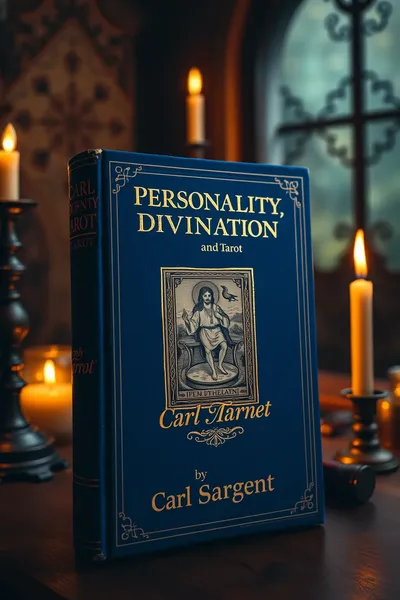
From the “Tarot” Collection
View all →
More Free Divination & Tarot Books
View all →