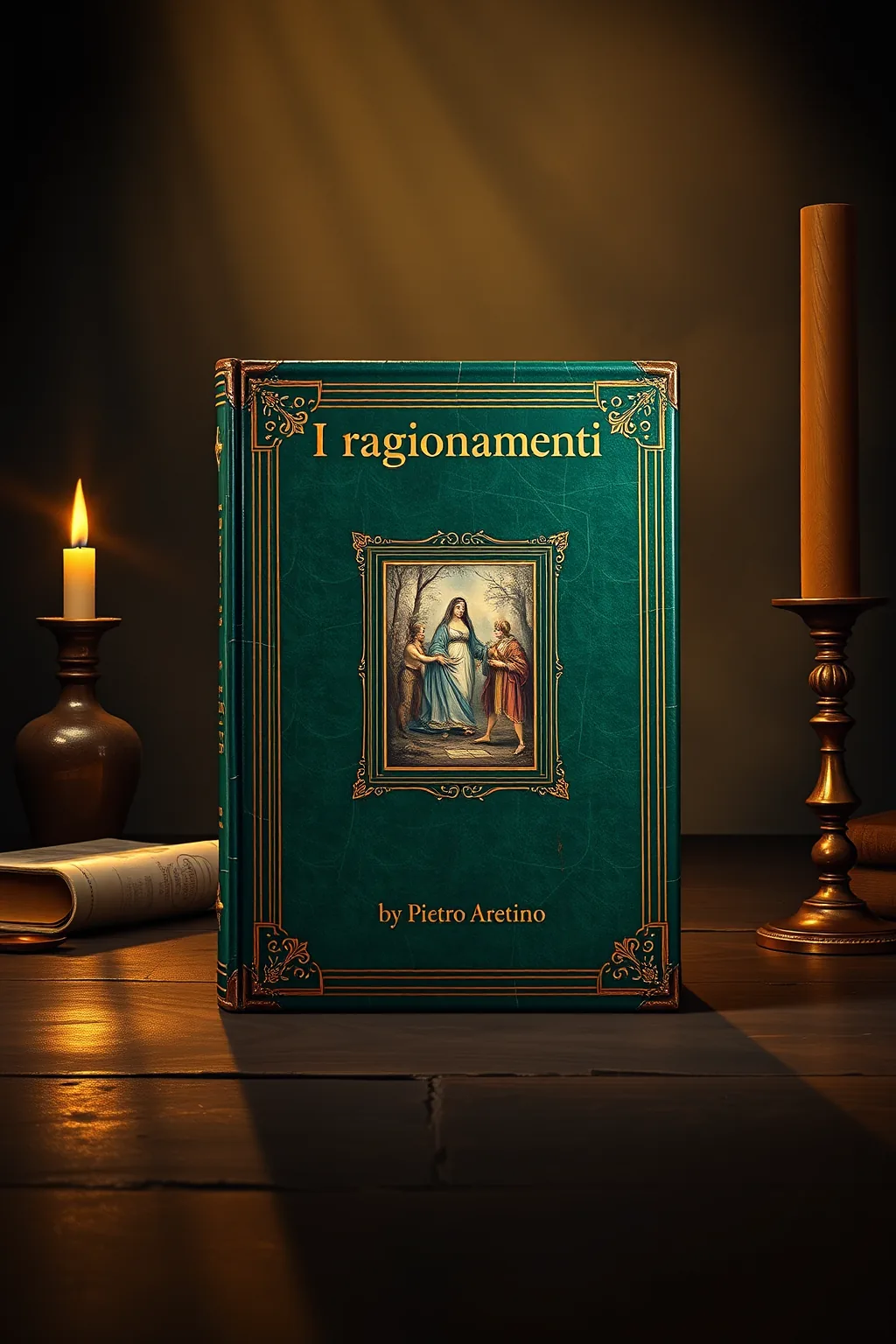
I ragionamenti
 64
64

I ragionamenti



Evander Ashcroft (Alchemy & Hermeticism Editor) — Pietro Aretino's 'I Ragionamenti' is a remarkable, albeit provocative, delve into the undercurrents of human nature and societal artifice. Esoterically, it offers a potent allegory for the alchemical process, wherein base desires and social structures are transmuted through frank examination into a form of raw, unadulterated wisdom. Aretino's genius lies in his ability to couch profound truths within seemingly scandalous dialogues, forcing the reader to confront their own perceptions. For scholars of Renaissance occultism and those interested in the symbolic language of desire, this is an essential, if challenging, text. Its strength is its unflinching gaze into the human psyche.
📝 Description
64
Pietro Aretino published 'I Ragionamenti' in Venice around 1538.
Pietro Aretino's 'I Ragionamenti,' published in Venice around 1538, presents dialogues that critique the moral and social fabric of the Renaissance. The work uses frank and often coarse language to discuss sexual practices, societal hypocrisy, and the pursuit of pleasure. Aretino frames these discussions through fictional characters, such as the courtesans Nanna and Pippa, who share their experiences and advice. This approach allows for an examination of human desires and failings, presented with a sharp wit characteristic of the author. The book offers a window into the underbelly of society, challenging conventional notions of virtue and decorum.
Beyond its surface provocations, 'I Ragionamenti' engages with deeper questions about knowledge, experience, and the nature of reality. Aretino suggests that a certain kind of understanding arises from confronting life's rawest aspects. The text implies that true insight can be found not in idealized pronouncements but in the direct observation of human behavior, both its baser instincts and its capacity for manipulation. It is a work that deliberately blurs the lines between vulgarity and philosophical inquiry, forcing readers to consider uncomfortable truths.
While not a treatise on formal esoteric systems, 'I Ragionamenti' touches upon currents of thought that resonated with esoteric interests in the Renaissance. The emphasis on hidden realities beneath outward appearances, the transmutation of base experiences into knowledge, and the exploration of the 'flesh and spirit' connect to broader alchemical and hermetic ideas. The book's frank depiction of worldly affairs can be seen as a form of confronting the 'prima materia' of human existence, suggesting that profound truths are revealed through direct engagement with the material world, rather than abstract contemplation. It reflects a period where boundaries between secular and sacred, science and magic, were often blurred.
💡 Why Read This Book?
Uncover the veiled wisdom of Renaissance Italy, where social critique meets esoteric allegory. 'I Ragionamenti' challenges conventional morality, revealing hidden truths about desire, power, and the transformative potential of experience. Ideal for scholars of occult literature, seekers of forbidden knowledge, and practitioners of symbolic interpretation who wish to explore the intersection of the carnal and the spiritual.
⭐ Reader Reviews
Honest opinions from readers who have explored this book.
❓ Frequently Asked Questions
What is the primary subject matter of 'I Ragionamenti'?
The book primarily explores social customs, sexual behavior, and human relationships through a series of dialogues, offering both sharp social commentary and veiled esoteric insights into human nature.
Is 'I Ragionamenti' considered an occult or mystical text?
While not explicitly a grimoire, its allegorical nature, exploration of hidden desires, and symbolic language lend it significant esoteric appeal for those interested in the less conventional aspects of Renaissance thought.
What is the historical significance of Pietro Aretino?
Aretino was a pivotal figure of the Italian Renaissance, renowned for his sharp wit, prolific writing, and influence on literature and art. He was a master of satire and often pushed societal boundaries with his candid observations.
Who is the intended audience for this work?
This work is best suited for mature readers, scholars of Renaissance literature, those interested in social history, and individuals with an appetite for philosophical and symbolic exploration beyond conventional narratives.
Are there any translations available in English?
Yes, 'I Ragionamenti' has been translated into English, making its complex themes and provocative content accessible to a wider, international audience seeking deeper understanding.
🔮 Key Themes & Symbolism
The Alchemy of Desire
Aretino masterfully employs desire not merely as a biological imperative but as a potent alchemical agent. Through frank and often scandalous dialogues, he suggests that confronting and understanding the rawest forms of human longing can lead to a profound internal transmutation. The text invites readers to view desire as a crucible, capable of refining the soul and revealing hidden truths about the self and society, echoing ancient Hermetic principles of transformation through the manipulation of primal energies.
Veiled Social Critique and Symbolic Language
Beneath the surface of explicit conversations lies a sharp indictment of Renaissance social hypocrisy and moral decay. Aretino's genius lies in his use of allegory and symbolic language, where seemingly mundane discussions about sexual encounters and social maneuvering reveal deeper patterns of power, manipulation, and societal control. This layered approach requires the reader to engage actively, deciphering the hidden meanings that critique the established order and expose the underlying currents of human behavior.
The Transmutation of Knowledge
The 'reasonings' within the book serve as a catalyst for a unique form of knowledge acquisition. Aretino suggests that true understanding emerges not from abstract philosophy or rigid dogma, but from direct, often uncomfortable, engagement with life's realities. The text functions as a manual for a different kind of learning—one that embraces the forbidden, questions authority, and seeks wisdom in the very fabric of human experience, akin to the Gnostic pursuit of hidden gnosis.
💬 Memorable Quotes
Direct passages from the work, attributed to the author.
“Words are but the shadows of deeds.”
— This emphasizes the primacy of action and lived experience over mere discourse. It implies that true understanding and impact come from concrete actions, not just eloquent pronouncements.
“In every pleasure, there is a hidden pain.”
— This poignant observation speaks to the duality of human experience, suggesting that even in moments of joy or indulgence, an underlying melancholy or consequence is often present, a theme resonant with Stoic and Gnostic thought.
“The world is a stage, and all men are actors.”
— A classic reflection on the performative nature of social life, implying that individuals often play roles dictated by society, masking their true selves and motivations for the sake of appearances.
“Truth often wears a vulgar dress.”
— This suggests that profound truths are not always found in refined or eloquent forms, but can be revealed in the most common, even crude, aspects of life and language, challenging conventional notions of purity.
💡 Key Ideas
Editorial paraphrase of the work's core concepts — not direct quotes.
The flesh is the true book of wisdom.
This quote highlights Aretino's materialistic and experiential approach to knowledge, suggesting that physical experience and carnal understanding are fundamental to true wisdom, rather than abstract or purely spiritual pursuits.
🌙 Esoteric Significance
Tradition
While not directly aligned with a single codified esoteric tradition, 'I Ragionamenti' resonates strongly with Hermeticism and Renaissance Neoplatonism. Its focus on the transformative power of experience, the symbolic interpretation of earthly desires, and the uncovering of hidden knowledge aligns with the Hermetic principle of 'as above, so below.' The text can be seen as an allegorical exploration of the soul's journey through the material world, seeking gnosis (knowledge) through the transmutation of base elements – in this case, societal conventions and carnal appetites – into spiritual insight.
Symbolism
The symbolism in 'I Ragionamenti' is rich and often provocative. The human body and its functions are not merely presented literally but serve as allegorical representations of societal structures, power dynamics, and the inner field of the human psyche. Sexual acts and desires become metaphors for the exchange of energy, the pursuit of pleasure as a catalyst for change, and the unveiling of hidden truths. Prostitution, often depicted, can symbolize the commodification of social interaction and the transactional nature of relationships, while the act of 'reasoning' itself symbolizes the alchemical process of distillation and purification of thought and experience.
Modern Relevance
In contemporary society, Aretino's 'I Ragionamenti' remains surprisingly relevant. Its exploration of desire, social critique, and the often-hidden motivations behind human behavior speaks to modern anxieties about authenticity, media manipulation, and the performance of self. The text challenges us to look beyond superficial appearances and confront the complex interplay of morality, sexuality, and societal expectation. For those interested in the evolution of human discourse and the enduring power of taboo subjects, Aretino's work offers a potent, if unsettling, mirror to our own times.
👥 Who Should Read This Book
This work is a treasure for the discerning reader. **Scholars** of Renaissance literature and social history will find invaluable primary source material, offering a candid counterpoint to more formal historical accounts. **Seekers of esoteric knowledge** will appreciate its allegorical depth and its unique approach to understanding human nature through the lens of desire and societal critique. **Practitioners** interested in symbolic interpretation and the alchemical transmutation of experience will find fertile ground for contemplation. While **beginners** might find the frankness challenging, those with an open mind and a curiosity for the darker, more complex facets of human existence will be richly rewarded.
📜 Historical Context
Pietro Aretino's 'I Ragionamenti,' penned in the vibrant yet morally complex field of 16th-century Italy, emerged during the High Renaissance, an era characterized by a flourishing of arts and sciences alongside intense religious and political upheaval. This period witnessed a burgeoning interest in humanism, classical learning, and a more empirical approach to understanding the world. However, it was also a time of strict social hierarchies, pervasive religious dogma, and the looming threat of the Inquisition. Aretino, a master provocateur, navigated these turbulent waters by using his biting wit and uncensored prose to dissect societal norms, sexual mores, and the hypocrisy of the elite. His work reflects a tension between the era's intellectual ferment and its deep-seated conservatism, offering a candid, often scandalous, glimpse into the underbelly of Renaissance life and thought.
📔 Journal Prompts
How does Aretino use dialogue to reveal hidden social dynamics and personal motivations?
In what ways can human desire be interpreted as an alchemical agent for transformation?
Analyze a specific scene from 'I Ragionamenti' and identify its underlying symbolic meaning.
How does the concept of 'vulgar dress' for truth apply to contemporary societal discussions?
Reflect on a personal experience where societal expectations masked underlying realities. How does this resonate with Aretino's themes?
🗂️ Glossary
I Ragionamenti
Literally 'The Reasonings' or 'The Dialogues,' this refers to the collection of conversations and narratives that form the core of Aretino's work, often looking at controversial topics.
Renaissance
A period in European history, roughly from the 14th to the 17th century, marked by a revival of classical art, literature, and learning, characterized by humanism and a burgeoning scientific spirit.
Hermeticism
A philosophical and religious tradition based on the supposed teachings of Hermes Trismegistus, emphasizing divine wisdom, the interconnectedness of all things, and the potential for human spiritual transformation.
Gnosis
From the Greek word for 'knowledge,' gnosis refers to a spiritual knowledge or insight, often esoteric, that leads to liberation or salvation. It is a central concept in Gnosticism.
Allegory
A literary device where characters, events, and settings represent abstract ideas or moral qualities, conveying a deeper, often hidden, meaning beyond the literal narrative.
This book appears in 3 collections
🔮 Readers Also Liked
Browse all →







From the “Tarot” Collection
View all →







More Free Divination & Tarot Books
View all →