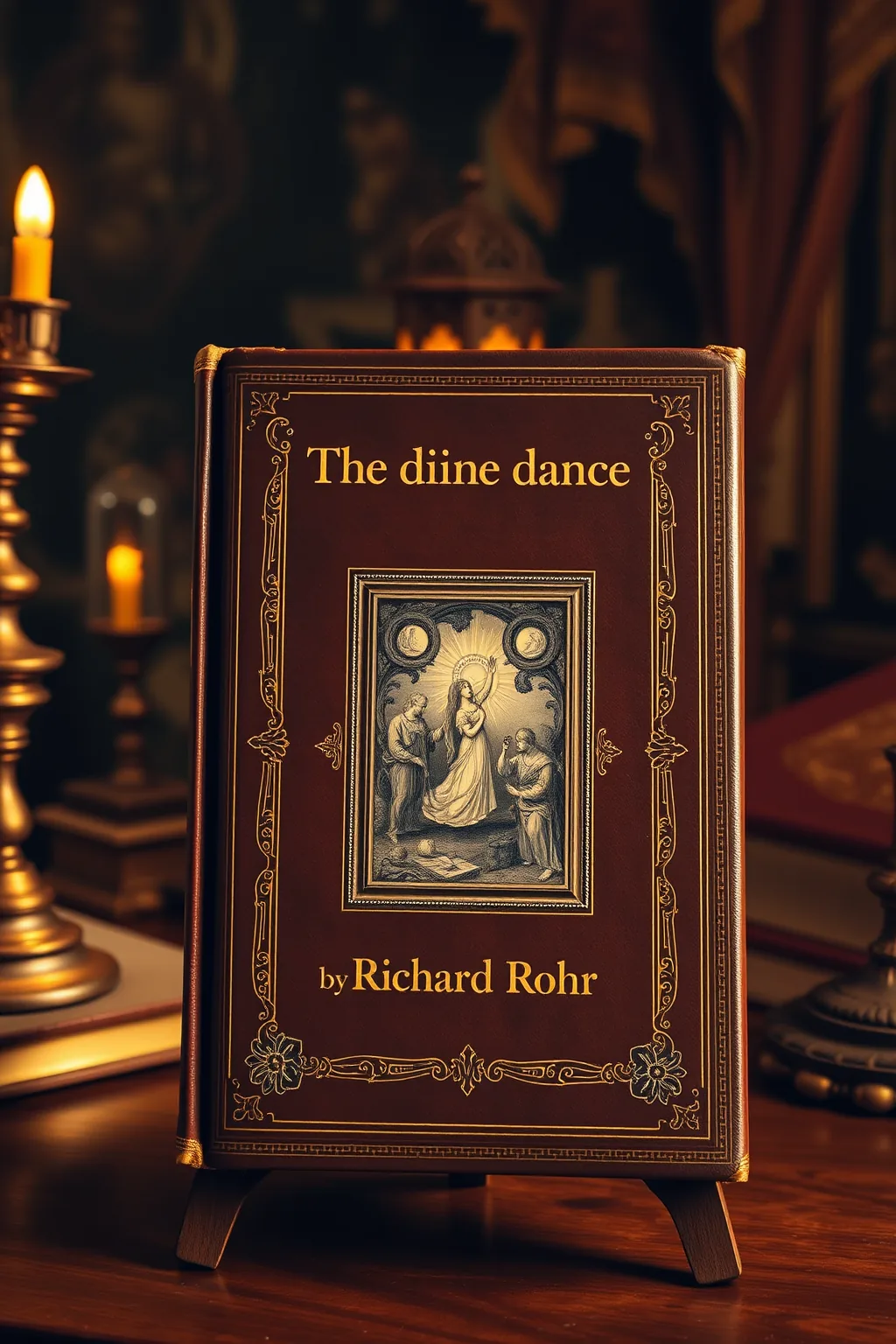
The divine dance
 64
64

The divine dance



Richard Rohr's 'The Divine Dance' is a seminal work, offering a breathtaking re-imagining of the Trinity not as abstract dogma, but as a vibrant, relational reality. Drawing from a vast reservoir of spiritual wisdom, Rohr artfully dismantles the image of a solitary Creator, presenting instead a God eternally engaged in a loving, dynamic exchange. His prose is both accessible and deeply profound, making complex theological concepts resonate with profound personal meaning. This book is essential reading for serious seekers of Christian mysticism and anyone wrestling with traditional theological frameworks. It illuminates the path towards experiencing God as an intimate, participatory reality.
📝 Description
64
Richard Rohr's 1996 book, The Divine Dance, posits God as an immanent communion of Love.
In The Divine Dance, Richard Rohr challenges the common perception of God as a remote figure. He presents a vision of the divine as an eternal, active participation in Love, understood as a dynamic Trinity. This is not a distant ruler, but a vibrant community and friendship. Rohr draws on various sources to build this understanding.
He integrates biblical texts, historical theological writings, and the insights of mystics and philosophers. The book aims to guide readers toward a more direct experience of this relational God. It suggests that this divine energy is present throughout creation and invites humanity to join this ongoing movement. The work is for those seeking a more personal and immediate connection with the divine.
The Divine Dance fits within a Christian esoteric tradition that emphasizes direct experience of the divine over purely doctrinal assent. Rohr engages with contemplative practices and mystical theology, often referencing figures like Meister Eckhart and Julian of Norwich. His work seeks to recover a sense of God's active presence in the world, aligning with traditions that see the divine not as separate from creation but as its animating principle. This approach contrasts with more literalist or dualistic interpretations, favoring a unified vision of God and existence.
💡 Why Read This Book?
Embark on a profound re-discovery of God's immanent nature. 'The Divine Dance' offers an alternative to distant theology, revealing God as an eternal, loving communion—a dynamic Trinity experienced as Friendship and cosmic movement. Ideal for spiritual seekers, theologians, and mystics yearning for a more relational and vibrant understanding of the divine.
⭐ Reader Reviews
Honest opinions from readers who have explored this book.
❓ Frequently Asked Questions
What is the core concept of the 'Divine Dance'?
The 'Divine Dance' refers to the eternal, relational, and loving communion within the Trinity (Father, Son, Holy Spirit), understood as a dynamic interplay of Love, Community, and Friendship, rather than static dogma.
How does Rohr's approach differ from traditional Trinity doctrines?
Rohr shifts the focus from abstract intellectual understanding to experiential reality, portraying the Trinity as a lived relationship of mutual giving and receiving, a cosmic dance of love that includes humanity.
What spiritual traditions does Rohr draw upon?
He synthesizes insights from Christian Scripture, early Church Fathers, mystics like Meister Eckhart and Julian of Norwich, as well as philosophical and wisdom traditions.
Who is the intended audience for this book?
This book is for anyone seeking a deeper, more relational understanding of God, including laypeople, clergy, theologians, spiritual directors, and seekers from various backgrounds.
Can this book be considered esoteric?
Yes, in its exploration of hidden theological depths, mystical experiences, and symbolic interpretations of divine reality, offering knowledge often considered beyond ordinary theological discourse.
🔮 Key Themes & Symbolism
The Relational Trinity: God as Community
This theme dismantles the solitary God image, revealing the Trinity not as three separate persons but as an eternal, vibrant, and loving communion. Rohr emphasizes that God's very essence is relational, a constant outflow and inflow of Love, characterized by mutual indwelling and interdependence. This understanding transforms God from an isolated sovereign into an intimate Friend and a dynamic Community, inviting humanity into its divine life and offering a profound model for human relationships and societal structures.
The Cosmic Dance of Creation and Redemption
The 'Divine Dance' extends beyond the inner life of God to encompass all of creation. Rohr presents existence as an ongoing, participatory dance, initiated by God and sustained by divine Love. This perspective imbues every aspect of life with sacred meaning, revealing the universe as a stage for divine activity and human participation. Redemption, in this context, is not merely a historical event but an ongoing invitation to join this cosmic ballet, aligning our lives with the divine rhythm and harmony.
Mystical Union and Experiential Theology
Rohr champions an experiential approach to theology, drawing heavily on the insights of mystics and contemplative traditions. He argues that the deepest truths about God are not solely grasped through intellectual assent but are revealed through direct experience of divine Love and presence. The book encourages readers to move beyond theoretical doctrines to cultivate a personal, felt relationship with the Divine, fostering a sense of awe, wonder, and intimate connection that transforms one's perception of reality.
💬 Memorable Quotes
Direct passages from the work, attributed to the author.
“God does not love us because we are lovable, but because God is Love.”
— This profound statement shifts the locus of love from human merit to divine nature, asserting that God's love is an inherent attribute, an unconditional outpouring.
“The Trinity is the original community.”
— This highlights God's inherent relationality, positing the Trinity as the foundational model for all community and connection, both divine and human.
“We are invited into the very life of God.”
— This emphasizes the intimate and participatory nature of our relationship with the Divine, suggesting a co-creation and shared existence with God.
“God is not a noun, but a verb.”
— This powerful metaphor redefines God as dynamic, active, and ever-present, emphasizing divine action and ongoing creation rather than static being.
“The universe is a dance of divine love.”
— This expands the concept of the Divine Dance to encompass all of creation, portraying existence as a sacred, harmonious movement orchestrated by God.
🌙 Esoteric Significance
Tradition
This work draws significantly from Christian mysticism and contemplative traditions, often referred to as the 'esoteric' or 'inner' path of Christianity. It aligns with Gnostic, Hermetic, and Neoplatonic undercurrents that explore the divine as immanent, relational, and accessible through inner experience rather than solely through external dogma. The emphasis on symbolic language, hidden meanings within scripture, and the direct apprehension of divine reality places it firmly within esoteric discourse.
Symbolism
The central symbol is the 'Dance,' representing the dynamic, relational, and life-affirming nature of the Trinity and its presence in creation. Other key symbols include 'Community,' 'Friendship,' and 'Love' as divine attributes and relational modes. Rohr also implicitly uses alchemical symbolism in his concept of transformation and union, and the idea of the 'divine spark' within humanity, echoing ancient esoteric notions of the interconnectedness of the divine and the human.
Modern Relevance
In an age of disconnection and individualism, 'The Divine Dance' offers a profound antidote by presenting God as inherently relational and communal. Its emphasis on experiential faith and the direct apprehension of the divine speaks to a generation seeking authenticity and meaning beyond institutional religion. The book's framework for understanding God as dynamic Love provides a potent theological basis for social justice, ecological consciousness, and the reconciliation of seemingly opposing forces, making its esoteric insights highly relevant for contemporary spiritual and ethical engagement.
👥 Who Should Read This Book
This book is a beacon for the spiritual seeker yearning for a God who is intimately present and actively engaged in the world. Laypeople and clergy alike will find it a transformative re-reading of core Christian doctrines. Scholars of theology and religious history will appreciate Rohr's synthesis of diverse traditions. Practicing contemplatives will discover new avenues for deepening their inner journey, while those new to spiritual exploration will find an accessible yet profound introduction to a more relational and vibrant understanding of the Divine.
📜 Historical Context
Richard Rohr's 'The Divine Dance' emerges within a contemporary theological landscape seeking to bridge ancient wisdom with modern spiritual sensibilities. Published in an era increasingly characterized by both secularization and a resurgent interest in mysticism and contemplative practices, the book appeals to a generation questioning traditional religious structures and seeking more immanent, relational experiences of the divine. It builds upon centuries of Trinitarian theology, particularly the work of figures like Augustine and Aquinas, while critically engaging with and often subverting more scholastic or abstract interpretations. Rohr's work is also influenced by the ecumenical movement and the growing dialogue between Christian theology and other wisdom traditions, reflecting a broader historical trend towards interfaith understanding and the recognition of universal spiritual truths.
📔 Journal Prompts
How does the metaphor of a 'dance' resonate with your understanding of God's relationship with creation?
In what ways can you experience God as 'Community' and 'Friendship' in your daily life?
Consider a moment when you felt a profound sense of divine presence; how does this connect to the 'Divine Dance'?
Reflect on a time you felt 'out of step' with life; how might embracing the 'Divine Dance' offer a path to harmony?
How can understanding the Trinity as relational Love transform your own relationships with others and with the world?
🗂️ Glossary
Trinity
The Christian doctrine of God as three co-equal, co-eternal persons: Father, Son (Jesus Christ), and Holy Spirit, united in one divine essence. Rohr reinterprets this as an eternal dance of Love and Relationship.
Immanence
The belief that God is present and active within the world and human experience, as opposed to transcendence, which emphasizes God's existence beyond the physical universe.
Contemplation
A form of prayer or meditation focused on direct, loving union with God, characterized by stillness, receptivity, and a deep awareness of divine presence.
Kenosis
A Greek term meaning 'self-emptying,' often used in Christian theology to describe Christ's voluntary renunciation of divine attributes for the sake of humanity, reflecting God's self-giving nature.
Mysticism
The pursuit of achieving a direct, intuitive, and ecstatic experience of divine reality or ultimate truth, often through practices of prayer, meditation, and contemplation.
This book appears in 3 collections
🔮 Readers Also Liked
Browse all →







More by Richard Rohr
All books →



From the “Tarot” Collection
View all →







More Free Divination & Tarot Books
View all →