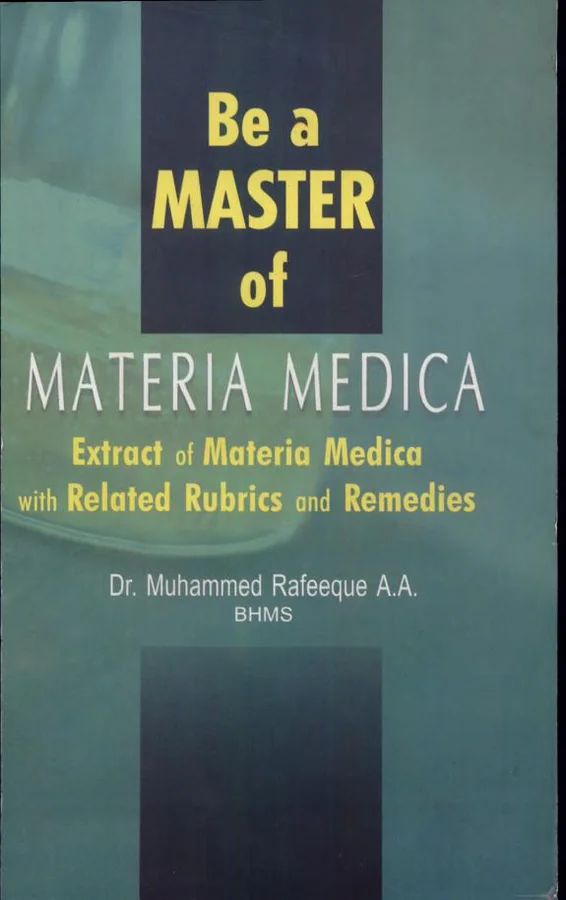
Be a Master of Materia Medica
 79
79

Be a Master of Materia Medica
Muhammed Rafeeque’s Be a Master of Materia Medica offers a commendable effort in organizing a vast amount of homeopathic symptom data. The author’s commitment to sourcing from established Materia Medicas and structuring information from general to specific is evident, providing a clear pathway for students grappling with the sheer volume of information. The strength of this work lies in its systematic arrangement, which aids in efficient recall and comparison. However, a limitation emerges in its reliance on pre-existing provings without significantly expanding upon them or offering novel interpretations, which may leave advanced practitioners seeking deeper, less cataloged insights. A particularly useful section involves the detailed breakdown of symptoms for drugs like *Belladonna*, illustrating how general states of fever and inflammation are followed by specific sensory and motor disturbances. The book serves as a reliable, albeit traditional, reference.
Verdict: A well-organized, foundational reference for students of homeopathy.
📝 Description
79
Published in 2004, Be a Master of Materia Medica organizes homeopathic drug symptoms from general observations to specific particulars.
Muhammed Rafeeque's Be a Master of Materia Medica compiles well-proven homeopathic drugs, drawing symptoms from established Materia Medicas. The book structures this information hierarchically, moving from broad observations to precise details. This systematic arrangement is designed to give practitioners a clear and accessible guide to understanding drug profiles. The text is particularly suited for homeopathic students and practitioners who need a structured and dependable reference. It aids in cross-referencing symptoms and understanding drug affinities at both general and specific levels.
The work focuses on the method of symptom aggregation and classification, emphasizing the principle of "generals to particulars." This approach is central to homeopathic case taking and remedy selection. By presenting symptoms in this ordered manner, the book helps readers gain a deeper understanding of the characteristic indications for each listed drug. This facilitates a more accurate matching of remedies to patients, supporting detailed case analysis and precise selection.
Originating with Samuel Hahnemann in the late 18th century, homeopathy operates within a tradition of detailed symptom recording and drug proving. Be a Master of Materia Medica builds on this established practice, organizing existing knowledge for contemporary study. It follows the homeopathic principle of "generals to particulars," a core concept in understanding how to match a patient's symptoms to the most suitable remedy. This method aims for a precise application of remedies based on observed drug effects.
💡 Why Read This Book?
• You will learn a structured method for understanding drug profiles, moving from general to specific indications, as demonstrated in the organization of remedies like *Nux Vomica*. • You will gain practical skills in cross-referencing symptoms from established Materia Medicas, enhancing your ability to select remedies based on Rafeeque's compiled data. • You will develop a deeper appreciation for the systematic cataloging of homeopathic symptomology, a practice refined since the time of Samuel Hahnemann's initial provings.
⭐ Reader Reviews
Honest opinions from readers who have explored this book.
❓ Frequently Asked Questions
What is the primary organizational principle in Be a Master of Materia Medica?
The book organizes drug symptoms from general observations to specific, detailed particulars. This method, derived from established homeopathic Materia Medicas, aims to simplify the understanding and application of remedy pictures for practitioners.
Who is the intended audience for this book?
It is primarily aimed at homeopathic students and practitioners who require a structured and accessible reference guide for drug symptoms and their characteristics.
When was Be a Master of Materia Medica first published?
The book was first published in 2004, placing it within contemporary homeopathic literature while drawing on historical symptom data.
Does the book present new drug provings?
No, the book primarily compiles and organizes symptoms from well-known, established Materia Medicas rather than introducing new drug provings.
How does the book help in remedy selection?
By systematically arranging symptoms from general to particular, it aids practitioners in identifying the most characteristic indications of a drug, facilitating a more precise match to a patient's symptom picture.
What is the significance of the "generals to particulars" approach?
This approach mirrors a key principle in homeopathic case-taking, emphasizing that the most important symptoms are often the broader, more characteristic ones that lead to specific manifestations.
🔮 Key Themes & Symbolism
Symptom Organization
The central theme revolves around the systematic arrangement of symptoms. Rafeeque meticulously gathers information from established Materia Medicas, presenting it in a logical flow from general to specific. This method is crucial for practitioners aiming to quickly grasp the essence of a drug's action and its characteristic indications. The emphasis is on clarity and accessibility, ensuring that complex symptom pictures are presented in a digestible format, aiding in both study and practical application during case analysis.
Generals to Particulars Principle
This organizing principle is fundamental to the book's utility. It reflects a core tenet of homeopathic case-taking, where broader, more characteristic symptoms often guide the selection of a specific remedy. By adhering to this structure, the book helps users prioritize symptom analysis and understand how general states manifest in particular ways, essential for accurate prescription and differentiation between similar remedies.
Reference and Compilation
The work functions as a vital reference, drawing its content from a lineage of well-respected Materia Medicas. It acts as a curated collection, consolidating established knowledge rather than introducing new provings. This approach ensures that users are working with time-tested drug information, providing a reliable foundation for study and practice, particularly for those new to the detailed study of homeopathic pharmacology.
Practical Application
Beyond theoretical knowledge, the book is geared towards practical application in the clinic. The structured presentation of symptoms is designed to directly assist practitioners in identifying the most suitable remedy for a patient. By providing clear, organized data, it streamlines the process of repertorization and remedy selection, making it a valuable tool for daily practice and enhancing the efficacy of homeopathic treatment.
💬 Memorable Quotes
Direct passages from the work, attributed to the author.
“Symptoms are collected from well known Materia Medicas.”
— This statement underscores the book's foundation in established homeopathic knowledge, highlighting its role as a compilation and systematization of existing data rather than an introduction of novel provings.
“Symptoms are arranged from generals to particulars.”
— This describes the core organizational methodology, emphasizing a hierarchical approach to symptom analysis that mirrors key principles in homeopathic case-taking and remedy selection.
“Well proved drugs are selected.”
— This indicates a focus on remedies with a substantial history of clinical verification and symptom collection, ensuring the reliability and practical relevance of the information presented.
“The arrangement facilitates understanding drug profiles.”
— This is an interpretation of the book's structure, suggesting that the ordered presentation of symptoms is designed to enhance a practitioner's comprehension of each drug's unique action and indications.
“Users can cross-reference symptom data efficiently.”
— This is an interpretation of the book's benefit, pointing to its value as a tool for comparing and contrasting symptoms of different remedies due to its organized format.
🌙 Esoteric Significance
Tradition
While homeopathy is primarily a medical system, its emphasis on energetic principles and the subtle effects of substances can align with certain esoteric traditions. Its foundational principles, particularly the concept of "like cures like" and the use of highly diluted substances, echo ideas found in Hermeticism regarding sympathetic correspondences and the unseen forces governing nature. Rafeeque's work, by focusing on the detailed symptom picture, implicitly engages with the energetic signature of remedies, a concept that resonates within holistic and energetic healing modalities.
Symbolism
Within the homeopathic framework, each drug symptom can be viewed as a symbolic representation of a deeper disturbance in the vital force. For instance, a symptom like 'fear of the dark' for *Arsenicum album* symbolizes not just a phobia but a deeper state of anxiety and insecurity. Similarly, a 'burning pain' associated with *Belladonna* symbolizes an acute, inflammatory process. The Materia Medica itself, as a compendium of these symbolic expressions of disease, becomes a symbolic map of the human condition at various energetic levels.
Modern Relevance
Contemporary practitioners in holistic health, energy medicine, and even some branches of psychology find value in the detailed symptomology presented in works like Rafeeque's. While not strictly esoteric in its presentation, the underlying energetic philosophy of homeopathy continues to inform practices that explore subtle energies and mind-body connections. Thinkers in fields such as psychoneuroimmunology and complementary and alternative medicine (CAM) may draw upon the detailed symptom pictures as a reference for understanding psychosomatic correlations and energetic imbalances.
👥 Who Should Read This Book
• Beginning students of homeopathy seeking a clear, structured introduction to understanding individual drug pictures. • Experienced homeopathic practitioners looking for a reliable reference to quickly cross-check symptoms and differentiate between remedies based on established data. • Researchers interested in the history and systematization of medical knowledge, specifically the development of homeopathic Materia Medica since its inception.
📜 Historical Context
Published in 2004, Muhammed Rafeeque’s *Be a Master of Materia Medica* emerged during a period when homeopathic literature continued to expand upon the foundational work established in the 19th and early 20th centuries. Homeopathy itself, pioneered by Samuel Hahnemann, faced fluctuating reception, often contrasted with the rise of allopathic medicine. While Rafeeque draws from established Materia Medicas, he operates in an era distinct from the initial, often controversial, drug provings conducted by figures like Clemens von Bönninghausen or James Tyler Kent. The work does not engage with the burgeoning field of evidence-based medicine that began questioning homeopathy's efficacy in the late 20th century, nor does it directly address the contemporary esoteric interpretations that some schools of thought were developing. Its focus remains firmly on the systematic organization of classical symptom data for practical application.
📔 Journal Prompts
The principle of 'generals to particulars' in remedy selection.
How the organization of *Belladonna*'s symptoms from general fever to specific sensations informs case analysis.
The compilation of symptoms from established Materia Medicas as a foundational practice.
Comparing the structure of drug profiles in this book to other medical texts.
The role of "well proved drugs" in building a reliable homeopathic practice.
🗂️ Glossary
Materia Medica
A comprehensive body of knowledge detailing the effects of substances (drugs) on the human body, particularly in the context of homeopathy, listing symptoms and indications.
Symptoms
The subjective or objective evidence of disease or physical disturbance; in homeopathy, these are meticulously recorded observations of drug effects.
Generals
Broad, characteristic symptoms that apply to the entire person or a significant aspect of their constitution, often considered more important in homeopathic prescribing.
Particulars
Specific, localized symptoms that relate to a particular body part, sensation, modality, or concomitant symptom, used to refine remedy selection.
Drug Proving
The process of testing a medicinal substance on healthy human volunteers to ascertain its symptom-producing capabilities, forming the basis of a homeopathic Materia Medica.
Homeopathy
A system of alternative medicine based on the principle of 'like cures like,' using highly diluted substances to stimulate the body's healing response.
Well proved drugs
Medicinal substances whose effects on the healthy human body have been extensively studied and documented through drug provings, forming the core of classical homeopathic knowledge.
This book appears in 1 collection
🔮 Readers Also Liked
Browse all →








From the “Homeopathy” Collection
View all →








More Free Occult Philosophy Books
View all →