A Text-book of Materia Medica and Therapeutics
 81
81

A Text-book of Materia Medica and Therapeutics
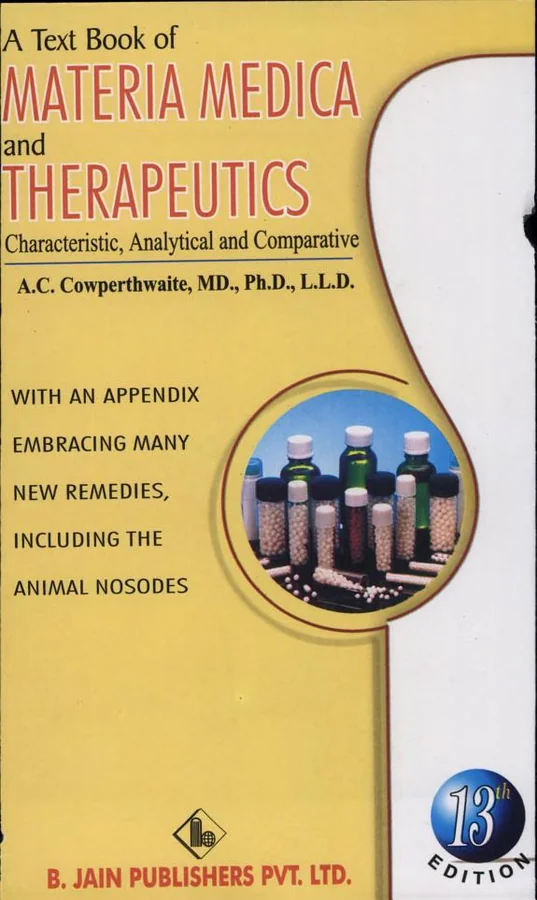
Cowperthwaite's Text-book of Materia Medica and Therapeutics presents a thorough, albeit dense, compilation of homeopathic remedies. Its strength lies in its systematic organization, allowing for clear differentiation between similar-acting substances through characteristic symptoms. The inclusion of newer remedies and animal nosodes, especially significant in the context of its 2001 publication, broadens its scope beyond earlier works. However, the sheer volume of information can be daunting for newcomers; a more introductory section on the principles of materia medica itself would have been beneficial. A particular passage detailing the nuanced mental and emotional symptoms of *Lachesis muta* exemplifies the book's depth. It is a solid reference for those already versed in homeopathic principles seeking detailed repertory-like information.
📝 Description
81
A. C. Cowperthwaite's 2001 Materia Medica details medicinal substances and their characteristic symptoms.
This textbook by A. C. Cowperthwaite examines medicinal substances, presenting a general analysis of each remedy alongside its characteristic symptoms. It aims to guide practitioners and students in understanding the application of various therapeutic agents. The work covers individual remedy profiles and their clinical indications, making it relevant for those seeking a thorough grasp of homeopathic materia medica.
The text reflects a period of development in homeopathic practice. Cowperthwaite builds on earlier principles, refining the understanding of drug provings and their therapeutic uses. The inclusion of animal nosodes points to a developing area of research within the field at the time of its initial publication. It emphasizes precise symptomology as key to selecting the correct remedy, a central tenet of homeopathic philosophy. Therapeutic and clinical indices are included to assist with practical case management.
Cowperthwaite's work is situated within the tradition of homeopathic materia medica, which itself draws from vitalist philosophies and empirical observation of substances on the healthy human body. Homeopathy, originating in the late 18th century, posits that 'like cures like' and relies on detailed provings to establish a remedy's symptom picture. This text follows that method, cataloging the effects of remedies to inform their therapeutic use in treating the sick. The inclusion of nosodes, remedies derived from disease products, further connects it to a lineage of exploring less conventional sources for healing agents.
💡 Why Read This Book?
• Gain a granular understanding of individual remedy profiles, including specific characteristic symptoms like those detailed for *Nux vomica*, which you won't find in broader medical texts. • Explore the therapeutic applications of newer remedies and animal nosodes, a facet of materia medica less commonly found in foundational texts published before 2001. • Develop precise diagnostic skills by learning to differentiate between remedies based on subtle symptom presentations, as outlined in the therapeutic indices.
⭐ Reader Reviews
Honest opinions from readers who have explored this book.
❓ Frequently Asked Questions
What is the primary focus of A. C. Cowperthwaite's Text-book of Materia Medica and Therapeutics?
The book's primary focus is the detailed analysis of individual medicinal substances, detailing their characteristic symptoms and therapeutic applications, including a section on animal nosodes.
When was A. C. Cowperthwaite's Text-book of Materia Medica and Therapeutics first published?
The first publication date for A. C. Cowperthwaite's Text-book of Materia Medica and Therapeutics is 2001.
Does the book include information on animal-derived remedies?
Yes, the text explicitly mentions the inclusion of 'many new remedies and animal Nosodes,' indicating a scope beyond traditional botanical or mineral sources.
Who would benefit most from using this materia medica?
Homeopathic practitioners, students, and researchers interested in a comprehensive and detailed materia medica with a focus on characteristic symptoms and newer remedies would find this book beneficial.
What kind of indices are available in the book?
The book includes therapeutic and clinical indices, designed to assist users in identifying appropriate remedies based on observed symptoms and conditions.
Is this book suitable for beginners in homeopathy?
While comprehensive, its depth and detail may be more suited to those with some foundational knowledge of homeopathic principles and materia medica.
🔮 Key Themes & Symbolism
Symptom Specificity
The work meticulously catalogues the characteristic symptoms of each remedy, emphasizing that precise, individualizing indications are paramount for successful homeopathic prescribing. This focus moves beyond general disease names to the unique manifestation of illness in a patient, reflecting a core tenet of the homeopathic method derived from Samuel Hahnemann's provings. The book's structure inherently guides the reader toward discerning the subtlest nuances in a patient's presentation, distinguishing one remedy's action from another's.
Expanded Pharmacopoeia
Cowperthwaite's text acknowledges and integrates 'many new remedies and animal Nosodes' into the established materia medica. This signifies an expansion of the homeopathic pharmacopoeia beyond its early 19th-century origins, reflecting ongoing research and exploration into the medicinal properties of a broader range of substances. The inclusion of animal nosodes, in particular, points to a more experimental and inclusive approach to discovering potentized therapeutic agents.
Therapeutic and Clinical Application
Beyond mere symptom listing, the book provides essential therapeutic and clinical indices. These sections serve as practical tools, bridging the gap between theoretical knowledge of a remedy's profile and its actual application in treating patients. They offer guidance on selecting remedies for specific ailments and conditions, underscoring the practical, healing-oriented purpose of materia medica study within the homeopathic framework.
Holistic Remedy Analysis
The 'general analysis of each remedy' suggests a holistic approach, considering not just physical symptoms but likely also mental and emotional states associated with a substance's action. This comprehensive view aligns with the homeopathic principle of treating the whole person. The text aims to provide a complete picture of a remedy's sphere of influence, enabling practitioners to match this totality with the patient's presenting totality.
💬 Memorable Quotes
Direct passages from the work, attributed to the author.
“general analysis of each remedy, characteristic symptoms”
— This phrase captures the book's core methodology: a systematic breakdown of a substance's medicinal profile, highlighting its most distinctive and reliable symptom indications for therapeutic use.
“therapeutic and clinical indices”
— These indices are practical navigational tools within the materia medica, allowing practitioners to quickly cross-reference symptoms and conditions with potential remedies for effective case management.
“Includes many new remedies and animal Nosodes”
— This statement signifies the text's contribution to expanding the homeopathic pharmacopoeia, incorporating less traditional or more recently introduced potentized substances, particularly those derived from animal sources.
“characteristic symptoms”
— Refers to the peculiar, uncommon, and striking symptoms that most strongly and definitely characterize a given remedy, serving as the keynotes for its selection.
“animal Nosodes”
— These are remedies prepared from morbid products or diseased tissues of animals, representing a specific category within the homeopathic materia medica that Cowperthwaite's work addresses.
🌙 Esoteric Significance
Tradition
This materia medica falls within the broader tradition of vitalistic medicine, particularly homeopathy, which posits a 'vital force' or life energy that can be influenced by potentized substances. While not directly Gnostic or Kabbalistic, its focus on subtle energies and the energetic imprint of substances aligns with esoteric concepts of correspondences and the energetic body.
Symbolism
The 'characteristic symptoms' themselves function as symbolic representations of a remedy's deeper energetic signature. Animal nosodes, derived from disease states, can be seen as symbolic of confronting and transforming the shadow aspects of life or illness, akin to alchemical processes of transmutation.
Modern Relevance
Contemporary practitioners of homeopathy, especially those focusing on complex cases or exploring advanced remedy pictures, continue to utilize detailed materia medica texts like Cowperthwaite's. Its inclusion of animal nosodes is particularly relevant for modern holistic health approaches that investigate a wider spectrum of therapeutic agents.
👥 Who Should Read This Book
• Homeopathic students and practitioners seeking a comprehensive reference for understanding individual remedy profiles and their specific indications. • Holistic health researchers interested in the historical development and expansion of the homeopathic pharmacopoeia, including the use of animal nosodes. • Individuals exploring alternative therapeutic systems who wish to gain a detailed understanding of how specific substances are matched to unique symptom presentations.
📜 Historical Context
Published initially in 2001, A. C. Cowperthwaite's Text-book of Materia Medica and Therapeutics emerged during a period where homeopathy, while established, continued to evolve and expand its pharmacopoeia. This era saw a renewed interest in detailed repertorial work and the exploration of less common substances. Cowperthwaite's effort to include 'many new remedies and animal Nosodes' reflects a drive to update and broaden the scope of existing materia medica texts, which had their roots in the 19th century with figures like Samuel Hahnemann and later James Tyler Kent. The work implicitly engaged with the ongoing debate within homeopathy regarding the validity and use of nosodes, a category of remedies sometimes viewed with skepticism by more conservative practitioners. While direct engagement with specific contemporaries like Kent or Hering isn't explicitly detailed, the book's structure and content clearly place it within the tradition of detailed, symptom-focused homeopathic literature.
📔 Journal Prompts
The 'general analysis of each remedy'—how does this concept inform your understanding of holistic healing?
Reflect on the significance of 'animal Nosodes' within the broader context of homeopathic materia medica.
Consider the role of 'characteristic symptoms' in differentiating between similar remedies.
Map the 'therapeutic and clinical indices' to a hypothetical case you have encountered.
Analyze the impact of including 'new remedies' on the evolution of materia medica study.
🗂️ Glossary
Materia Medica
A body of knowledge detailing the effects of a drug or substance on the human body, particularly in relation to its use in medicine.
Therapeutics
The branch of medicine concerned with the treatment of disease and the action of remedial agents.
Characteristic Symptoms
Peculiar, uncommon, and striking symptoms that most strongly and definitely characterize a given remedy or disease.
Nosodes
Homeopathic remedies prepared from morbid products or diseased tissues, such as abscesses, ulcers, or diseased organs.
Animal Nosodes
A specific category of nosodes derived from diseased states or products of animals.
General Analysis
A comprehensive overview of a remedy's overall action, including its main spheres of influence and key symptom picture.
Clinical Indices
Lists or sections within a materia medica that help practitioners find remedies based on the specific clinical conditions or diseases observed in patients.
This book appears in 1 collection
🔮 Readers Also Liked
Browse all →








From the “Homeopathy” Collection
View all →






More Free Occult Philosophy Books
View all →