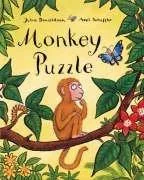
Monkey Puzzle
 76
76

Monkey Puzzle
Julia Donaldson's "Monkey Puzzle" succeeds primarily through its sheer, unadulterated simplicity. The narrative of a lost monkey seeking its mother, rendered in Donaldson's signature bouncy rhyme, is undeniably effective for its target audience. The pacing is excellent, driving the search forward with each new animal encountered. However, the book’s thematic depth is limited; it functions almost purely as a plot-driven exercise in identification and rhyming couplets. While the interactions with the parrot, snake, and frog are charming, they offer little beyond surface-level characterization. The most memorable aspect is the visual progression of the search, amplified by Scheffler's illustrations. For adults, the book's charm lies in its execution of a classic children's trope. It's a well-crafted piece of entertainment, but one that doesn't linger in the mind once the final page is turned. "Monkey Puzzle" is a competent, enjoyable read for the very young, fulfilling its role without aiming for higher literary ground.
📝 Description
76
Julia Donaldson's 2016 book, Monkey Puzzle, follows a young monkey's search for its mother.
The story begins with a young monkey who has lost its mother in the jungle. As the monkey searches, it asks various animals if they are its mother. Each animal it encounters is described with a rhyme, but none are the correct mother. The monkey becomes increasingly anxious as the search continues. Eventually, the monkey meets a butterfly who helps it by showing the monkey what its mother looks like. The monkey then reunites with its mother. The book uses rhyme and rhythm, typical of Donaldson's work, to create a playful yet relatable narrative about separation and reunion.
While aimed at young children, the book's structure and themes can also appeal to adults. Readers interested in narrative patterns, the development of simple characters, or how literature can aid early learning will find value here. The vibrant illustrations by Axel Scheffler complement the text, enhancing the story's appeal for both children and adults.
Published in 2016, Monkey Puzzle entered a children's literature scene already populated with animal stories and emotional narratives. Donaldson and Scheffler were well-known authors, having previously collaborated on popular books like The Gruffalo. The book's reception highlights a continued audience for rhyming tales that subtly address problem-solving and family connections.
While categorized as children's literature, Monkey Puzzle engages with archetypal themes common in esoteric thought. The young monkey's quest mirrors the individual's search for the divine or true self, often experienced as a period of separation and confusion. The various animals encountered can represent different aspects of the psyche or external forces that offer guidance, some helpful, others misleading. The ultimate reunion with the mother figure symbolizes integration and the return to a state of wholeness or primal connection, a concept resonant within traditions focused on unity and origin.
💡 Why Read This Book?
• You will experience the unique rhythm and rhyme that made Julia Donaldson a celebrated author, exemplified in the repetitive, comforting structure of the monkey's search for its mother. • You will gain insight into effective narrative pacing for young children, observing how the introduction of the parrot, snake, and frog propels the plot towards its resolution. • You will discover how Axel Scheffler's illustrations, particularly the visual cues for each animal, enhance the storytelling, making the 2016 publication accessible and engaging for early readers.
⭐ Reader Reviews
Honest opinions from readers who have explored this book.
❓ Frequently Asked Questions
What is the main plot of Julia Donaldson's "Monkey Puzzle"?
The book follows a young monkey who has lost its mother in the jungle and embarks on a search, encountering various animals like a parrot and a snake who offer unhelpful advice before finally being reunited.
Who illustrated "Monkey Puzzle"?
The book was illustrated by Axel Scheffler, who is well-known for his collaborations with Julia Donaldson, including "The Gruffalo."
What age group is "Monkey Puzzle" suitable for?
It is primarily aimed at preschoolers and early elementary school children, typically ages 3-6, due to its simple language, rhyme, and engaging storyline.
Does "Monkey Puzzle" have a happy ending?
Yes, the book concludes with the monkey successfully finding its mother, providing a satisfying and reassuring resolution for young readers.
When was "Monkey Puzzle" first published?
Julia Donaldson's "Monkey Puzzle" was first published in 2016.
What are some of the animals the monkey meets?
The monkey encounters a parrot, a snake, and a frog during its search, each offering a different perspective or piece of advice.
🔮 Key Themes & Symbolism
The Search for Belonging
Fundamentally, , "Monkey Puzzle" explores the primal need for connection and the anxiety that arises from separation. The young monkey's frantic search for its mother mirrors the universal experience of seeking security and identity within a family unit. Each encounter with a different animal highlights the monkey's growing distress but also its persistent hope. The narrative structure, built around a series of near-misses, emphasizes the singular importance of the maternal bond and the relief found in reunion, a theme resonant across cultures and ages.
Animal Identification and Mimicry
The book cleverly uses the jungle setting to present a cast of diverse animals, each offering a potential, yet incorrect, identification of the mother. This introduces young readers to different species and their characteristics, while also playing with the concept of superficial resemblance. The parrot, snake, and frog are distinct, yet none fit the description of the mother monkey. This element subtly educates about animal diversity and the specific traits that define individuals within a species, reinforcing the idea that true belonging is based on unique connection, not mere similarity.
Guidance and Misdirection
The narrative arc of "Monkey Puzzle" involves the young monkey receiving advice from various jungle inhabitants. While generally well-intentioned, the guidance offered by the parrot, snake, and frog is ultimately misleading regarding the mother's identity. This introduces a subtle lesson about discernment and the importance of accurate information. The monkey must persist in its search, learning to differentiate between helpful clues and unhelpful diversions, a valuable early lesson in critical thinking within a narrative context.
The Power of Rhyme and Rhythm
Julia Donaldson is renowned for her mastery of rhyme and rhythm, and "Monkey Puzzle" is a prime example. The consistent AABB rhyme scheme and the lively meter make the text highly memorable and enjoyable for young children. This poetic structure not only enhances the reading experience but also aids in language acquisition and phonological awareness. The musicality of the language transforms a simple story about being lost into an engaging, almost song-like, adventure, making it a staple for early literacy development.
💬 Memorable Quotes
Direct passages from the work, attributed to the author.
““Oh, help!” cried the monkey. “My Mummy’s not here! / I want my Mummy. I want her right near!””
— This expresses the core emotional driver of the story: the child's distress and longing for parental security when separated. It sets the stage for the entire narrative quest.
““She’s big and she’s green,” said the monkey. “She swings through the trees.””
— This highlights the monkey's limited, yet specific, description of its mother, serving as a clue that the parrot, with its green feathers, misinterprets, showcasing the theme of misdirection.
““She’s long and she’s brown,” said the monkey. “She wriggles and slides.””
— Another descriptive clue given by the monkey. This leads to the snake, which is long and brown but decidedly not a monkey, further illustrating the search's challenges.
““She’s fuzzy and funny,” said the monkey. “She’s warm and she’s sweet.””
— This final description before the reunion captures the comforting and affectionate qualities the monkey associates with its mother, contrasting with the previous animal descriptions.
““Then where,” chirped the parrot, “is your mother?””
— This question from the parrot underscores the central problem and the repeated failure of the encountered animals to provide the correct answer, driving the plot forward.
🌙 Esoteric Significance
Tradition
While "Monkey Puzzle" is primarily a children's book, its narrative structure can be loosely interpreted through the lens of archetypal journeys found in various esoteric traditions. The young monkey's quest for its mother can be seen as a microcosm of the soul's search for its divine source or true home, a theme present in Gnostic and Hermetic thought. The separation from the mother figure represents a state of primordial unity lost, and the journey through the jungle signifies the trials and encounters one faces in seeking reconnection or enlightenment.
Symbolism
The jungle itself serves as a symbol of the material world or the subconscious, filled with diverse forms and potential confusions. The various animals encountered—the parrot, snake, and frog—can represent different aspects of the psyche or misleading spiritual guides. The monkey, as the protagonist, embodies the innocent seeker, driven by instinctual longing. Its mother, ultimately found, symbolizes wholeness, unconditional love, and the return to the true self or divine origin.
Modern Relevance
Contemporary approaches to child psychology and early education often draw on principles of secure attachment and emotional processing, themes implicitly present in "Monkey Puzzle." While not directly citing esoteric texts, modern parenting philosophies that emphasize understanding a child's emotional needs echo the book's core message. Therapists and educators might use the book to discuss separation, fear, and reassurance. The enduring popularity of Donaldson's work suggests a continued societal value placed on stories that offer comfort and a sense of security through narrative resolution.
👥 Who Should Read This Book
• Parents and educators seeking engaging picture books for early literacy development, who will appreciate the book's rhythmic language and clear narrative structure. • Children aged 3-6 who enjoy stories about animals and relatable emotional experiences like being lost or seeking comfort. • Adult fans of Julia Donaldson and Axel Scheffler's previous works, looking for another charming collaboration that exemplifies their signature style.
📜 Historical Context
Published in 2016, Julia Donaldson's "Monkey Puzzle" entered a vibrant children's literature market already significantly shaped by her own earlier successes, notably "The Gruffalo" (1999). This period saw a continued emphasis on emotional literacy and relatable animal characters in picture books. Donaldson and her illustrator, Axel Scheffler, had already cemented their status as a premier author-illustrator team, with their works consistently topping bestseller lists and receiving critical acclaim. The book’s arrival coincided with a trend favouring narratives that gently explore themes of separation anxiety and the comfort of familial bonds. While not directly engaging with a specific intellectual movement, its success reflects the enduring appeal of well-crafted, rhyming stories for early childhood development, a genre also championed by contemporaries like Michael Rosen. The reception was predictably warm, building on the established fanbase, with no significant controversy or censorship reported, underscoring its broad appeal.
📔 Journal Prompts
The young monkey's initial separation from its mother.
The descriptions offered to the parrot, snake, and frog.
The final reunion between the monkey and its mother.
The role of the jungle animals in the monkey's search.
The feeling of being lost and the desire for comfort.
🗂️ Glossary
Monkey
A primate belonging to the order of mammals known as Primates. In the context of the book, it refers to a young primate separated from its mother, embodying innocence and a desperate need for security.
Parrot
A type of bird known for its colorful plumage and ability to mimic sounds. In the story, the parrot misidentifies the mother based on color, representing a superficial form of guidance.
Snake
A long, legless reptile. The snake in the book is described as long and brown, leading to another incorrect identification by the monkey, highlighting the challenges of the search.
Frog
An amphibian characterized by powerful hind legs used for jumping. The frog offers a different description, further complicating the monkey's search for its mother.
Jungle
A dense forest found in tropical regions with high rainfall. It serves as the setting for the story, symbolizing a place of potential confusion and diverse encounters.
Rhyme Scheme
The ordered pattern of rhymes at the ends of the lines of a poem or verse. "Monkey Puzzle" predominantly uses an AABB scheme, contributing to its musicality and memorability.
Illustration
A drawing, painting, or other work of art that explains, adorns, or complements text. Axel Scheffler's illustrations are integral to the storytelling in "Monkey Puzzle."
🔮 Readers Also Liked
Browse all →








More by Julia Donaldson
All books →





More Free Occult Philosophy Books
View all →