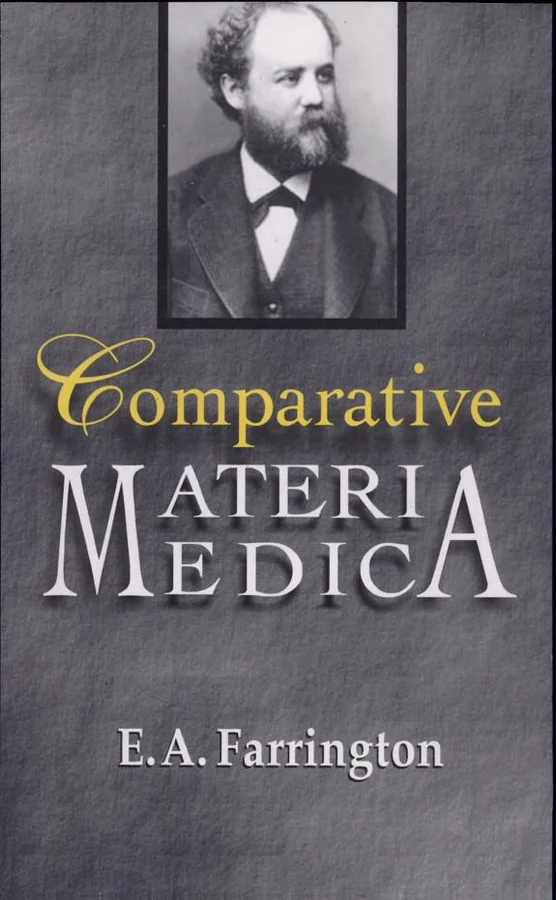
Comparative Materia Medica
 82
82

Comparative Materia Medica
Ernest Albert Farrington’s Comparative Materia Medica offers a starkly practical approach to a notoriously complex field. Rather than offering poetic descriptions, Farrington drills down into the essential distinctions that separate one remedy from another. The alphabetical arrangement is straightforward, though at times I wished for more thematic grouping to quickly grasp related substances. A particularly illuminating section compares Pulsatilla and its relatives, demonstrating how subtle changes in disposition and modality can point to a different prescribing choice. The limitation lies in its purely comparative nature; it assumes a foundational knowledge of materia medica rather than building it from scratch. However, for the practitioner aiming to sharpen their differential diagnosis, this work provides a valuable, unadorned tool.
📝 Description
82
Ernest Albert Farrington's Comparative Materia Medica, published in 1988, offers a structured method for homeopathic remedy differentiation.
This book presents a systematic approach to understanding and applying homeopathic remedies through direct comparison. Farrington contrasts various remedies, detailing their unique characteristics and specific indications. The remedies are arranged alphabetically, creating a clear reference for practitioners. The work is intended for homeopaths at all levels, from students to experienced practitioners who wish to sharpen their diagnostic abilities. It is especially helpful for those who prefer a comparative method for selecting remedies, assisting in distinguishing between substances that act similarly.
Farrington's method centers on differential diagnosis within homeopathy. This requires identifying subtle but important differences between remedies that share overlapping symptom profiles. The book stresses that precise remedy selection depends on recognizing these distinctions, which in turn leads to better therapeutic results. It guides the practitioner to perceive not only symptoms but also the distinct expression of the vital force that each remedy influences.
Within the tradition of homeopathy, Farrington's work builds upon the foundational principles established by Samuel Hahnemann. While Hahnemann's Organon provided the theoretical framework, and subsequent materia medica texts expanded the known remedies, practical guides for distinguishing between similar remedies were still needed. Farrington's contribution addresses this gap by focusing on the precise details that differentiate one remedy from another, a critical element for accurate homeopathic prescribing. This emphasis on detailed comparison aligns with the homeopathic understanding of individualized treatment.
💡 Why Read This Book?
• Gain precise differentiation skills for remedies like Pulsatilla and its relatives, enabling more accurate prescription based on subtle symptom nuances. • Understand the core principle of comparative analysis as presented in Farrington's methodical approach, directly applicable to daily practice since its 1988 publication. • Develop a systematic way to contrast remedies with overlapping indications, moving beyond generic symptom matching to individualized treatment selection.
⭐ Reader Reviews
Honest opinions from readers who have explored this book.
❓ Frequently Asked Questions
What is the primary method used in Comparative Materia Medica?
The book utilizes differential comparison, systematically contrasting various homeopathic remedies to highlight their unique characteristics and indications, aiding practitioners in precise selection.
Who would benefit most from Ernest Albert Farrington's work?
Homeopathic practitioners, from students to experienced professionals, who need to refine their diagnostic skills and learn to differentiate between remedies with similar symptom presentations.
When was Comparative Materia Medica first published?
The work was first published in 1988, positioning it as a significant guide during a period of expansion in homeopathic literature.
How are the remedies organized in the book?
The remedies are arranged alphabetically, providing a clear and accessible structure for practitioners looking up specific substances and their comparisons.
What is the main goal of the comparative approach presented?
The primary goal is to improve therapeutic outcomes by teaching practitioners to recognize the subtle yet critical differences between remedies, leading to more accurate prescribing.
Does this book introduce new remedies?
No, the book focuses on comparing established remedies within the materia medica, rather than introducing new ones, making it a tool for understanding existing knowledge.
🔮 Key Themes & Symbolism
Differential Diagnosis in Homeopathy
The core of Farrington's work lies in its meticulous approach to differential diagnosis. It moves beyond listing symptoms for individual remedies and instead focuses on the critical distinctions that separate similar-acting substances. This method is crucial for practitioners aiming for high-level prescribing, where subtle variations in patient presentation demand a precise match with the most indicated remedy. The book emphasizes that understanding what a remedy *doesn't* cover is as important as knowing what it does, a principle vital for avoiding prescription errors and ensuring effective treatment within the homeopathic framework.
Alphabetical Remedy Arrangement
The deliberate choice to arrange remedies alphabetically provides a structured and easily navigable reference. This organizational principle facilitates quick consultation during patient encounters or study sessions. It allows practitioners to efficiently compare specific remedies or groups of remedies that share common symptom clusters. This systematic presentation underscores Farrington's commitment to practical utility, ensuring that the complex information within the materia medica is accessible and applicable in the demanding environment of clinical practice since its 1988 publication.
Practical Application for Practitioners
Comparative Materia Medica is fundamentally a tool for enhancing daily practice. It translates theoretical knowledge of materia medica into actionable insights for selecting the correct remedy. By focusing on comparisons, Farrington equips practitioners with the means to overcome prescribing dilemmas when faced with patients who present a complex or confusing array of symptoms. The work directly addresses the challenge of differentiating between remedies that might otherwise be confused, thereby empowering practitioners to act with greater confidence and efficacy.
Understanding Remedy Nuances
The book stresses the importance of subtle nuances in remedy profiles. It guides the reader to perceive the qualitative differences in symptoms, mental states, and modalities that define each remedy's unique character. This focus on specific details moves the practitioner away from a purely symptomatic approach towards a deeper understanding of the remedy's action on the vital force. Such insight is critical for achieving curative results in homeopathy, especially when dealing with chronic conditions.
💬 Memorable Quotes
Direct passages from the work, attributed to the author.
“The remedies are arranged alphabetically.”
— This statement highlights the book's structural design, emphasizing its function as a clear, accessible reference guide for practitioners who need to quickly compare remedy profiles.
“The book is of differential comparisons.”
— This succinctly captures the essence of the work, indicating that its primary contribution is in systematically contrasting the characteristics of various homeopathic remedies.
“Distinguishing between similar remedies is key to accurate prescribing.”
— This interpretation emphasizes the practical outcome of using the book: achieving greater precision in remedy selection by understanding the subtle differences between drugs with overlapping symptom pictures.
💡 Key Ideas
Editorial paraphrase of the work's core concepts — not direct quotes.
This shows how one might use remedy comparisons in one's daily practice.
This paraphrase points to the book's practical orientation, underscoring its value as an instructional tool for applying comparative analysis in real-time clinical scenarios.
Focus on the unique indications of each substance.
This paraphrase suggests that the book guides the reader to identify the specific, differentiating symptoms and modalities that point towards a particular remedy, rather than relying on generalities.
🌙 Esoteric Significance
Tradition
While homeopathy itself is often considered an esoteric discipline due to its focus on subtle energies and vital forces, Farrington's work is primarily a practical materia medica guide. It operates within the broader framework of vitalistic medicine that emerged in the late 18th and 19th centuries, influenced by figures like Paracelsus and Mesmer, who explored unseen forces. The comparative method, however, can be seen as a form of alchemical distillation, reducing complex substances to their essential, differentiating properties, a process that mirrors the Hermetic principle of 'separation and purification'.
Symbolism
The primary 'symbols' in this work are the remedies themselves, each representing a complex energetic pattern or 'psora' (a concept from Hahnemannian theory). The act of comparison itself symbolizes the practitioner's journey to discern truth from illusion, or superficial similarity from true correspondence. The alphabetical arrangement can be seen as imposing order on chaos, a common motif in esoteric systems aiming to reveal underlying structures within apparent randomness.
Modern Relevance
Contemporary homeopathic practitioners continue to rely on comparative materia medica for refining their prescribing skills. Farrington's methodical approach remains relevant in an era where practitioners often face complex chronic conditions and a vast array of potential remedies. His emphasis on precise differentiation aids practitioners in identifying the single best-suited remedy, a principle that aligns with the holistic and individualized approach valued in modern esoteric healing practices and vitalistic medicine.
👥 Who Should Read This Book
• Homeopathic students seeking to develop their diagnostic skills by learning to differentiate between remedies with overlapping symptoms. • Experienced homeopathic practitioners looking to refine their prescribing accuracy and overcome challenging differential diagnosis cases. • Students of vitalistic medicine and energetic healing who want to understand the practical application of materia medica principles through comparative analysis.
📜 Historical Context
Ernest Albert Farrington's Comparative Materia Medica, first published in 1988, arrived during a period when homeopathic literature continued to expand, building upon the foundational work of Samuel Hahnemann. While numerous materia medica texts existed, the need for practical, comparative guides remained acute for practitioners grappling with complex cases. Farrington's approach, focusing on direct contrasts between remedies, offered a method to sharpen diagnostic acumen. This work emerged in a landscape populated by established texts and evolving homeopathic theory. Unlike earlier compendia that might list remedies individually, Farrington's work explicitly addressed the challenge of differentiating between similar-acting substances. Contemporary authors continued to explore various facets of homeopathic philosophy and practice, but Farrington's specific focus on comparative analysis provided a distinct pedagogical tool, aiding practitioners in working through the nuances of remedy selection, a critical skill refined since the late 18th century.
📔 Journal Prompts
Comparative analysis of Pulsatilla and related remedies.
The practical utility of alphabetical arrangement in materia medica study.
Identifying the unique indications of a chosen remedy.
Strategies for differentiating remedies with similar mental-physical modalities.
How the concept of 'differential comparison' informs your understanding of vital force expression.
🗂️ Glossary
Materia Medica
A body of knowledge detailing the effects of drugs or substances on the healthy human body, forming the basis for homeopathic prescribing.
Differential Comparison
A method of study that involves systematically contrasting the symptoms, modalities, and indications of two or more remedies to highlight their unique characteristics.
Remedy
In homeopathy, a substance (drug) that has been proven to cause a specific set of symptoms in a healthy individual and is used to treat similar symptoms in a sick individual.
Indications
The symptoms, signs, and conditions for which a particular remedy is considered appropriate or effective in homeopathic treatment.
Alphabetical Arrangement
The organization of remedies within the book according to their names in alphabetical order, facilitating easy reference.
Modality
Factors that can aggravate (worsen) or ameliorate (improve) a patient's symptoms, such as time of day, weather, position, or emotions.
Vital Force
A concept in vitalistic medicine, including homeopathy, referring to the inherent life energy or animating principle that maintains health and is disturbed in disease.
This book appears in 1 collection
🔮 Readers Also Liked
Browse all →








From the “Homeopathy” Collection
View all →







More Free Occult Philosophy Books
View all →